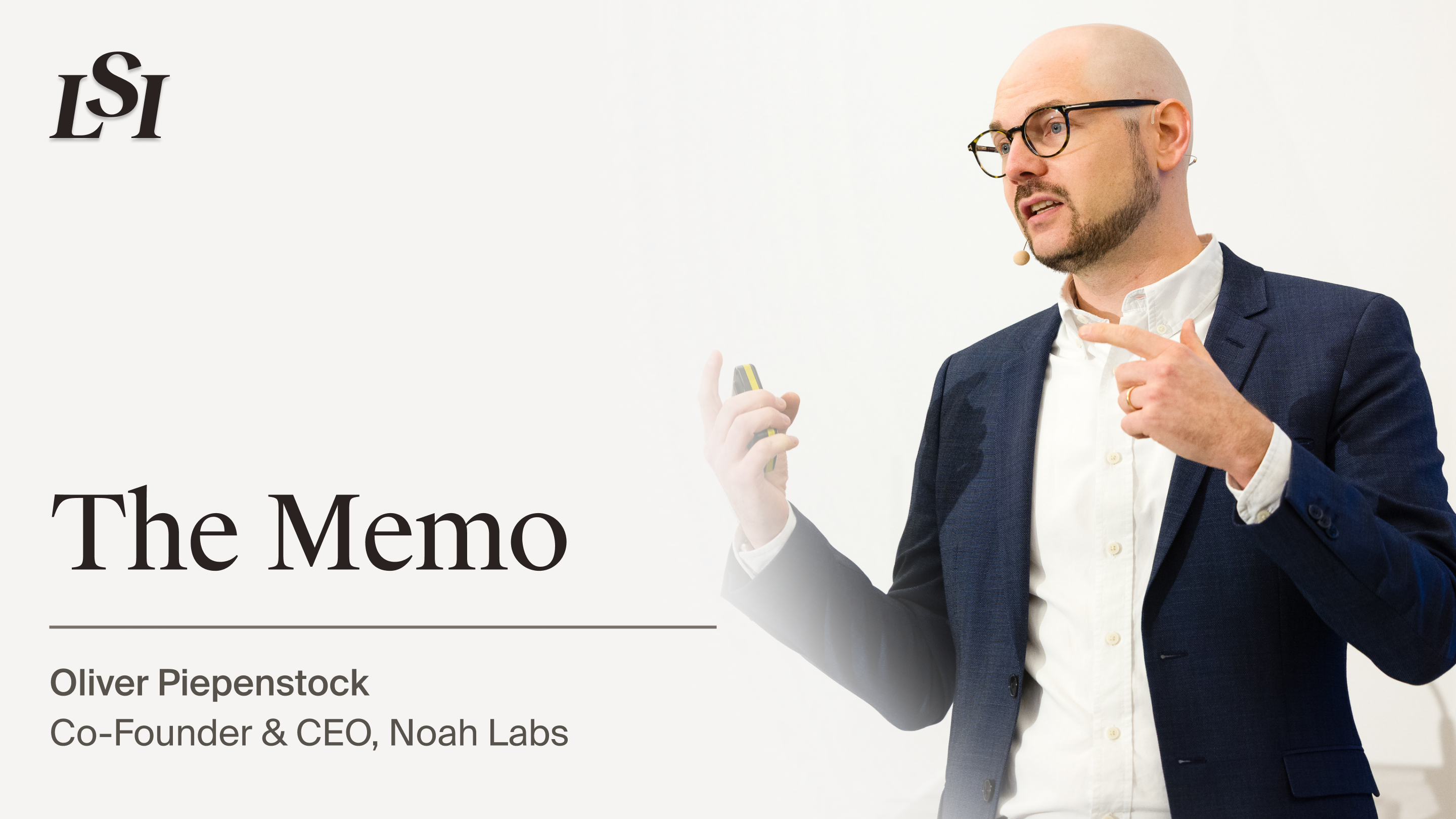
Under the direction of Co-Founder and CEO Oliver Piepenstock, Noah Labs is developing a new approach to heart failure monitoring built around an unlikely source of clinical information: the human voice. The Boston- and Berlin-based company has developed Vox, an investigational AI-driven software medical device designed to detect vocal changes associated with worsening heart failure before hospitalization. Its deep learning models are trained on more than three million voice samples, while its commercially deployed Ark remote patient monitoring platform provides a foundation in clinical workflows and data. With Vox now advancing through a pivotal U.S. trial following FDA Breakthrough Device Designation, Noah Labs is working toward a larger vision Piepenstock describes as “the world’s first voice-powered operating system for heart failure care.”
Origin Story
Noah Labs began in Berlin in late 2021, when Piepenstock met Co-Founder and CTO Marcus Hott through Entrepreneur First. Their backgrounds brought two different perspectives to the same challenge.
Hott came from Harvard Medical School, where he had developed cardiac MRI sequences that are now deployed across U.S. health systems. Piepenstock had previously founded a healthcare startup in elderly care, giving him firsthand experience with the operational and regulatory challenges involved in scaling medical technology.
“When we began discussing the intersection of AI, cardiology, and patient monitoring, we recognized the same unmet need from two different angles,” Piepenstock said.
What emerged was the idea that voice could provide a largely untapped window into the pathophysiology of heart failure. Fluid accumulation in the lungs associated with acute decompensation can produce subtle changes in a patient’s voice, creating signals that machine learning may be able to detect.
“The core insight was simple but overlooked: voice contains measurable clinical information relevant to heart failure pathophysiology,” Piepenstock said. “Yet virtually no one had built a scalable, clinical-grade product around this signal.”
Dr. Leonhard Riehle joined Noah Labs as its third co-founder and CMO in 2024 after previously running remote monitoring programs and clinical research at Charité Berlin, adding clinical rigor to the founding team.
The Current Landscape
The need Noah Labs is addressing is significant. According to Piepenstock, heart failure accounts for roughly 1.2 million congestive heart failure hospitalizations annually in the U.S. and $28.2 billion in healthcare costs, averaging $22,000 per U.S. patient. The challenge is not simply managing diagnosed heart failure, but recognizing deterioration early enough to intervene.
“Today’s monitoring landscape is fragmented and inadequate,” Piepenstock said.
Approximately 61% of heart failure patients receive no monitoring whatsoever, according to the company. For those who are monitored, existing options occupy opposite ends of the spectrum. Weight monitoring is inexpensive and widely accessible, but Piepenstock said it has less than 30% sensitivity and typically provides only about three to five days of warning before hospitalization. Implantable hemodynamic monitors can provide far greater precision, but at approximately $25,000 per device, he said they reach fewer than 1% of heart failure patients.
The result is a substantial population without an effective early warning system. That gap carries serious consequences. Piepenstock cited a 32% readmission rate within 90 days of discharge and noted that one-third of heart failure patients die within one year of a hospitalization event.
For Noah Labs, the opportunity is to create another option between low-sensitivity conventional monitoring and costly invasive technology.
Inside the Innovation
Vox is a patented, AI-driven software medical device designed to detect early signs of heart failure decompensation through a 10-second daily voice recording captured with a smartphone.
The underlying concept connects changes in voice to pulmonary fluid buildup. Vox’s deep learning models analyze subtle changes in the vocal folds that occur as fluid accumulates. Each recording is compared with the individual patient’s baseline to generate a risk score. If that score crosses a health system’s preferred threshold, the clinical team receives an alert and can initiate its intervention protocol.
“Our technology delivers implant-level precision, 84% sensitivity for detecting worsening heart failure, through a smartphone application at a fraction of the cost,” Piepenstock said.
That 84% sensitivity was demonstrated in the TIM-HF3 Voice study, where Noah Labs’ voice analysis detected 21 of 25 heart failure hospitalizations, compared with nine of 25 using daily weight-based alerts. The voice algorithm also provided a median 29-day alert-to-event time, creating the potential for a substantially longer window in which clinicians can act.
For Piepenstock, that lead time is central to the technology’s potential.
“By identifying vocal biomarkers linked to fluid overload up to 29 days before hospitalization, Vox opens an interventional window that does not exist in today’s standard of care,” he said.
Vox is also built around a proprietary dataset containing more than three million heart failure voice samples. Because the system is software-based and requires only a smartphone on the patient side, Noah Labs sees the technology as potentially scalable across settings where specialized monitoring infrastructure may not be practical.
The company has already established a commercial foundation through Ark, its CE-marked Class IIa remote patient monitoring platform. Ark is deployed across more than 150 clinics in Germany and is generating revenue, providing Noah Labs with clinical experience and a proprietary data pipeline as it advances Vox toward the U.S. market.
Progress and Milestones
Noah Labs is now moving from clinical validation toward U.S. commercialization. Vox received FDA Breakthrough Device Designation in March 2026, and the company has commenced its VOICE-HF pivotal U.S. trial under the De Novo pathway. EU clearance is anticipated in early 2027.
Vox has been evaluated across five multicenter clinical trials involving more than 1,000 patients, with collaborators including Mayo Clinic and UCSF. In May 2026, Noah Labs presented late-breaking results from TIM-HF3 at Heart Failure 2026 in Barcelona, showing 84% sensitivity for voice analysis compared with 36% for daily weight monitoring.
Beyond its clinical and regulatory progress, Noah Labs received the 2025 Deep Tech Award in the AI category, was selected for MedTech Innovator 2026, and is a member of the American Heart Association’s Center for Health Technology and Innovation.
The next phase could be particularly consequential. Noah Labs plans to launch its Series A fundraising round in fall 2026 while advancing VOICE-HF toward FDA clearance. The company has also initiated an interventional study with a leading U.S. health system to generate real-world clinical evidence and, following regulatory clearance, commercially deploy Vox in the U.S.
“This year is pivotal for our U.S. market entry,” Piepenstock said. “We are simultaneously advancing FDA clearance through our pivotal trial, launching our Series A fundraising round, and building health system partnerships.”
Heart failure, however, may ultimately be only the beginning. Noah Labs sees voice-based monitoring as a potential foundation for a broader shift in chronic disease management, moving care away from reacting to acute events and toward detecting deterioration earlier.
“Heart failure is our entry point: a large, high-cost, high-acuity population where early detection demonstrably changes outcomes,” Piepenstock said. “The broader opportunity lies in chronic disease management across hundreds of millions of patients, most of whom remain managed today through the reactive, episodic care model that Noah Labs is architected to replace.”
Join Us at LSI Europe ‘26
The Noah Labs team has been selected to present at LSI Europe '26, September 28th–October 1st, in front of hundreds of global medical technology companies. Join us in welcoming their team to the event in Barcelona, where they will share the latest updates on Noah Labs’ technology and development.







Request Info

The Lens - Complimentary Issue
Subscription Includes

Global Medtech Market Analysis & Projections (MAP), 2021-2031
Published: 2023
Next Update: Q4 2024
Deliverables:



Global Surgical Procedure Volumes Dashboard, 2018-2029
Published: 2022
Next Update: Q2 2024
Deliverables:
United States Surgical Procedure Volumes, 2018-2029
Published: 2022
Next Update: Q2 2024
Deliverables:
Aesthetics, Global Surgical Procedure Volumes, 2018-2029
Published: 2022
Next Update: Q2 2024
Deliverables:
Cardio, Global Surgical Procedure Volumes, 2018-2029
Published: 2022
Next Update: Q2 2024
Deliverables:
ENT, Global Surgical Procedure Volumes, 2018-2029
Published: 2022
Next Update: Q2 2024
Deliverables:
General, Global Surgical Procedure Volumes, 2018-2029
Published: 2022
Next Update: Q2 2024
Deliverables:
Neuro, Global Surgical Procedure Volumes, 2018-2029
Published: 2022
Next Update: Q2 2024
Deliverables:
OB/GYN, Global Surgical Procedure Volumes, 2018-2029
Published: 2022
Next Update: Q2 2024
Deliverables:
Ophthalmology, Global Surgical Procedure Volumes, 2018-2029
Published: 2022
Next Update: Q2 2024
Deliverables:
Orthopedic, Global Surgical Procedure Volumes, 2018-2029
Published: 2022
Next Update: Q2 2024
Deliverables:
Peripheral Vascular, Global Surgical Procedure Volumes, 2018-2029
Published: 2022
Next Update: Q2 2024
Deliverables:
Spine, Global Surgical Procedure Volumes, 2018-2029
Published: 2022
Next Update: Q2 2024
Deliverables:
SRS, Global Surgical Procedure Volumes, 2018-2029
Published: 2022
Next Update: Q2 2024
Deliverables:
Urological, Global Surgical Procedure Volumes, 2018-2029
Published: 2022
Next Update: Q2 2024
Deliverables:
Global Markets for Hip Replacement Implants, 2023-2028
Published: 2023
Next Update: Q2 2024
Deliverables:
Global Markets for Peripheral Vascular Guidewires, 2023-2028
Published: 2023
Next Update: Q2 2024
Deliverables:
Global Markets for Peripheral Atherectomy Catheters, 2023-2028
Published: 2023
Next Update: Q2 2024
Deliverables:
Global Markets for Electrosurgery, 2023-2028
Published: 2023
Next Update: Q2 2024
Deliverables:
Global Markets for Peripheral Vascular Balloons & Vena Cava Filter, 2023-2028
Published: 2023
Next Update: Q2 2024
Deliverables:
Global Markets for Mechanical Heart Valves, 2023-2028
Published: 2023
Next Update: Q2 2024
Deliverables:
Global Markets for Tissue Heart Valve Replacement, 2023-2028
Published: 2023
Next Update: Q2 2030
Deliverables:
Global Markets for Transcatheter Mitral Valve Devices, 2023-2028
Published: 2023
Next Update: Q2 2024
Deliverables:
Global Markets for Femoral Closure, 2023-2029
Published: 2023
Next Update: Q2 2024
Deliverables:
Global Markets for Tricuspid Valve Repair, 2023-2028
Published: 2023
Next Update: Q2 2024
Deliverables:
Global Markets for Percutaneous Pulmonary Valves, 2023-2028
Published: 2023
Next Update: Q2 2024
Deliverables:
Global Markets for Coronary Angio Guidewires & Catheters, 2023-2028
Published: 2023
Next Update: Q2 2024
Deliverables:
Global Markets for Oncology Ablation Devices, 2023-2028
Published: 2023
Next Update: Q2 2024
Deliverables:
Global Markets for ENT Devices, 2023-2028
Published: 2023
Next Update: Q2 2024
Deliverables:
Global Markets for Cell Delivery Catheters, 2023-2028
Published: 2023
Next Update: Q3 2024
Deliverables:
Global Markets for Urology Devices, 2023-2028
Published: 2023
Next Update: Q3 2024
Deliverables:
Global Markets for External Pain Pumps, 2023-2028
Published: 2023
Next Update: Q3 2024
Deliverables:
Global Markets for Ureteral Access Devices, 2023-2028
Published: 2023
Next Update: Q3 2024
Deliverables:
Global Markets for Pelvic Floor Repair, 2023-2028
Published: 2023
Next Update: Q3 2024
Deliverables:
Global Markets for Atrial Fibrillation, 2023-2028
Published: 2023
Next Update: Q3 2024
Deliverables:
Global Markets for Neurovascular Devices Ischemic, 2023-2028
Published: 2023
Next Update: Q3 2024
Deliverables:
Global Markets for Neuromodulation Devices, 2023-2028
Published: 2023
Next Update: Q3 2024
Deliverables:
Global Markets for Vertebroplasty Devices, 2023-2028
Published: 2023
Next Update: Q3 2024
Deliverables:
Global Markets for Benign Prostation Hyperplasia Implants, 2023-2028
Published: 2023
Next Update: Q3 2024
Deliverables:
Global Markets for Cryoablation, 2023-2028
Published: 2023
Next Update: Q3 2024
Deliverables:
Global Markets for Diagnostic Electrophysiology Catheters, 2023-2028
Published: 2023
Next Update: Q3 2024
Deliverables:
Global Markets for Hernia Repair, 2023-2028
Published: 2023
Next Update: Q4 2024
Deliverables:
Global Markets for CRM Devices, 2023-2028
Published: 2023
Next Update: Q4 2024
Deliverables:
Global Markets for Neurovascular Devices Hemorrhagic, 2023-2028
Published: 2023
Next Update: Q4 2024
Deliverables:
Global Markets for Renal Denervation, 2023-2028
Published: 2023
Next Update: Q4 2024
Deliverables:
Global Markets for Upper+Lower Suture Anchors, 2023-2028
Published: 2023
Next Update: Q4 2024
Deliverables:
Global Markets for Peripheral Stents, 2023-2028
Published: 2023
Next Update: Q4 2024
Deliverables:
Global Markets for Electromagnetic Navigation Systems, 2023-2028
Published: 2023
Next Update: Q4 2024
Deliverables:
Global Markets for GI Endoscopy, 2023-2028
Published: 2023
Next Update: Q4 2024
Deliverables:
Global Markets for Hemodialysis, 2023-2028
Published: 2023
Next Update: Q4 2024
Deliverables:
Globals Markets for Cardiac Ablation, 2023-2028
Published:
Next Update:
Deliverables:
Global Markets for Atrial Septal Occlusion, 2023-2028
Published: 2023
Next Update: Q4 2024
Deliverables:
Global Markets for Aortic Grafts, 2023-2028
Published: 2023
Next Update: Q4 2024
Deliverables:
Global Markets for Interventional Cardiology Devices, 2023-2028
Published: 2023
Next Update: Q4 2024
Deliverables:
Global Markets for Oncology Embolization, 2023-2028
Published: 2023
Next Update: Q4 2024
Deliverables:
Global Markets for Vascular Access Devices, 2023-2028
Published: 2023
Next Update: Q4 2024
Deliverables:
Global Markets for Rotator Cuff Repair Suture Anchors, 2023-2028
Published: 2023
Next Update: Q4 2024
Deliverables:
Global Markets for Electrical Stimulation Devices, 2023-2028
Published: 2023
Next Update: Q4 2024
Deliverables:
Global Markets for Wearable Monitoring Devices, 2023-2028
Published: 2023
Next Update: Q4 2024
Deliverables:
Global Markets for Low Complexity Medical Devices, 2023-2028
Published: 2023
Next Update: Q4 2024
Deliverables:
Canada Surgical Procedure Volumes, 2018-2029
Published: 2022
Next Update: Q2 2024
Deliverables:
Germany Surgical Procedure Volumes, 2018-2029
Published: 2022
Next Update: Q2 2024
Deliverables:
France Surgical Procedure Volumes, 2018-2029
Published: 2022
Next Update: Q2 2024
Deliverables:
U.K. Surgical Procedure Volumes, 2018-2029
Published: 2022
Next Update: Q2 2024
Deliverables:
Italy Surgical Procedure Volumes, 2018-2029
Published: 2022
Next Update: Q2 2024
Deliverables:
Spain Surgical Procedure Volumes, 2018-2029
Published: 2022
Next Update: Q2 2024
Deliverables:
Poland Surgical Procedure Volumes, 2018-2029
Published: 2022
Next Update: Q2 2024
Deliverables:
Netherlands Surgical Procedure Volumes, 2018-2029
Published: 2022
Next Update: Q2 2024
Deliverables:
Belgium Surgical Procedure Volumes, 2018-2029
Published: 2022
Next Update: Q2 2024
Deliverables:
Sweden Surgical Procedure Volumes, 2018-2029
Published: 2022
Next Update: Q2 2024
Deliverables:
Switzerland Surgical Procedure Volumes, 2018-2029
Published: 2022
Next Update: Q2 2024
Deliverables:
Denmark Surgical Procedure Volumes, 2018-2029
Published: 2022
Next Update: Q2 2024
Deliverables:
Finland Surgical Procedure Volumes, 2018-2029
Published: 2022
Next Update: Q2 2024
Deliverables:
Norway Surgical Procedure Volumes, 2018-2029
Published: 2022
Next Update: Q2 2024
Deliverables:
China Surgical Procedure Volumes, 2018-2029
Published: 2022
Next Update: Q2 2024
Deliverables:
India Surgical Procedure Volumes, 2018-2029
Published: 2022
Next Update: Q2 2024
Deliverables:
Japan Surgical Procedure Volumes, 2018-2029
Published: 2022
Next Update: Q2 2024
Deliverables:
South Korea Surgical Procedure Volumes, 2018-2029
Published: 2022
Next Update: Q2 2024
Deliverables:
Australia Surgical Procedure Volumes, 2018-2029
Published: 2022
Next Update: Q2 2024
Deliverables:
Thailand Surgical Procedure Volumes, 2018-2029
Published: 2022
Next Update: Q2 2024
Deliverables:
Malaysia Surgical Procedure Volumes, 2018-2029
Published: 2022
Next Update: Q2 2024
Deliverables:
Singapore Surgical Procedure Volumes, 2018-2029
Published: 2022
Next Update: Q2 2024
Deliverables:
New Zealand Surgical Procedure Volumes, 2018-2029
Published: 2022
Next Update: Q2 2024
Deliverables:
Caribbean Surgical Procedure Volumes, 2018-2029
Published: 2022
Next Update: Q2 2024
Deliverables:
Argentina Surgical Procedure Volumes, 2018-2029
Published: 2022
Next Update: Q2 2024
Deliverables:
Colombia Surgical Procedure Volumes, 2018-2029
Published: 2022
Next Update: Q2 2024
Deliverables:
Chile Surgical Procedure Volumes, 2018-2029
Published: 2022
Next Update: Q2 2024
Deliverables:
Guatemala Surgical Procedure Volumes, 2018-2029
Published: 2022
Next Update: Q2 2024
Deliverables:
Dominican Republic Surgical Procedure Volumes, 2018-2029
Published: 2022
Next Update: Q2 2024
Deliverables:
Costa Rica Surgical Procedure Volumes, 2018-2029
Published: 2022
Next Update: Q2 2024
Deliverables:
Panama Surgical Procedure Volumes, 2018-2029
Published: 2022
Next Update: Q2 2024
Deliverables:
Mexico Surgical Procedure Volumes, 2018-2029
Published: 2022
Next Update: Q2 2024
Deliverables:
Brazil Surgical Procedure Volumes, 2018-2029
Published: 2022
Next Update: Q2 2024
Deliverables:
Turkey Surgical Procedure Volumes, 2018-2029
Published: 2022
Next Update: Q2 2024
Deliverables:
Russia Surgical Procedure Volumes, 2018-2029
Published: 2022
Next Update: Q2 2024
Deliverables:
South Africa Surgical Procedure Volumes, 2018-2029
Published: 2022
Next Update: Q2 2024
Deliverables:
Request Info
See Full Attendee List