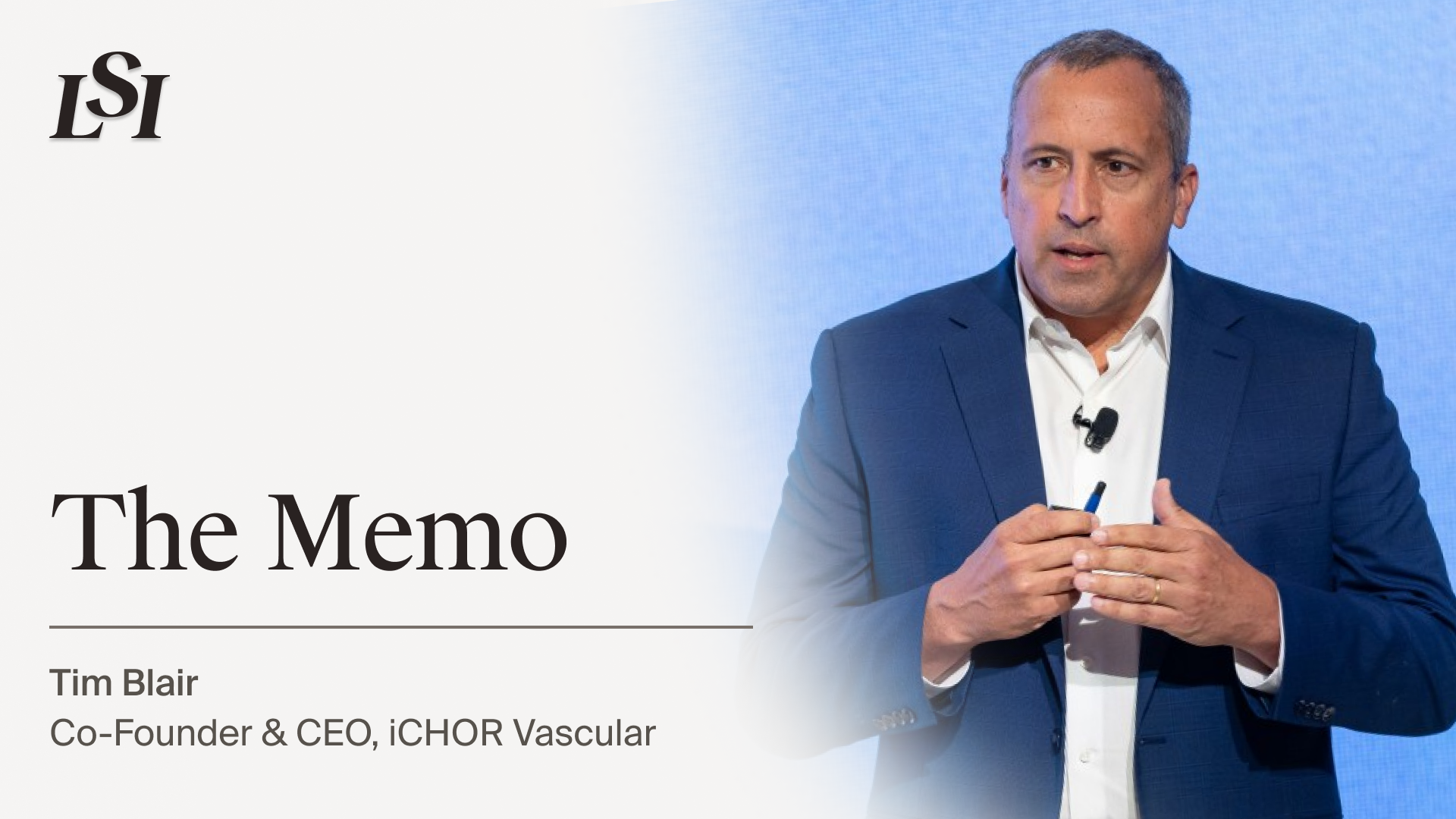
Under the leadership of Co-Founder and CEO Tim Blair, iCHOR Vascular is advancing a new approach to treating peripheral vascular occlusions by converting one of surgery’s most proven techniques into a simple, minimally invasive endovascular procedure. Founded to address shortcomings in clot removal, the company’s iSWEEP platform modernizes the classic Fogarty balloon sweep, delivering rapid vessel clearance without thrombolytic drugs, complex surgery, blood loss, vessel damage, or capital equipment.
Origin Story
iCHOR Vascular was founded by practicing Vascular Interventional Radiologist Dr. Troy Long and industry veteran Tim Blair, sparked by a clear realization.
“The iCHOR aha moment came from our preclinical experiences with various thrombectomy technologies in their early development stages,” Blair explained. “Whether it was another aspiration technology, another Archimedes screw, another maceration contraption, or another metal scrapping tool, nobody was superior to clot removal and vessel integrity compared to the surgical Fogarty predicate device.”
That insight became the foundation of the company’s mission: to take what has worked for decades in open thrombectomy and translate it into a streamlined endovascular solution.
“We applied our preclinical experiences to essentially create an endovascular balloon sweeping system that can be applied across a wide range of clot morphology and anatomy with a single system,” Blair said.
The founders brought complementary expertise. As a practicing Vascular Interventional Radiologist, Dr. Long brings decades of training and experience with clot removal. Blair, meanwhile, brings more than three decades of experience in peripheral vascular disease from the sales and marketing perspective, with added preclinical and regulatory depth in early-stage vascular technologies.
The company began in Minneapolis, Minnesota, and has since formed as a Delaware C-Corp. Since its founding, iCHOR has secured early pre-seed, seed, and Series A funding, along with three FDA 510(k) clearances supported by early real-world clinical experience.
The Current Landscape
Peripheral vascular occlusions remain a major and costly challenge across peripheral venous disease, peripheral artery disease, and dialysis access. Despite innovation in mechanical thrombectomy, the standard of care has long been dominated by drug-based and surgical approaches.
“Today’s market is still dominated by lytic therapy followed by surgical approaches,” Blair said.
While newer mechanical technologies have shifted the field away from thrombolytics, most device mechanisms were originally designed for other indications and often present with trade-offs because they weren’t designed for the peripheral system.
“Every mechanism of action to date was borrowed from stroke or pulmonary embolism,” he explained. “Peripheral issues are different.”
That difference in anatomy and clot morphology demands tools specifically built for the peripheral vasculature.
iCHOR’s approach is deliberate: rather than reinventing clot removal with increasingly complex systems, the company has focused on adapting the most validated predicate in the field while addressing the blood loss and vessel damage shortcomings.
“We have been using the Fogarty balloon successfully for 60+ years,” Blair said. “iCHOR Vascular created an endovascular option for physicians that is simple, proven, and highly economical.”
The implications are significant for hospitals and increasingly, ambulatory environments where economics and simplicity matter more than ever.
Inside the Innovation
At the core of iCHOR Vascular’s platform is the iSWEEP System, a catheter-based kit designed to replicate the Fogarty balloon sweep in a minimally invasive procedure.
The platform is designed to eliminate many of the burdens that come with traditional clot removal approaches, offering a streamlined path to reperfusion with fewer downstream complications and fewer resource demands. As Blair summarized, iCHOR’s system is built to deliver vessel clearance with:
- No drug-related complications or ICU stays
- No surgical complications or ICU stays
- No blood loss
- No vessel damage
- No distal embolization
- No capital equipment
The system includes a simple sheath, guide catheter, and over-the-wire balloon that any vascular surgeon or interventional radiologist could use and any technician could set up without training. The concept is to eliminate the confusion and complicated setup that comes with current devices and offer something that is simple, affordable, and fast.
“The iCHOR iSweep System is designed with everything a physician needs in the packaging,” Blair said. “There are no compliance or fit challenges. You open the kit and treat; it has to be that simple.”
That simplicity is central to iCHOR’s differentiation.
“We are the only Endo-Fogarty system on the market today,” Blair said.
By targeting both clinical performance and health economics, the company aims to offer an option that is effective, scalable, and aligned with cost pressures reshaping vascular care.
Progress and Milestones
iCHOR Vascular is now gaining early commercial traction in the limited market release, supported by multiple regulatory clearances and a growing base of real-world clinical experience.
“iCHOR has three 510(k)s, all with real-world clinical procedures that are growing on a monthly basis,” Blair shared.
That early usage is informing the company’s next phase of clinical validation, device iteration, and scale. The team is refining its platform through limited market release data and feedback, with an eye toward broader distribution partnerships and commercial expansion beginning in late 2026 and continuing into 2027.
On the funding front, iCHOR is now preparing for its next growth round as it moves toward broader adoption.
“We are in discussions about the future of a Series B,” Blair said. “It will likely be a Series B between $10M to $15M aimed at fueling the commercial efforts and post-market clinical validation of our solutions.”
Blair expects this financing could represent the company’s final institutional raise before reaching a positive balance sheet. “However, we will never rule out another raise if there is a strategic opportunity or scalable growth,” he added.
While iCHOR’s near-term focus remains on the U.S., where they estimate a $5B market opportunity, the company is building its platform with international expansion in mind.
The LSI Effect
For Blair, LSI has played a unique role in helping companies like iCHOR connect with the right stakeholders at the right stage.
“LSI has cracked the code on delivering real value,” he said. “I’ve personally found the audiences for networking (industry, investors, other CEOs, and supply chain vendors) to be incredibly well thought through, and that has tremendous impact.”
He also points to the immersive environment of the events themselves as a differentiator.
“I also think the destination keeps people together compared to other events where attendees pop in and out, or worse, completely disappear.”
Beyond networking, Blair emphasized the lasting value of LSI’s media and promotional engine.
“On top of that, the marketing is excellent. LSI promotes companies in a great light, and the follow-on videos become valuable assets that startups can use in pitch decks and broader marketing long after the event.”
Join Us at LSI USA ‘26
Blair has been selected to present at LSI USA ‘26, March 16th–20th, in front of hundreds of global medical technology companies. Join us in welcoming him to the event in Dana Point, CA, where he will share the latest updates on iCHOR Vascular’s technology and development.



-(1).png)




Request Info

The Lens - Complimentary Issue
Subscription Includes

Global Medtech Market Analysis & Projections (MAP), 2021-2031
Published: 2023
Next Update: Q4 2024
Deliverables:



Global Surgical Procedure Volumes Dashboard, 2018-2029
Published: 2022
Next Update: Q2 2024
Deliverables:
United States Surgical Procedure Volumes, 2018-2029
Published: 2022
Next Update: Q2 2024
Deliverables:
Aesthetics, Global Surgical Procedure Volumes, 2018-2029
Published: 2022
Next Update: Q2 2024
Deliverables:
Cardio, Global Surgical Procedure Volumes, 2018-2029
Published: 2022
Next Update: Q2 2024
Deliverables:
ENT, Global Surgical Procedure Volumes, 2018-2029
Published: 2022
Next Update: Q2 2024
Deliverables:
General, Global Surgical Procedure Volumes, 2018-2029
Published: 2022
Next Update: Q2 2024
Deliverables:
Neuro, Global Surgical Procedure Volumes, 2018-2029
Published: 2022
Next Update: Q2 2024
Deliverables:
OB/GYN, Global Surgical Procedure Volumes, 2018-2029
Published: 2022
Next Update: Q2 2024
Deliverables:
Ophthalmology, Global Surgical Procedure Volumes, 2018-2029
Published: 2022
Next Update: Q2 2024
Deliverables:
Orthopedic, Global Surgical Procedure Volumes, 2018-2029
Published: 2022
Next Update: Q2 2024
Deliverables:
Peripheral Vascular, Global Surgical Procedure Volumes, 2018-2029
Published: 2022
Next Update: Q2 2024
Deliverables:
Spine, Global Surgical Procedure Volumes, 2018-2029
Published: 2022
Next Update: Q2 2024
Deliverables:
SRS, Global Surgical Procedure Volumes, 2018-2029
Published: 2022
Next Update: Q2 2024
Deliverables:
Urological, Global Surgical Procedure Volumes, 2018-2029
Published: 2022
Next Update: Q2 2024
Deliverables:
Global Markets for Hip Replacement Implants, 2023-2028
Published: 2023
Next Update: Q2 2024
Deliverables:
Global Markets for Peripheral Vascular Guidewires, 2023-2028
Published: 2023
Next Update: Q2 2024
Deliverables:
Global Markets for Peripheral Atherectomy Catheters, 2023-2028
Published: 2023
Next Update: Q2 2024
Deliverables:
Global Markets for Electrosurgery, 2023-2028
Published: 2023
Next Update: Q2 2024
Deliverables:
Global Markets for Peripheral Vascular Balloons & Vena Cava Filter, 2023-2028
Published: 2023
Next Update: Q2 2024
Deliverables:
Global Markets for Mechanical Heart Valves, 2023-2028
Published: 2023
Next Update: Q2 2024
Deliverables:
Global Markets for Tissue Heart Valve Replacement, 2023-2028
Published: 2023
Next Update: Q2 2030
Deliverables:
Global Markets for Transcatheter Mitral Valve Devices, 2023-2028
Published: 2023
Next Update: Q2 2024
Deliverables:
Global Markets for Femoral Closure, 2023-2029
Published: 2023
Next Update: Q2 2024
Deliverables:
Global Markets for Tricuspid Valve Repair, 2023-2028
Published: 2023
Next Update: Q2 2024
Deliverables:
Global Markets for Percutaneous Pulmonary Valves, 2023-2028
Published: 2023
Next Update: Q2 2024
Deliverables:
Global Markets for Coronary Angio Guidewires & Catheters, 2023-2028
Published: 2023
Next Update: Q2 2024
Deliverables:
Global Markets for Oncology Ablation Devices, 2023-2028
Published: 2023
Next Update: Q2 2024
Deliverables:
Global Markets for ENT Devices, 2023-2028
Published: 2023
Next Update: Q2 2024
Deliverables:
Global Markets for Cell Delivery Catheters, 2023-2028
Published: 2023
Next Update: Q3 2024
Deliverables:
Global Markets for Urology Devices, 2023-2028
Published: 2023
Next Update: Q3 2024
Deliverables:
Global Markets for External Pain Pumps, 2023-2028
Published: 2023
Next Update: Q3 2024
Deliverables:
Global Markets for Ureteral Access Devices, 2023-2028
Published: 2023
Next Update: Q3 2024
Deliverables:
Global Markets for Pelvic Floor Repair, 2023-2028
Published: 2023
Next Update: Q3 2024
Deliverables:
Global Markets for Atrial Fibrillation, 2023-2028
Published: 2023
Next Update: Q3 2024
Deliverables:
Global Markets for Neurovascular Devices Ischemic, 2023-2028
Published: 2023
Next Update: Q3 2024
Deliverables:
Global Markets for Neuromodulation Devices, 2023-2028
Published: 2023
Next Update: Q3 2024
Deliverables:
Global Markets for Vertebroplasty Devices, 2023-2028
Published: 2023
Next Update: Q3 2024
Deliverables:
Global Markets for Benign Prostation Hyperplasia Implants, 2023-2028
Published: 2023
Next Update: Q3 2024
Deliverables:
Global Markets for Cryoablation, 2023-2028
Published: 2023
Next Update: Q3 2024
Deliverables:
Global Markets for Diagnostic Electrophysiology Catheters, 2023-2028
Published: 2023
Next Update: Q3 2024
Deliverables:
Global Markets for Hernia Repair, 2023-2028
Published: 2023
Next Update: Q4 2024
Deliverables:
Global Markets for CRM Devices, 2023-2028
Published: 2023
Next Update: Q4 2024
Deliverables:
Global Markets for Neurovascular Devices Hemorrhagic, 2023-2028
Published: 2023
Next Update: Q4 2024
Deliverables:
Global Markets for Renal Denervation, 2023-2028
Published: 2023
Next Update: Q4 2024
Deliverables:
Global Markets for Upper+Lower Suture Anchors, 2023-2028
Published: 2023
Next Update: Q4 2024
Deliverables:
Global Markets for Peripheral Stents, 2023-2028
Published: 2023
Next Update: Q4 2024
Deliverables:
Global Markets for Electromagnetic Navigation Systems, 2023-2028
Published: 2023
Next Update: Q4 2024
Deliverables:
Global Markets for GI Endoscopy, 2023-2028
Published: 2023
Next Update: Q4 2024
Deliverables:
Global Markets for Hemodialysis, 2023-2028
Published: 2023
Next Update: Q4 2024
Deliverables:
Globals Markets for Cardiac Ablation, 2023-2028
Published:
Next Update:
Deliverables:
Global Markets for Atrial Septal Occlusion, 2023-2028
Published: 2023
Next Update: Q4 2024
Deliverables:
Global Markets for Aortic Grafts, 2023-2028
Published: 2023
Next Update: Q4 2024
Deliverables:
Global Markets for Interventional Cardiology Devices, 2023-2028
Published: 2023
Next Update: Q4 2024
Deliverables:
Global Markets for Oncology Embolization, 2023-2028
Published: 2023
Next Update: Q4 2024
Deliverables:
Global Markets for Vascular Access Devices, 2023-2028
Published: 2023
Next Update: Q4 2024
Deliverables:
Global Markets for Rotator Cuff Repair Suture Anchors, 2023-2028
Published: 2023
Next Update: Q4 2024
Deliverables:
Global Markets for Electrical Stimulation Devices, 2023-2028
Published: 2023
Next Update: Q4 2024
Deliverables:
Global Markets for Wearable Monitoring Devices, 2023-2028
Published: 2023
Next Update: Q4 2024
Deliverables:
Global Markets for Low Complexity Medical Devices, 2023-2028
Published: 2023
Next Update: Q4 2024
Deliverables:
Canada Surgical Procedure Volumes, 2018-2029
Published: 2022
Next Update: Q2 2024
Deliverables:
Germany Surgical Procedure Volumes, 2018-2029
Published: 2022
Next Update: Q2 2024
Deliverables:
France Surgical Procedure Volumes, 2018-2029
Published: 2022
Next Update: Q2 2024
Deliverables:
U.K. Surgical Procedure Volumes, 2018-2029
Published: 2022
Next Update: Q2 2024
Deliverables:
Italy Surgical Procedure Volumes, 2018-2029
Published: 2022
Next Update: Q2 2024
Deliverables:
Spain Surgical Procedure Volumes, 2018-2029
Published: 2022
Next Update: Q2 2024
Deliverables:
Poland Surgical Procedure Volumes, 2018-2029
Published: 2022
Next Update: Q2 2024
Deliverables:
Netherlands Surgical Procedure Volumes, 2018-2029
Published: 2022
Next Update: Q2 2024
Deliverables:
Belgium Surgical Procedure Volumes, 2018-2029
Published: 2022
Next Update: Q2 2024
Deliverables:
Sweden Surgical Procedure Volumes, 2018-2029
Published: 2022
Next Update: Q2 2024
Deliverables:
Switzerland Surgical Procedure Volumes, 2018-2029
Published: 2022
Next Update: Q2 2024
Deliverables:
Denmark Surgical Procedure Volumes, 2018-2029
Published: 2022
Next Update: Q2 2024
Deliverables:
Finland Surgical Procedure Volumes, 2018-2029
Published: 2022
Next Update: Q2 2024
Deliverables:
Norway Surgical Procedure Volumes, 2018-2029
Published: 2022
Next Update: Q2 2024
Deliverables:
China Surgical Procedure Volumes, 2018-2029
Published: 2022
Next Update: Q2 2024
Deliverables:
India Surgical Procedure Volumes, 2018-2029
Published: 2022
Next Update: Q2 2024
Deliverables:
Japan Surgical Procedure Volumes, 2018-2029
Published: 2022
Next Update: Q2 2024
Deliverables:
South Korea Surgical Procedure Volumes, 2018-2029
Published: 2022
Next Update: Q2 2024
Deliverables:
Australia Surgical Procedure Volumes, 2018-2029
Published: 2022
Next Update: Q2 2024
Deliverables:
Thailand Surgical Procedure Volumes, 2018-2029
Published: 2022
Next Update: Q2 2024
Deliverables:
Malaysia Surgical Procedure Volumes, 2018-2029
Published: 2022
Next Update: Q2 2024
Deliverables:
Singapore Surgical Procedure Volumes, 2018-2029
Published: 2022
Next Update: Q2 2024
Deliverables:
New Zealand Surgical Procedure Volumes, 2018-2029
Published: 2022
Next Update: Q2 2024
Deliverables:
Caribbean Surgical Procedure Volumes, 2018-2029
Published: 2022
Next Update: Q2 2024
Deliverables:
Argentina Surgical Procedure Volumes, 2018-2029
Published: 2022
Next Update: Q2 2024
Deliverables:
Colombia Surgical Procedure Volumes, 2018-2029
Published: 2022
Next Update: Q2 2024
Deliverables:
Chile Surgical Procedure Volumes, 2018-2029
Published: 2022
Next Update: Q2 2024
Deliverables:
Guatemala Surgical Procedure Volumes, 2018-2029
Published: 2022
Next Update: Q2 2024
Deliverables:
Dominican Republic Surgical Procedure Volumes, 2018-2029
Published: 2022
Next Update: Q2 2024
Deliverables:
Costa Rica Surgical Procedure Volumes, 2018-2029
Published: 2022
Next Update: Q2 2024
Deliverables:
Panama Surgical Procedure Volumes, 2018-2029
Published: 2022
Next Update: Q2 2024
Deliverables:
Mexico Surgical Procedure Volumes, 2018-2029
Published: 2022
Next Update: Q2 2024
Deliverables:
Brazil Surgical Procedure Volumes, 2018-2029
Published: 2022
Next Update: Q2 2024
Deliverables:
Turkey Surgical Procedure Volumes, 2018-2029
Published: 2022
Next Update: Q2 2024
Deliverables:
Russia Surgical Procedure Volumes, 2018-2029
Published: 2022
Next Update: Q2 2024
Deliverables:
South Africa Surgical Procedure Volumes, 2018-2029
Published: 2022
Next Update: Q2 2024
Deliverables:
Request Info
See Full Attendee List