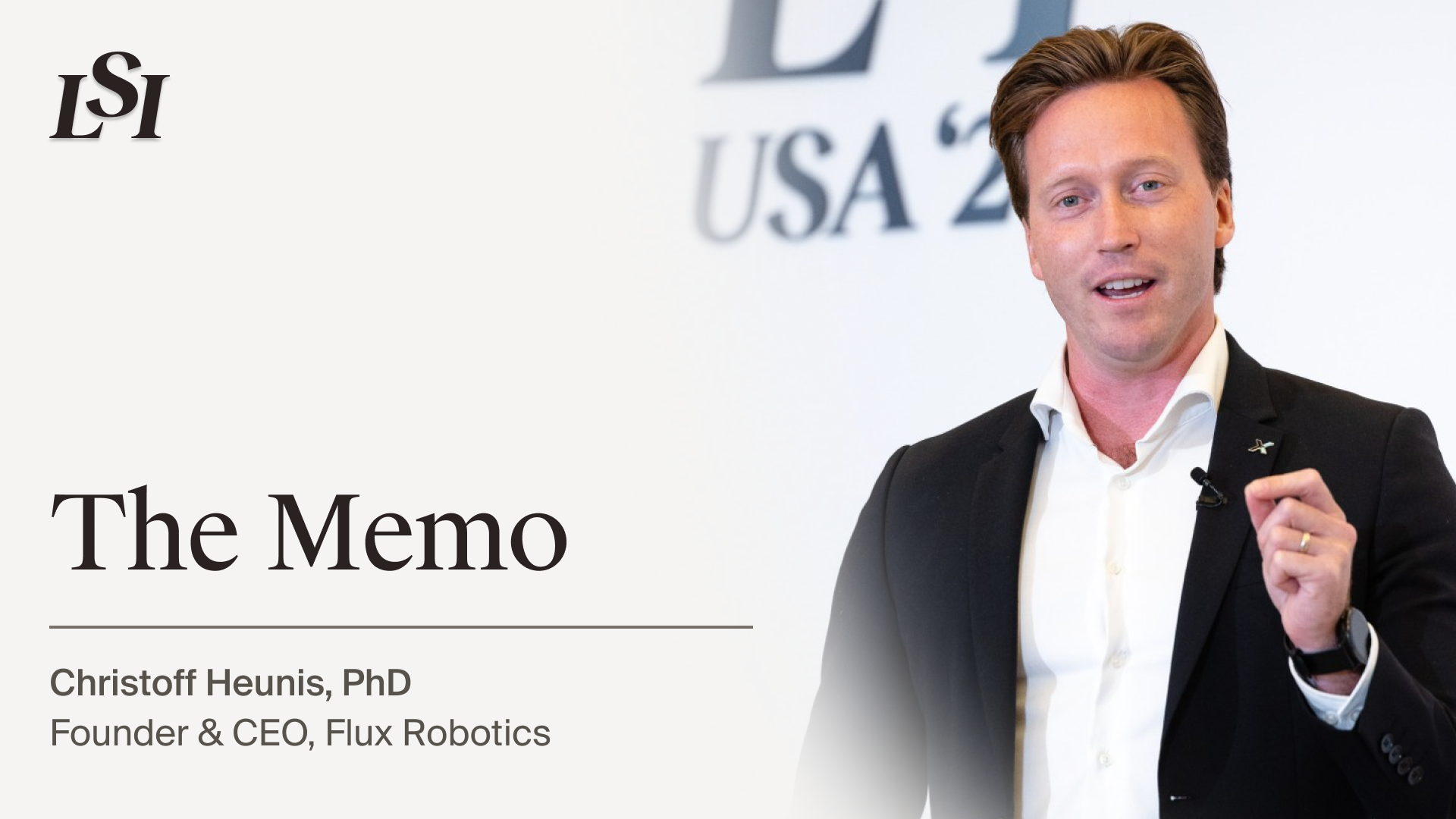
Under the direction of Founder and CEO Christoff Heunis, PhD, Flux Robotics is developing a magnetic vascular navigation platform designed to give physicians more controlled steering of guidewire movement inside blood vessels. By replacing the traditional reliance on pushing and twisting wires from outside the body with magnetically guided tip steering, the company aims to make one of the most challenging steps in vascular intervention more predictable, repeatable, and accessible. As vascular disease burdens rise worldwide and specialist shortages intensify, Flux is pursuing a new approach to minimally invasive surgery that could help more physicians successfully treat more patients.
Origin Story
For Heunis, the inspiration behind Flux Robotics traces back to a deeply personal experience.
“When I was 20, studying mechatronic engineering in South Africa, my best friend Shaun called me,” he recalled. “I’ve known Shaun since I was five, and his mother was like family to me. She had suffered an MCA stroke and ended up in a wheelchair because treatment came too late.”
What shocked him most was learning how limited access to advanced vascular care could be.
“At the time, there were only around three surgeons on the entire continent who could perform the procedure she needed. That made no sense to me.”
The experience set Heunis on a path that would shape the rest of his career. He transitioned from mechatronics into biomedical engineering, pursued a PhD in surgical robotics at the University of Twente in the Netherlands, and focused his research on magnetic navigation systems for minimally invasive vascular procedures. Today, he has authored 27 peer-reviewed publications, accumulated more than 460 citations, and co-owns two patents related to magnetic vascular navigation.
More importantly, the experience crystallized the mission behind Flux.
“What excited me was realizing that many vascular procedures still depend on one very manual step: the surgeon’s ability to physically push and twist a tiny wire through fragile blood vessels,” Heunis said. “If only a few surgeons can perform a procedure well, then access is not truly solved.”
Founded in the Netherlands, with activities in Groningen and Enschede, Flux Robotics was built to make complex vascular navigation “more controlled, repeatable, and scalable, so more patients can benefit regardless of where they live or which specialist happens to be available.”
The Current Landscape
In vascular interventions, one of the most difficult and consequential tasks is often the simplest sounding: crossing a blockage.
“The problem is control inside blood vessels,” said Heunis. “In many vascular procedures, the hardest step is crossing a blocked artery.”
Today, physicians typically navigate guidewires manually under fluoroscopic imaging, pushing, twisting, and exchanging devices while interpreting two-dimensional X-ray images in real time. While effective in many cases, the approach can become increasingly challenging in tortuous anatomy and difficult blockages, where guidewire movement may become less predictable.
If the guidewire fails to cross the blockage, the consequences can be significant.
“If the surgeon cannot cross the blockage, the procedure can fail,” Heunis explained. “In severe peripheral artery disease, that can mean amputation. In other vascular territories, it can mean longer procedures, more radiation, more device exchanges, or escalation to more invasive treatment.”
The need for improved navigation tools is growing. Peripheral artery disease affects more than 200 million people globally, and incidence continues to rise alongside aging populations and increasing rates of diabetes. At the same time, physician shortages threaten access to specialized care, creating a widening gap between patient demand and available expertise.
For Heunis, those trends reinforce the same access challenge that first inspired the company years ago.
Inside the Innovation
Flux Robotics is tackling the problem by changing how guidewires are controlled.
Rather than relying exclusively on mechanical force applied from outside the patient’s body, the company’s platform uses external magnetic fields to steer a magnetically responsive guidewire tip from within the vasculature.
“Instead of only pushing the wire from outside the body, the system allows the physician to influence and control the tip directly,” Heunis said.
The platform combines three primary components: an external magnetic navigation robot, a magnetically responsive guidewire, and an image-guided workflow. Using CT- and DICOM-based procedural planning, physicians can create patient-specific navigation roadmaps before entering the vasculature. During the procedure, magnetic fields generated around the patient interact with a magnetic element near the guidewire tip, enabling controlled steering through complex anatomy while keeping the physician firmly in control of advancement and navigation.
The concept addresses what Flux sees as a fundamental limitation of current navigation approaches.
“Most robotics companies improve how surgeons push tools,” Heunis said. “We change the control mechanism itself by pulling, not pushing, the guidewire tip magnetically inside the body.”
According to the company, early validation studies demonstrated a 47% reduction in navigation time compared with manual navigation. The broader objective is to reduce vessel trauma, shorten procedure times, decrease radiation exposure, and improve procedural success in challenging anatomy.
The technology has been developed with a strong emphasis on physician adoption and workflow integration.
Development is guided by approximately 10 international key opinion leaders, and the company’s operating philosophy remains simple: “Keep the surgeon in the loop, always.”
Progress and Milestones
Despite operating with relatively modest resources, Flux Robotics has already achieved several significant development milestones.
The company reports advancing toward GLP-stage development readiness with less than €2 million in direct development spending over six years, following a lean build-test-learn approach developed in close collaboration with surgeons.
To date, Flux has completed 11 successful pre-clinical/animal studies across Europe and the U.S. and is advancing toward first-in-human evaluation. Additional milestones include two patents, 27 peer-reviewed publications, approximately €3.2 million in non-dilutive funding, and recognition through Dutch engineering and startup awards. Most recently, Flux Robotics was selected for the MedTech Innovator 2026 cohort and the American Heart Association Specialty Track, adding further external validation from one of the leading global medtech accelerator platforms.
The company is currently raising a Seed round to support the next phase of development.
“The Seed round gets us to first-in-human readiness and early clinical validation,” Heunis said. “The goal is to move Flux from advanced pre-clinical validation into human use and prepare the company for the next major value inflection.”
Looking ahead, Flux plans to continue refining its platform, advancing regulatory efforts, expanding pre-clinical validation, and preparing for large-scale clinical studies. Long term, the company sees magnetic navigation as a foundational technology that could extend beyond vascular interventions into a broader range of endovascular and intravascular procedures.
For Heunis, the vision has remained remarkably consistent from the moment he received that phone call in South Africa. The goal is not simply to build another surgical robot. It is to make complex vascular procedures more predictable, more scalable, and ultimately more accessible to the patients who need them most.
The LSI Effect
“LSI is really unique. It is a community,” said Heunis. “You meet investors early, often before the timing is perfect on either side, and then keep the relationship warm as the company matures.”
He added, “LSI has built one of the strongest global communities for emerging medtech companies like Flux. What makes it valuable is that the audience understands the complexity of building regulated medical technologies, not just the headline story.”
For Flux Robotics, that audience is an ideal fit as the company prepares for its next major milestone and works to demonstrate why magnetic vascular navigation could represent a new control layer for minimally invasive surgery.
Join Us at LSI Europe ‘26
Heunis has been selected to present at LSI Europe '26, September 28th–October 1st, in front of hundreds of global medical technology companies. Join us in welcoming him to the event in Barcelona, where he will share the latest updates on Flux Robotics’ technology and development.








Request Info

The Lens - Complimentary Issue
Subscription Includes

Global Medtech Market Analysis & Projections (MAP), 2021-2031
Published: 2023
Next Update: Q4 2024
Deliverables:


Global Surgical Procedure Volumes Dashboard, 2018-2029
Published: 2022
Next Update: Q2 2024
Deliverables:
United States Surgical Procedure Volumes, 2018-2029
Published: 2022
Next Update: Q2 2024
Deliverables:
Aesthetics, Global Surgical Procedure Volumes, 2018-2029
Published: 2022
Next Update: Q2 2024
Deliverables:
Cardio, Global Surgical Procedure Volumes, 2018-2029
Published: 2022
Next Update: Q2 2024
Deliverables:
ENT, Global Surgical Procedure Volumes, 2018-2029
Published: 2022
Next Update: Q2 2024
Deliverables:
General, Global Surgical Procedure Volumes, 2018-2029
Published: 2022
Next Update: Q2 2024
Deliverables:
Neuro, Global Surgical Procedure Volumes, 2018-2029
Published: 2022
Next Update: Q2 2024
Deliverables:
OB/GYN, Global Surgical Procedure Volumes, 2018-2029
Published: 2022
Next Update: Q2 2024
Deliverables:
Ophthalmology, Global Surgical Procedure Volumes, 2018-2029
Published: 2022
Next Update: Q2 2024
Deliverables:
Orthopedic, Global Surgical Procedure Volumes, 2018-2029
Published: 2022
Next Update: Q2 2024
Deliverables:
Peripheral Vascular, Global Surgical Procedure Volumes, 2018-2029
Published: 2022
Next Update: Q2 2024
Deliverables:
Spine, Global Surgical Procedure Volumes, 2018-2029
Published: 2022
Next Update: Q2 2024
Deliverables:
SRS, Global Surgical Procedure Volumes, 2018-2029
Published: 2022
Next Update: Q2 2024
Deliverables:
Urological, Global Surgical Procedure Volumes, 2018-2029
Published: 2022
Next Update: Q2 2024
Deliverables:
Global Markets for Hip Replacement Implants, 2023-2028
Published: 2023
Next Update: Q2 2024
Deliverables:
Global Markets for Peripheral Vascular Guidewires, 2023-2028
Published: 2023
Next Update: Q2 2024
Deliverables:
Global Markets for Peripheral Atherectomy Catheters, 2023-2028
Published: 2023
Next Update: Q2 2024
Deliverables:
Global Markets for Electrosurgery, 2023-2028
Published: 2023
Next Update: Q2 2024
Deliverables:
Global Markets for Peripheral Vascular Balloons & Vena Cava Filter, 2023-2028
Published: 2023
Next Update: Q2 2024
Deliverables:
Global Markets for Mechanical Heart Valves, 2023-2028
Published: 2023
Next Update: Q2 2024
Deliverables:
Global Markets for Tissue Heart Valve Replacement, 2023-2028
Published: 2023
Next Update: Q2 2030
Deliverables:
Global Markets for Transcatheter Mitral Valve Devices, 2023-2028
Published: 2023
Next Update: Q2 2024
Deliverables:
Global Markets for Femoral Closure, 2023-2029
Published: 2023
Next Update: Q2 2024
Deliverables:
Global Markets for Tricuspid Valve Repair, 2023-2028
Published: 2023
Next Update: Q2 2024
Deliverables:
Global Markets for Percutaneous Pulmonary Valves, 2023-2028
Published: 2023
Next Update: Q2 2024
Deliverables:
Global Markets for Coronary Angio Guidewires & Catheters, 2023-2028
Published: 2023
Next Update: Q2 2024
Deliverables:
Global Markets for Oncology Ablation Devices, 2023-2028
Published: 2023
Next Update: Q2 2024
Deliverables:
Global Markets for ENT Devices, 2023-2028
Published: 2023
Next Update: Q2 2024
Deliverables:
Global Markets for Cell Delivery Catheters, 2023-2028
Published: 2023
Next Update: Q3 2024
Deliverables:
Global Markets for Urology Devices, 2023-2028
Published: 2023
Next Update: Q3 2024
Deliverables:
Global Markets for External Pain Pumps, 2023-2028
Published: 2023
Next Update: Q3 2024
Deliverables:
Global Markets for Ureteral Access Devices, 2023-2028
Published: 2023
Next Update: Q3 2024
Deliverables:
Global Markets for Pelvic Floor Repair, 2023-2028
Published: 2023
Next Update: Q3 2024
Deliverables:
Global Markets for Atrial Fibrillation, 2023-2028
Published: 2023
Next Update: Q3 2024
Deliverables:
Global Markets for Neurovascular Devices Ischemic, 2023-2028
Published: 2023
Next Update: Q3 2024
Deliverables:
Global Markets for Neuromodulation Devices, 2023-2028
Published: 2023
Next Update: Q3 2024
Deliverables:
Global Markets for Vertebroplasty Devices, 2023-2028
Published: 2023
Next Update: Q3 2024
Deliverables:
Global Markets for Benign Prostation Hyperplasia Implants, 2023-2028
Published: 2023
Next Update: Q3 2024
Deliverables:
Global Markets for Cryoablation, 2023-2028
Published: 2023
Next Update: Q3 2024
Deliverables:
Global Markets for Diagnostic Electrophysiology Catheters, 2023-2028
Published: 2023
Next Update: Q3 2024
Deliverables:
Global Markets for Hernia Repair, 2023-2028
Published: 2023
Next Update: Q4 2024
Deliverables:
Global Markets for CRM Devices, 2023-2028
Published: 2023
Next Update: Q4 2024
Deliverables:
Global Markets for Neurovascular Devices Hemorrhagic, 2023-2028
Published: 2023
Next Update: Q4 2024
Deliverables:
Global Markets for Renal Denervation, 2023-2028
Published: 2023
Next Update: Q4 2024
Deliverables:
Global Markets for Upper+Lower Suture Anchors, 2023-2028
Published: 2023
Next Update: Q4 2024
Deliverables:
Global Markets for Peripheral Stents, 2023-2028
Published: 2023
Next Update: Q4 2024
Deliverables:
Global Markets for Electromagnetic Navigation Systems, 2023-2028
Published: 2023
Next Update: Q4 2024
Deliverables:
Global Markets for GI Endoscopy, 2023-2028
Published: 2023
Next Update: Q4 2024
Deliverables:
Global Markets for Hemodialysis, 2023-2028
Published: 2023
Next Update: Q4 2024
Deliverables:
Globals Markets for Cardiac Ablation, 2023-2028
Published:
Next Update:
Deliverables:
Global Markets for Atrial Septal Occlusion, 2023-2028
Published: 2023
Next Update: Q4 2024
Deliverables:
Global Markets for Aortic Grafts, 2023-2028
Published: 2023
Next Update: Q4 2024
Deliverables:
Global Markets for Interventional Cardiology Devices, 2023-2028
Published: 2023
Next Update: Q4 2024
Deliverables:
Global Markets for Oncology Embolization, 2023-2028
Published: 2023
Next Update: Q4 2024
Deliverables:
Global Markets for Vascular Access Devices, 2023-2028
Published: 2023
Next Update: Q4 2024
Deliverables:
Global Markets for Rotator Cuff Repair Suture Anchors, 2023-2028
Published: 2023
Next Update: Q4 2024
Deliverables:
Global Markets for Electrical Stimulation Devices, 2023-2028
Published: 2023
Next Update: Q4 2024
Deliverables:
Global Markets for Wearable Monitoring Devices, 2023-2028
Published: 2023
Next Update: Q4 2024
Deliverables:
Global Markets for Low Complexity Medical Devices, 2023-2028
Published: 2023
Next Update: Q4 2024
Deliverables:
Canada Surgical Procedure Volumes, 2018-2029
Published: 2022
Next Update: Q2 2024
Deliverables:
Germany Surgical Procedure Volumes, 2018-2029
Published: 2022
Next Update: Q2 2024
Deliverables:
France Surgical Procedure Volumes, 2018-2029
Published: 2022
Next Update: Q2 2024
Deliverables:
U.K. Surgical Procedure Volumes, 2018-2029
Published: 2022
Next Update: Q2 2024
Deliverables:
Italy Surgical Procedure Volumes, 2018-2029
Published: 2022
Next Update: Q2 2024
Deliverables:
Spain Surgical Procedure Volumes, 2018-2029
Published: 2022
Next Update: Q2 2024
Deliverables:
Poland Surgical Procedure Volumes, 2018-2029
Published: 2022
Next Update: Q2 2024
Deliverables:
Netherlands Surgical Procedure Volumes, 2018-2029
Published: 2022
Next Update: Q2 2024
Deliverables:
Belgium Surgical Procedure Volumes, 2018-2029
Published: 2022
Next Update: Q2 2024
Deliverables:
Sweden Surgical Procedure Volumes, 2018-2029
Published: 2022
Next Update: Q2 2024
Deliverables:
Switzerland Surgical Procedure Volumes, 2018-2029
Published: 2022
Next Update: Q2 2024
Deliverables:
Denmark Surgical Procedure Volumes, 2018-2029
Published: 2022
Next Update: Q2 2024
Deliverables:
Finland Surgical Procedure Volumes, 2018-2029
Published: 2022
Next Update: Q2 2024
Deliverables:
Norway Surgical Procedure Volumes, 2018-2029
Published: 2022
Next Update: Q2 2024
Deliverables:
China Surgical Procedure Volumes, 2018-2029
Published: 2022
Next Update: Q2 2024
Deliverables:
India Surgical Procedure Volumes, 2018-2029
Published: 2022
Next Update: Q2 2024
Deliverables:
Japan Surgical Procedure Volumes, 2018-2029
Published: 2022
Next Update: Q2 2024
Deliverables:
South Korea Surgical Procedure Volumes, 2018-2029
Published: 2022
Next Update: Q2 2024
Deliverables:
Australia Surgical Procedure Volumes, 2018-2029
Published: 2022
Next Update: Q2 2024
Deliverables:
Thailand Surgical Procedure Volumes, 2018-2029
Published: 2022
Next Update: Q2 2024
Deliverables:
Malaysia Surgical Procedure Volumes, 2018-2029
Published: 2022
Next Update: Q2 2024
Deliverables:
Singapore Surgical Procedure Volumes, 2018-2029
Published: 2022
Next Update: Q2 2024
Deliverables:
New Zealand Surgical Procedure Volumes, 2018-2029
Published: 2022
Next Update: Q2 2024
Deliverables:
Caribbean Surgical Procedure Volumes, 2018-2029
Published: 2022
Next Update: Q2 2024
Deliverables:
Argentina Surgical Procedure Volumes, 2018-2029
Published: 2022
Next Update: Q2 2024
Deliverables:
Colombia Surgical Procedure Volumes, 2018-2029
Published: 2022
Next Update: Q2 2024
Deliverables:
Chile Surgical Procedure Volumes, 2018-2029
Published: 2022
Next Update: Q2 2024
Deliverables:
Guatemala Surgical Procedure Volumes, 2018-2029
Published: 2022
Next Update: Q2 2024
Deliverables:
Dominican Republic Surgical Procedure Volumes, 2018-2029
Published: 2022
Next Update: Q2 2024
Deliverables:
Costa Rica Surgical Procedure Volumes, 2018-2029
Published: 2022
Next Update: Q2 2024
Deliverables:
Panama Surgical Procedure Volumes, 2018-2029
Published: 2022
Next Update: Q2 2024
Deliverables:
Mexico Surgical Procedure Volumes, 2018-2029
Published: 2022
Next Update: Q2 2024
Deliverables:
Brazil Surgical Procedure Volumes, 2018-2029
Published: 2022
Next Update: Q2 2024
Deliverables:
Turkey Surgical Procedure Volumes, 2018-2029
Published: 2022
Next Update: Q2 2024
Deliverables:
Russia Surgical Procedure Volumes, 2018-2029
Published: 2022
Next Update: Q2 2024
Deliverables:
South Africa Surgical Procedure Volumes, 2018-2029
Published: 2022
Next Update: Q2 2024
Deliverables:
Request Info
See Full Attendee List