
From humble beginnings in rural Indiana to advising billion‑dollar global impact initiatives, and now leading a company looking to reshape surgical practice, Gabriel Jones is redefining how we see and trust surgery. As CEO and co-founder of Proprio, Jones is forging a platform that blends real‑time, light-field imaging with artificial intelligence to shift the odds in the operating room and in people’s lives.
In the medtech world, where innovation often means retrofitting AI into legacy tools, Gabriel Jones is thinking bigger. Much bigger.
As the co-founder and CEO of Seattle-based Proprio, Jones is leading a movement that isn’t just digitizing surgery. It’s reimagining the way that surgical intelligence is captured, trusted, and acted upon. Proprio’s flagship FDA-cleared platform, Paradigm, uses light-field imaging, real-time AI, and immersive 3D visualization to guide surgical decision-making with dynamic precision. In a recent interview with The Lens, Jones talked about his life and career path, and how these experiences fuel his boldness and resolve to reshape what is possible in the notoriously high-barrier field of medtech.
Surgical AI is not a new concept, but what makes Proprio’s approach uniquely valuable and poised to transform surgery is its AI-native foundation, real-time intelligence, and platform-first approach to surgical transformation. Unlike legacy systems retrofitted with AI, Proprio’s Paradigm system is purpose-built to provide intelligent, intraoperative guidance, offering surgeons dynamic 3D visualization and data-driven decision support in real time. By capturing and structuring rich surgical data, the platform enables predictive insights, automated documentation, and scalable simulation tools. It’s designed to earn surgeon trust, fit seamlessly into clinical workflows, and adapt to multiple specialties.
Working with the world’s leading surgeons, Proprio is reshaping what’s possible in surgery with AI, not just automating tasks, but improving cognitive calibration, optimizing workflows for operating teams, robotics, and devices, while reducing the risk of adverse events. “Our goal is to extend the boundaries of what humans and computers can do together, and to continue to shape the AI-driven future of surgery,” Jones says.
Backed by top-tier technology and healthcare investors, including DCVC, BOLD, Cota Capital, Intel, and HTC, and fueled by strategic partnerships with global distributors and medical device companies, Proprio is looking to shift the industry from implants and incrementalism to data and intelligence. (Also see “What the TechMed Revolution Means for Healthcare; Alan Cohen of DCVC Forecasts Agile, Data-Driven Innovation,” The Lens, January 2025.)
Unlikely Path to a Life-Saving Mission
Jones rejects the label visionary, but is unapologetically comfortable with being called a zealot. His upbringing in rural Indiana, raised by a single mom, instilled an unyielding belief. “If we could hustle a few pennies for rent from crushed cans, we can reimagine human health.”
Even in hard times during childhood, he always felt destined for big things. Jones began his career in international trade in Japan and Washington, DC, and worked on large-scale mergers and acquisitions on Wall Street. Prior to co-founding Proprio, he worked with the Bill & Melinda Gates Foundation on global initiatives in health and technology, also helping Gates and the Microsoft leadership team with new technology development and evaluation. “Bill Gates taught me the audacity of impact,” he reflects.
His passion for creating direct social impacts led him to new technology ventures where he worked to commercialize several successful startups, ranging from biotech and medtech to AI and property technologies.
But he wanted to do more than advise. He saw firsthand the volume of healthcare data that is lost every day because of the lack of technology to capture it. He felt that every surgeon’s method, workflow, and outcome are lost to a “black box” of wasted potential in the operating room. This unmet need, in Jones’ view, was an opportunity to revolutionize how AI is used in surgery.
“I saw how emerging tech could truly save lives, and I wanted to be closer to the front lines,” says Jones. “I saw that surgery, where the decisions are truly life-altering, has the potential to operate more precisely and efficiently with a roadmap to success, similar to how MapQuest was revolutionary to anyone who drove a car. That is what inspired me the most to start Proprio,” he noted in an interview for the Titan Innovation Awards, which Proprio won in 2023 in the “Innovation in Technology - Best Digital Health Technology Innovation” category.
He co-founded Proprio in 2016, alongside Seattle Children’s neurosurgeon Dr. Samuel Browd, University of Washington professor Joshua Smith, and computer vision expert James Youngquist. Their goal: To illuminate the black box of surgery and make surgical precision scalable, teachable, and data-rich.
At Proprio, that high-impact philosophy manifests in a future-facing, enabling mindset. “We’re building a platform, and it has to empower others,” Jones explains. “Instrument makers, implant companies, and robotics players all should be able to plug into Proprio’s AI-based ecosystem.”
This is backed by unprecedented speed: Proprio has secured three FDA clearances in 2025, each unlocking new capabilities, and has plans for additional 510(k)s ahead. The team’s initial focus is on spine, orthopedic surgery, and neurosurgery, with broader potential applications in surgical guidance and training across various specialties.
One of these approvals was received in April 2025, for Paradigm’s groundbreaking, real-time intraoperative intelligence application. This makes it the first technology to enable segmental 3D anatomy viewing and real-time measurement and success metrics during surgery. Then in June, Proprio was named a winner in Fast Company’s 2025 World Changing Ideas Awards for empowering surgeons with AI-driven certainty in the OR.
Shining a Light into the Black Box of Surgery
In the same way early space missions used LiDAR (Light Detection and Ranging) to bounce light off the moon, Proprio’s Paradigm system “bounces light” inside the human body using light-field imaging arrays that reconstruct an entire 3D scene pixel by pixel, capturing 50 GB/hour of surgical data.
“Every time we look deeper into human biology, we leap forward. Proprio is taking that leap, inside the OR,” he says.
Proprio’s ambition is decidedly bold: to map and quantify all the invisible elements, including skill, nuance, timing, and spatial relationships that contribute to surgical success. It’s a form of computational empathy.
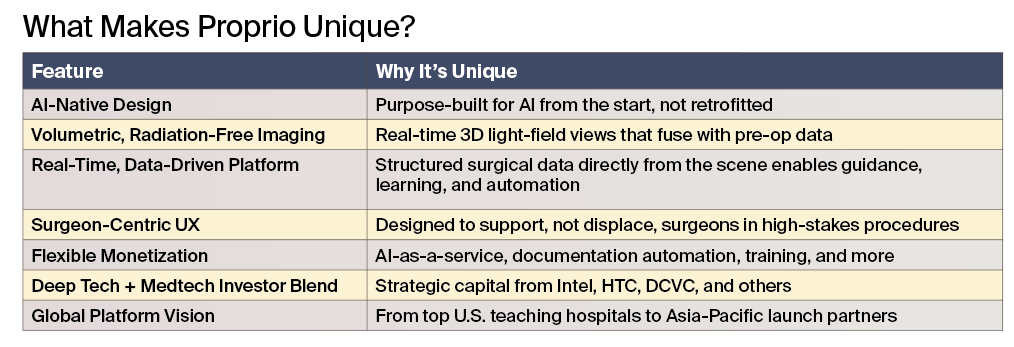
Rather than generating data for data’s sake, Proprio curates structured, high-resolution, interoperable datasets, both real and synthetic, to train, validate, and evolve surgical AI in a regulatory-safe, outcome-driven way.
“We’re running 10,000 cadaver simulations per real case. There’s no way to scale that with traditional methods,” Jones says.
He also explains how Proprio plans to reframe economics. “If your unit of value is a screw or an implant, every incentive in the company optimizes selling more screws,” he says. Instead, he urges redefining surgery as “an opportunity for ongoing impact,” rather than a transaction. Through data capture and simulation, each case becomes a source of learning, modeling, and future improvement.
This is a radical pivot from traditional medtech economics and a bet on long-term value over volume.
Building a Platform, and a Movement
From the start, Proprio was designed as a platform, not a point solution. And Jones is building the ecosystem and partnerships to match, including a strategic integration with Biedermann Group on spinal implants; international distribution through LifeHealthcare (Australia, New Zealand, and Southeast Asia); and technical collaborations with Amazon, Intel, HTC, and NVIDIA.
He’s also keen to collaborate with other innovators. “We need implant partners, data partners. This is a movement. It’s going to take all of us.”
What Comes Next: From Precision to Prediction
With massive datasets in hand, Proprio is moving beyond precision imaging into powerful predictive analytics, answering questions like:
- What will the outcome be if we proceed with this screw trajectory?
- How many millimeters off will affect spinal alignment long-term?
- Can we generate real-time guidance before a mistake is made?
- And perhaps more powerfully, can this platform teach new surgeons faster, safer, and with surgical “muscle memory” derived from millions of hours of data?
“We are reconstructing surgery not just visually, but computationally. That opens doors we’re only beginning to walk through,” he says.
LSI: Building Community and Calling for Collective Zeal
When asked why he participates in LSI events, Jones views the network as vital. “We’ve invested in this community, and it’s paid back in friendships, advice, and accountability.” He calls on LSI to be more than a playbook for innovative attendees. “It’s a place that pushes each other to think bigger.”
For him, The Lens’ and LSI’s mission to spotlight audacious pioneers is essential to sustaining industry-wide transformation.
Closing Thoughts
Jones doesn’t see data as a byproduct of surgery. He sees it as the blueprint for its future. From co-founding Proprio in a Seattle lab to sharing a stage at LSI with a call for collective reinvention and safer, smarter, human-centered care, he’s not just building tools; he’s reshaping the conversation.
With FDA-cleared technology, visionary partnerships, and a CEO unafraid to ask the bigger questions, Proprio has never been just a “medtech startup.” Proprio is a platform, a philosophy, and a powerful bet on what happens when you turn the lights on inside the OR and illuminate patient outcomes across the care continuum, for everyone to learn.
Jones is clear-eyed about the stakes. “We’re moving from educated guesswork to measurable certainty. That changes everything, for patients, for outcomes, for what we even consider possible.”

Gabriel Jones is the CEO of Proprio, which he co-founded in 2016 with Seattle Children’s Hospital neurosurgeon Dr. Samuel Browd, University of Washington Professor Joshua Smith, and computer vision specialist James Youngquist. The team set out to create a system that makes surgeons more precise and exponentially increases surgical accuracy and efficiency.
Jones is a well-known and experienced technology leader with a passion for helping others and bringing innovation to life. Jones has more than a decade of leadership experience in emerging technology and intellectual property law, with specific expertise in AI and healthcare. He began his career in international trade in Japan and Washington, DC, and worked in large-scale mergers and acquisitions on Wall Street. Prior to founding Proprio, Jones helped clients like Bill Gates and the leadership of Microsoft evaluate and develop emerging technologies while working with the Bill & Melinda Gates Foundation on global initiatives in health and technology. Seeking to create a more direct, positive societal impact, his work led him to technology ventures. He has assisted several successful startups on their commercialization path, from biotech and medtech to AI and prop tech. Gabe has held seats on several boards, including the Washington Biotech and Biomedical Association and the Group Health Foundation through its acquisition by Kaiser.







Request Info

The Lens - Complimentary Issue
Subscription Includes

Global Medtech Market Analysis & Projections (MAP), 2021-2031
Published: 2023
Next Update: Q4 2024
Deliverables:



Global Surgical Procedure Volumes Dashboard, 2018-2029
Published: 2022
Next Update: Q2 2024
Deliverables:
United States Surgical Procedure Volumes, 2018-2029
Published: 2022
Next Update: Q2 2024
Deliverables:
Aesthetics, Global Surgical Procedure Volumes, 2018-2029
Published: 2022
Next Update: Q2 2024
Deliverables:
Cardio, Global Surgical Procedure Volumes, 2018-2029
Published: 2022
Next Update: Q2 2024
Deliverables:
ENT, Global Surgical Procedure Volumes, 2018-2029
Published: 2022
Next Update: Q2 2024
Deliverables:
General, Global Surgical Procedure Volumes, 2018-2029
Published: 2022
Next Update: Q2 2024
Deliverables:
Neuro, Global Surgical Procedure Volumes, 2018-2029
Published: 2022
Next Update: Q2 2024
Deliverables:
OB/GYN, Global Surgical Procedure Volumes, 2018-2029
Published: 2022
Next Update: Q2 2024
Deliverables:
Ophthalmology, Global Surgical Procedure Volumes, 2018-2029
Published: 2022
Next Update: Q2 2024
Deliverables:
Orthopedic, Global Surgical Procedure Volumes, 2018-2029
Published: 2022
Next Update: Q2 2024
Deliverables:
Peripheral Vascular, Global Surgical Procedure Volumes, 2018-2029
Published: 2022
Next Update: Q2 2024
Deliverables:
Spine, Global Surgical Procedure Volumes, 2018-2029
Published: 2022
Next Update: Q2 2024
Deliverables:
SRS, Global Surgical Procedure Volumes, 2018-2029
Published: 2022
Next Update: Q2 2024
Deliverables:
Urological, Global Surgical Procedure Volumes, 2018-2029
Published: 2022
Next Update: Q2 2024
Deliverables:
Global Markets for Hip Replacement Implants, 2023-2028
Published: 2023
Next Update: Q2 2024
Deliverables:
Global Markets for Peripheral Vascular Guidewires, 2023-2028
Published: 2023
Next Update: Q2 2024
Deliverables:
Global Markets for Peripheral Atherectomy Catheters, 2023-2028
Published: 2023
Next Update: Q2 2024
Deliverables:
Global Markets for Electrosurgery, 2023-2028
Published: 2023
Next Update: Q2 2024
Deliverables:
Global Markets for Peripheral Vascular Balloons & Vena Cava Filter, 2023-2028
Published: 2023
Next Update: Q2 2024
Deliverables:
Global Markets for Mechanical Heart Valves, 2023-2028
Published: 2023
Next Update: Q2 2024
Deliverables:
Global Markets for Tissue Heart Valve Replacement, 2023-2028
Published: 2023
Next Update: Q2 2030
Deliverables:
Global Markets for Transcatheter Mitral Valve Devices, 2023-2028
Published: 2023
Next Update: Q2 2024
Deliverables:
Global Markets for Femoral Closure, 2023-2029
Published: 2023
Next Update: Q2 2024
Deliverables:
Global Markets for Tricuspid Valve Repair, 2023-2028
Published: 2023
Next Update: Q2 2024
Deliverables:
Global Markets for Percutaneous Pulmonary Valves, 2023-2028
Published: 2023
Next Update: Q2 2024
Deliverables:
Global Markets for Coronary Angio Guidewires & Catheters, 2023-2028
Published: 2023
Next Update: Q2 2024
Deliverables:
Global Markets for Oncology Ablation Devices, 2023-2028
Published: 2023
Next Update: Q2 2024
Deliverables:
Global Markets for ENT Devices, 2023-2028
Published: 2023
Next Update: Q2 2024
Deliverables:
Global Markets for Cell Delivery Catheters, 2023-2028
Published: 2023
Next Update: Q3 2024
Deliverables:
Global Markets for Urology Devices, 2023-2028
Published: 2023
Next Update: Q3 2024
Deliverables:
Global Markets for External Pain Pumps, 2023-2028
Published: 2023
Next Update: Q3 2024
Deliverables:
Global Markets for Ureteral Access Devices, 2023-2028
Published: 2023
Next Update: Q3 2024
Deliverables:
Global Markets for Pelvic Floor Repair, 2023-2028
Published: 2023
Next Update: Q3 2024
Deliverables:
Global Markets for Atrial Fibrillation, 2023-2028
Published: 2023
Next Update: Q3 2024
Deliverables:
Global Markets for Neurovascular Devices Ischemic, 2023-2028
Published: 2023
Next Update: Q3 2024
Deliverables:
Global Markets for Neuromodulation Devices, 2023-2028
Published: 2023
Next Update: Q3 2024
Deliverables:
Global Markets for Vertebroplasty Devices, 2023-2028
Published: 2023
Next Update: Q3 2024
Deliverables:
Global Markets for Benign Prostation Hyperplasia Implants, 2023-2028
Published: 2023
Next Update: Q3 2024
Deliverables:
Global Markets for Cryoablation, 2023-2028
Published: 2023
Next Update: Q3 2024
Deliverables:
Global Markets for Diagnostic Electrophysiology Catheters, 2023-2028
Published: 2023
Next Update: Q3 2024
Deliverables:
Global Markets for Hernia Repair, 2023-2028
Published: 2023
Next Update: Q4 2024
Deliverables:
Global Markets for CRM Devices, 2023-2028
Published: 2023
Next Update: Q4 2024
Deliverables:
Global Markets for Neurovascular Devices Hemorrhagic, 2023-2028
Published: 2023
Next Update: Q4 2024
Deliverables:
Global Markets for Renal Denervation, 2023-2028
Published: 2023
Next Update: Q4 2024
Deliverables:
Global Markets for Upper+Lower Suture Anchors, 2023-2028
Published: 2023
Next Update: Q4 2024
Deliverables:
Global Markets for Peripheral Stents, 2023-2028
Published: 2023
Next Update: Q4 2024
Deliverables:
Global Markets for Electromagnetic Navigation Systems, 2023-2028
Published: 2023
Next Update: Q4 2024
Deliverables:
Global Markets for GI Endoscopy, 2023-2028
Published: 2023
Next Update: Q4 2024
Deliverables:
Global Markets for Hemodialysis, 2023-2028
Published: 2023
Next Update: Q4 2024
Deliverables:
Globals Markets for Cardiac Ablation, 2023-2028
Published:
Next Update:
Deliverables:
Global Markets for Atrial Septal Occlusion, 2023-2028
Published: 2023
Next Update: Q4 2024
Deliverables:
Global Markets for Aortic Grafts, 2023-2028
Published: 2023
Next Update: Q4 2024
Deliverables:
Global Markets for Interventional Cardiology Devices, 2023-2028
Published: 2023
Next Update: Q4 2024
Deliverables:
Global Markets for Oncology Embolization, 2023-2028
Published: 2023
Next Update: Q4 2024
Deliverables:
Global Markets for Vascular Access Devices, 2023-2028
Published: 2023
Next Update: Q4 2024
Deliverables:
Global Markets for Rotator Cuff Repair Suture Anchors, 2023-2028
Published: 2023
Next Update: Q4 2024
Deliverables:
Global Markets for Electrical Stimulation Devices, 2023-2028
Published: 2023
Next Update: Q4 2024
Deliverables:
Global Markets for Wearable Monitoring Devices, 2023-2028
Published: 2023
Next Update: Q4 2024
Deliverables:
Global Markets for Low Complexity Medical Devices, 2023-2028
Published: 2023
Next Update: Q4 2024
Deliverables:
Canada Surgical Procedure Volumes, 2018-2029
Published: 2022
Next Update: Q2 2024
Deliverables:
Germany Surgical Procedure Volumes, 2018-2029
Published: 2022
Next Update: Q2 2024
Deliverables:
France Surgical Procedure Volumes, 2018-2029
Published: 2022
Next Update: Q2 2024
Deliverables:
U.K. Surgical Procedure Volumes, 2018-2029
Published: 2022
Next Update: Q2 2024
Deliverables:
Italy Surgical Procedure Volumes, 2018-2029
Published: 2022
Next Update: Q2 2024
Deliverables:
Spain Surgical Procedure Volumes, 2018-2029
Published: 2022
Next Update: Q2 2024
Deliverables:
Poland Surgical Procedure Volumes, 2018-2029
Published: 2022
Next Update: Q2 2024
Deliverables:
Netherlands Surgical Procedure Volumes, 2018-2029
Published: 2022
Next Update: Q2 2024
Deliverables:
Belgium Surgical Procedure Volumes, 2018-2029
Published: 2022
Next Update: Q2 2024
Deliverables:
Sweden Surgical Procedure Volumes, 2018-2029
Published: 2022
Next Update: Q2 2024
Deliverables:
Switzerland Surgical Procedure Volumes, 2018-2029
Published: 2022
Next Update: Q2 2024
Deliverables:
Denmark Surgical Procedure Volumes, 2018-2029
Published: 2022
Next Update: Q2 2024
Deliverables:
Finland Surgical Procedure Volumes, 2018-2029
Published: 2022
Next Update: Q2 2024
Deliverables:
Norway Surgical Procedure Volumes, 2018-2029
Published: 2022
Next Update: Q2 2024
Deliverables:
China Surgical Procedure Volumes, 2018-2029
Published: 2022
Next Update: Q2 2024
Deliverables:
India Surgical Procedure Volumes, 2018-2029
Published: 2022
Next Update: Q2 2024
Deliverables:
Japan Surgical Procedure Volumes, 2018-2029
Published: 2022
Next Update: Q2 2024
Deliverables:
South Korea Surgical Procedure Volumes, 2018-2029
Published: 2022
Next Update: Q2 2024
Deliverables:
Australia Surgical Procedure Volumes, 2018-2029
Published: 2022
Next Update: Q2 2024
Deliverables:
Thailand Surgical Procedure Volumes, 2018-2029
Published: 2022
Next Update: Q2 2024
Deliverables:
Malaysia Surgical Procedure Volumes, 2018-2029
Published: 2022
Next Update: Q2 2024
Deliverables:
Singapore Surgical Procedure Volumes, 2018-2029
Published: 2022
Next Update: Q2 2024
Deliverables:
New Zealand Surgical Procedure Volumes, 2018-2029
Published: 2022
Next Update: Q2 2024
Deliverables:
Caribbean Surgical Procedure Volumes, 2018-2029
Published: 2022
Next Update: Q2 2024
Deliverables:
Argentina Surgical Procedure Volumes, 2018-2029
Published: 2022
Next Update: Q2 2024
Deliverables:
Colombia Surgical Procedure Volumes, 2018-2029
Published: 2022
Next Update: Q2 2024
Deliverables:
Chile Surgical Procedure Volumes, 2018-2029
Published: 2022
Next Update: Q2 2024
Deliverables:
Guatemala Surgical Procedure Volumes, 2018-2029
Published: 2022
Next Update: Q2 2024
Deliverables:
Dominican Republic Surgical Procedure Volumes, 2018-2029
Published: 2022
Next Update: Q2 2024
Deliverables:
Costa Rica Surgical Procedure Volumes, 2018-2029
Published: 2022
Next Update: Q2 2024
Deliverables:
Panama Surgical Procedure Volumes, 2018-2029
Published: 2022
Next Update: Q2 2024
Deliverables:
Mexico Surgical Procedure Volumes, 2018-2029
Published: 2022
Next Update: Q2 2024
Deliverables:
Brazil Surgical Procedure Volumes, 2018-2029
Published: 2022
Next Update: Q2 2024
Deliverables:
Turkey Surgical Procedure Volumes, 2018-2029
Published: 2022
Next Update: Q2 2024
Deliverables:
Russia Surgical Procedure Volumes, 2018-2029
Published: 2022
Next Update: Q2 2024
Deliverables:
South Africa Surgical Procedure Volumes, 2018-2029
Published: 2022
Next Update: Q2 2024
Deliverables:
Request Info
See Full Attendee List