
With a $1.1B exit and decades of hard-won lessons under his belt, Corindus co-founder Tal Wenderow is back in the trenches. This time he’s building momentum and star power as a hands-on investor with his new firm, Star51 Capital, that is on an urgent, non-traditional mission to align incentives across key stakeholders, support founders, and reshape healthcare from the ground up.
In a medtech world where most startups struggle to cross the valley of death, Star51 Capital, with Tal Wenderow as Managing Partner, has built a direct bridge. Anchored by two powerhouse partners, a leading healthcare system and a Fortune 100 strategic medical device company, its mission is to bring groundbreaking, truly innovative therapies from early stage to acquisition. Backed by these and other collaborative partners, Wenderow and team are deploying a unique combination of venture and structured deals to bring innovation into the clinic.
Wenderow has sat on both sides of the table, as a founder and now as an investor looking to disrupt the status quo in the medtech investment space. He’s building a formidable team of operating and innovation partners to leverage expertise beyond capital and drive value creation.
“Our anchors bring expertise, proprietary know-how, and credibility. We work together to identify, build, and scale innovative companies. Of course, it goes without saying, they are also the home base for many of the top key opinion leaders in our industry. Together, that’s the right mix to create value,” he says.
Star51’s model addresses a key moment in the industry. Medtech is undergoing a once-in-a-generation transformation, where artificial intelligence, surgical robotics, regulatory momentum, and global aging demographics are rewriting the playbook. While others watch the door open, Wenderow and his team are already stepping through it.
And, Wenderow knows a thing or two about shooting for the stars in the often-unforgiving medtech business. He co-founded Corindus Vascular Robotics in Israel in 2002, when he was 28, along with interventional cardiologist Rafael Beyar, MD. In those days,robotic surgery was still science fiction to most. Da Vinci was a Renaissance artist, not a $175 billion icon of precision medicine. There were no roadmaps, no how-to guides, no guarantee of success. Just a vision and relentless hustle.
In a recent interview with The Lens, and now 51, Wenderow reflects on the two-decade Corindus journey with a mixture of pride and humility. The company that developed the CorPathSystem, the leading robotic system for coronary and peripheral endovascular interventions, went public on the New York Stock Exchange, navigated the valleys of dilution and reinvention, and ultimately was acquired by Siemens Healthineers in 2019 for a sizeable $1.1 billion. Lessons learned along the pathway to exit are serving Wenderow well now.
“We almost shut down four times,” he says. “There were painful pivots, tough board conversations, and more than a few sleepless nights. Persistence, relationships, and listening to our physician partners kept us alive.”
That perseverance and deep operator experience now fuels Star51 Capital, Wenderow’s new venture vehicle designed around a simple but radical philosophy of aligned incentives for key stakeholders, transparent relationships, and deep operational support.
“We’re bridging the gap between innovation and liquidity in a more efficient way and with aligned incentives,” says Wenderow. “And our deep, personal and trusted relationships with top decision-makers and thought leaders at strategics, unlock unparalleled access and opportunities.”
Lessons from the Operating Trenches
So why would Wenderow choose to jump into the stormy realm of startup investing? Because, as he puts it, “There are countless opportunities and innovation, particularly in the U.S. and Israel markets, that require more than just capital alone. They need context and insight.”
He would know. Corindus wasn’t a straight-line success. It was a 17-year education in navigating regulation, convincing skeptics, and pioneering a market that didn’t yet exist.
Corindus’ initial vision was bold: bring precision robotics into the heart of the cath lab. The early years were a mix of ingenuity and grit, developing a first-of-its-kind, remote-controlled system for coronary interventions, securing initial FDA clearance, and convincing a cautious market that this wasn’t science fiction, but the future of interventional cardiology.
But the company had to shift, not just once, but repeatedly, in order to stay alive. “We were acquired on the premise of remote stroke,” Wenderow says, “but we started in cardiology. Learning how and when to pivot, that’s where the real leadership shows up.”
From leading through layoffs to negotiating with strategics, Wenderow lived the full founder spectrum.
“You learn most when things are hard,” he says. “It’s about trust, team quality, and persistence.”
As many founders know firsthand, building a company requires a full support system. Wenderow moved his family from Israel when his oldest son was three; now he is 22, and his youngest is starting college this month. “On a personal level, my wife and children have inspired me every step of the way, through every milestone and celebration we shared together for the company and as a family. Their support and shared passion for healthcare have been the cornerstone of both my personal growth and the growth of the company,” he shared.
Growth at Corindus came in steps, not leaps. Each new FDA clearance represented another hard-won milestone. Each next-generation upgrade, like the CorPath GRX, demanded significant R&D investment while navigating the regulatory gauntlet and the uphill battle of hospital adoption. Behind the scenes, the company weathered the financial pressures familiar to medtech entrepreneurs: balancing innovation with burn rate, and progress with patience.
“I did every job you can imagine,” Wenderow says, half-joking. “Chief coffee maker. Chief janitor. Business development. Sales. Marketing. Whatever it took.”
By 2019, Corindus had achieved what few startups in the space could: a proven, differentiated technology platform, a growing base of clinical champions, and a clear runway into new markets like neurovascular robotics. That combination of engineering vision, clinical traction, and untapped potential caught the attention of Siemens Healthineers. The strategic fit was obvious: pair Corindus’ robotic precision with Siemens’ imaging and interventional reach, and the result could reshape minimally invasive procedures.
In August 2019, Siemens announced its intent to acquire Corindus, in one of the largest medtech transactions of the year. While Wenderow left shortly prior to the announcement to pursue a CEO role in an AI biomarker company, it was a defining moment in a nearly two-decade journey marked by the belief that the future of vascular intervention could be driven from behind a robotic console.
The category that Corindus created, vascular robotics, was the topic of an entire session at the Society of Robotic Surgery annual meeting last month. “It’s humbling to see something you helped pioneer become a field,” says Wenderow.
Driving Deal Flow with a Non-Traditional, Anchor-Backed Dual Strategy
Now, Wenderow is looking to make a meaningful impact on patients’ lives from the investor perspective. The name Star51 isn’t just a nod to Wenderow’s age at launch. It’s a metaphor, a guiding light, and a commitment to charting new territory with clarity and conviction.
Star51 Capital is a diversified medtech investment platform combining a venture fund anchored by a leading healthcare system and a Fortune 100 strategic medical device company, with a parallel investment vehicle consisting of off-balance sheet structured deals with strategic partners.
“The unique model is designed to de-risk innovation and align incentives at every level,” says Wenderow. “The fund will invest in U.S. and Israeli companies, helping bridge markets, mentor founders, and navigate global commercialization.”
Rather than relying solely on capital, Star51’s anchor relationships provide differentiated advantages, including access to innovation, trial sites, and clinical expertise, to accelerate the development and validation of breakthrough therapies.
“These aren’t passive investors, they’re embedded partners,” Wenderow says. “They understand what innovation can deliver, and they know how to bring it to scale. They contribute expertise, proprietary know-how, and credibility. Together, that’s the right mix to create value.”
Wenderow describes Star51 as a collaborative platform, a builder’s toolkit. It’s being designed as an ecosystem for founders, strategics, and limited partners to move together, with strong personal relationships, trust, and shared stakes and success.
“This model solves for two needs,” Wenderow explains. “On one side, we identify external innovations. On the other, we build companies from day one to fill strategics’ innovation needs.”
On one end of the model, Wenderow and his team are developing “build-to-buy” partnerships with strategic partners: de-risking innovation by aligning projects from day one with clear milestones. Additionally, they’re investing in early-stage companies through what he calls “engaged investment,” defined as rolling up sleeves, diving into go-to-market strategy, regulatory pathways, and founder coaching, all fueled by deep, personal, and trusted relationships.
“I want to be your 3 a.m. call. With trust, we can overcome obstacles and challenges together; it is never straightforward.”
Wenderow’s investment philosophy is shaped by his operator years.
“I had to learn not to take the driver’s seat,” he says. “You pick the right CEO, identify the milestones that truly create value, and clear the noise.”
At Corindus, milestones were sometimes dictated by fundraising survival, not strategic growth. At Star51, he’s determined to guide companies toward the value-inflection points that matter to patients, acquirers, and investors alike.
“We’re not chasing unicorns. We’re building relationships and trust, and we work collaboratively to create value. That’s where the magic happens.”
Pillars of Innovation
Star51’s medtech investment thesis is built around three pillars of innovation, each tied to major trends reshaping healthcare delivery:
- New Therapies, Diagnostics, and Monitoring: Cancer, brain, and neurovascular innovations.
- Personalized Interventions: Integrating data, biomarkers, and predictive analytics for tailored care.
- Digitalization of Healthcare: Transforming manual procedures and hospital infrastructure.
The firm’s ecosystem of expertise is built to provide value to portfolio companies. It includes LSI for market intelligence and a collaborative platform, The Mullings Group for executive search and a media platform, and a network of physician, scientist, and engineer innovation partners. Portfolio companies get hands-on guidance, including clinical trial design, regulatory strategy, and provider network access, from people who’ve built and scaled companies themselves.
Tal Wenderow’s Time-Tested Takeaways
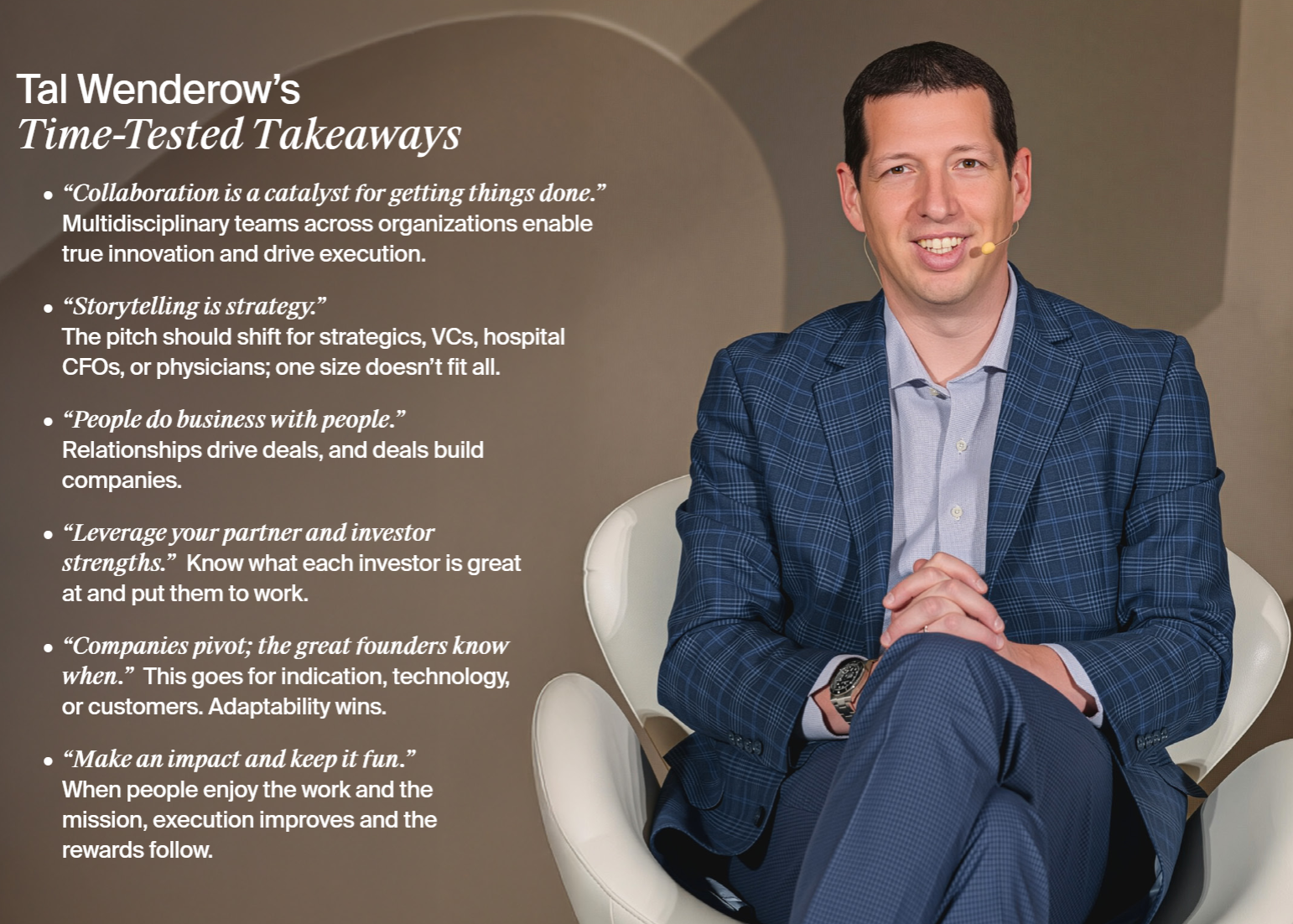
- “Collaboration is a catalyst for getting things done.”
Multidisciplinary teams across organizations enable true innovation and drive execution. - “Storytelling is strategy.”
The pitch should shift for strategics, VCs, hospital CFOs, or physicians; one size doesn’t fit all. - “People do business with people.”
Relationships drive deals, and deals build companies. - “Leverage your partner and investor strengths.”
Know what each investor is great at and put them to work. - “Companies pivot; the great founders know when.”
This goes for indication, technology, or customers. Adaptability wins. - “Make an impact and keep it fun.”
When people enjoy the work and the mission, execution improves and the rewards follow.
The Role of Community: Why LSI Matters

Wenderow is a self-described “ambassador” of Life Science Intelligence (LSI), the medtech conference platform where founders, investors, and strategics converge.
“LSI is the most inclusive community in our space,” he says. “It attracts not just startups, but real decision-makers. Strategics who don’t hide, investors who don’t send their analysts. And everyone stays. They talk, connect, and listen, and that’s rare.”
Star51 quietly celebrated its public debut at a reception at LSI USA ‘25 in Dana Point, a fitting start for a firm that prioritizes relationships over fanfare. Wenderow believes these connections are vital to startup success.
“If you want to get remembered by an investor, don’t just send a deck,” he advises. “Build a relationship. Make a connection. Talk about music, your kids, something human. That’s what sticks.”
The Bottom Line, and Sage Advice
Star51 Capital isn’t just investing in the future of medtech. It’s building it, in collaboration with the very institutions that will define it. With early validation from our anchors, deep strategic alignment, and a proven founder at the helm, the opportunity is as rare as the moment itself.
As of mid-2025, Star51 is moving forward with anchors onboard, additional investors in progress, its first fund investment identified, and a term sheet signed for one structured deal.
“Our model resonates because it aligns everyone, including the LPs, strategics, founders, and GPs, toward a common goal,” he continues. “Importantly, there is a reason many of us are in healthcare. Most of us carry a deep personal motivation and a story that inspires us to improve patient care and deliver better solutions to those who need them.”
As for advice to his 28-year-old self? “Keep dreaming, be persistent, and know it always takes longer than you think. Listen to mentors. The old way isn’t working, innovate this as well.”
Tal Wenderow, Managing Partner, Star51 Capital

With more than 25 years of industry experience, Mr. Wenderow holds multiple patents and is a recognized thought leader in the vascular interventions market. Prior to founding Star51 Capital, Wenderow served as a Venture Partner at the global medical device company Genesis MedTech, where he led investment activities.
Previously, Wenderow was the President & CEO of Vocalis Health, and prior to that, co-founded and was CEO of Corindus Vascular Robotics, acquired by Siemens Healthineers in 2019 for $1.1 billion.
He is also a member of the Board of Directors of Microbot Medical and serves on other private companies’ boards.
Wenderow holds a Bachelor of Science, Summa Cum Laude, in Mechanical Engineering from Technion in Israel, and completed the Executive Program at the Merage Foundation, Merage Business School, at the University of California, Irvine.
For more insights like this, subscribe to The Lens medtech magazine today.





Request Info

The Lens - Complimentary Issue
Subscription Includes

Global Medtech Market Analysis & Projections (MAP), 2021-2031
Published: 2023
Next Update: Q4 2024
Deliverables:



Global Surgical Procedure Volumes Dashboard, 2018-2029
Published: 2022
Next Update: Q2 2024
Deliverables:
United States Surgical Procedure Volumes, 2018-2029
Published: 2022
Next Update: Q2 2024
Deliverables:
Aesthetics, Global Surgical Procedure Volumes, 2018-2029
Published: 2022
Next Update: Q2 2024
Deliverables:
Cardio, Global Surgical Procedure Volumes, 2018-2029
Published: 2022
Next Update: Q2 2024
Deliverables:
ENT, Global Surgical Procedure Volumes, 2018-2029
Published: 2022
Next Update: Q2 2024
Deliverables:
General, Global Surgical Procedure Volumes, 2018-2029
Published: 2022
Next Update: Q2 2024
Deliverables:
Neuro, Global Surgical Procedure Volumes, 2018-2029
Published: 2022
Next Update: Q2 2024
Deliverables:
OB/GYN, Global Surgical Procedure Volumes, 2018-2029
Published: 2022
Next Update: Q2 2024
Deliverables:
Ophthalmology, Global Surgical Procedure Volumes, 2018-2029
Published: 2022
Next Update: Q2 2024
Deliverables:
Orthopedic, Global Surgical Procedure Volumes, 2018-2029
Published: 2022
Next Update: Q2 2024
Deliverables:
Peripheral Vascular, Global Surgical Procedure Volumes, 2018-2029
Published: 2022
Next Update: Q2 2024
Deliverables:
Spine, Global Surgical Procedure Volumes, 2018-2029
Published: 2022
Next Update: Q2 2024
Deliverables:
SRS, Global Surgical Procedure Volumes, 2018-2029
Published: 2022
Next Update: Q2 2024
Deliverables:
Urological, Global Surgical Procedure Volumes, 2018-2029
Published: 2022
Next Update: Q2 2024
Deliverables:
Global Markets for Hip Replacement Implants, 2023-2028
Published: 2023
Next Update: Q2 2024
Deliverables:
Global Markets for Peripheral Vascular Guidewires, 2023-2028
Published: 2023
Next Update: Q2 2024
Deliverables:
Global Markets for Peripheral Atherectomy Catheters, 2023-2028
Published: 2023
Next Update: Q2 2024
Deliverables:
Global Markets for Electrosurgery, 2023-2028
Published: 2023
Next Update: Q2 2024
Deliverables:
Global Markets for Peripheral Vascular Balloons & Vena Cava Filter, 2023-2028
Published: 2023
Next Update: Q2 2024
Deliverables:
Global Markets for Mechanical Heart Valves, 2023-2028
Published: 2023
Next Update: Q2 2024
Deliverables:
Global Markets for Tissue Heart Valve Replacement, 2023-2028
Published: 2023
Next Update: Q2 2030
Deliverables:
Global Markets for Transcatheter Mitral Valve Devices, 2023-2028
Published: 2023
Next Update: Q2 2024
Deliverables:
Global Markets for Femoral Closure, 2023-2029
Published: 2023
Next Update: Q2 2024
Deliverables:
Global Markets for Tricuspid Valve Repair, 2023-2028
Published: 2023
Next Update: Q2 2024
Deliverables:
Global Markets for Percutaneous Pulmonary Valves, 2023-2028
Published: 2023
Next Update: Q2 2024
Deliverables:
Global Markets for Coronary Angio Guidewires & Catheters, 2023-2028
Published: 2023
Next Update: Q2 2024
Deliverables:
Global Markets for Oncology Ablation Devices, 2023-2028
Published: 2023
Next Update: Q2 2024
Deliverables:
Global Markets for ENT Devices, 2023-2028
Published: 2023
Next Update: Q2 2024
Deliverables:
Global Markets for Cell Delivery Catheters, 2023-2028
Published: 2023
Next Update: Q3 2024
Deliverables:
Global Markets for Urology Devices, 2023-2028
Published: 2023
Next Update: Q3 2024
Deliverables:
Global Markets for External Pain Pumps, 2023-2028
Published: 2023
Next Update: Q3 2024
Deliverables:
Global Markets for Ureteral Access Devices, 2023-2028
Published: 2023
Next Update: Q3 2024
Deliverables:
Global Markets for Pelvic Floor Repair, 2023-2028
Published: 2023
Next Update: Q3 2024
Deliverables:
Global Markets for Atrial Fibrillation, 2023-2028
Published: 2023
Next Update: Q3 2024
Deliverables:
Global Markets for Neurovascular Devices Ischemic, 2023-2028
Published: 2023
Next Update: Q3 2024
Deliverables:
Global Markets for Neuromodulation Devices, 2023-2028
Published: 2023
Next Update: Q3 2024
Deliverables:
Global Markets for Vertebroplasty Devices, 2023-2028
Published: 2023
Next Update: Q3 2024
Deliverables:
Global Markets for Benign Prostation Hyperplasia Implants, 2023-2028
Published: 2023
Next Update: Q3 2024
Deliverables:
Global Markets for Cryoablation, 2023-2028
Published: 2023
Next Update: Q3 2024
Deliverables:
Global Markets for Diagnostic Electrophysiology Catheters, 2023-2028
Published: 2023
Next Update: Q3 2024
Deliverables:
Global Markets for Hernia Repair, 2023-2028
Published: 2023
Next Update: Q4 2024
Deliverables:
Global Markets for CRM Devices, 2023-2028
Published: 2023
Next Update: Q4 2024
Deliverables:
Global Markets for Neurovascular Devices Hemorrhagic, 2023-2028
Published: 2023
Next Update: Q4 2024
Deliverables:
Global Markets for Renal Denervation, 2023-2028
Published: 2023
Next Update: Q4 2024
Deliverables:
Global Markets for Upper+Lower Suture Anchors, 2023-2028
Published: 2023
Next Update: Q4 2024
Deliverables:
Global Markets for Peripheral Stents, 2023-2028
Published: 2023
Next Update: Q4 2024
Deliverables:
Global Markets for Electromagnetic Navigation Systems, 2023-2028
Published: 2023
Next Update: Q4 2024
Deliverables:
Global Markets for GI Endoscopy, 2023-2028
Published: 2023
Next Update: Q4 2024
Deliverables:
Global Markets for Hemodialysis, 2023-2028
Published: 2023
Next Update: Q4 2024
Deliverables:
Globals Markets for Cardiac Ablation, 2023-2028
Published:
Next Update:
Deliverables:
Global Markets for Atrial Septal Occlusion, 2023-2028
Published: 2023
Next Update: Q4 2024
Deliverables:
Global Markets for Aortic Grafts, 2023-2028
Published: 2023
Next Update: Q4 2024
Deliverables:
Global Markets for Interventional Cardiology Devices, 2023-2028
Published: 2023
Next Update: Q4 2024
Deliverables:
Global Markets for Oncology Embolization, 2023-2028
Published: 2023
Next Update: Q4 2024
Deliverables:
Global Markets for Vascular Access Devices, 2023-2028
Published: 2023
Next Update: Q4 2024
Deliverables:
Global Markets for Rotator Cuff Repair Suture Anchors, 2023-2028
Published: 2023
Next Update: Q4 2024
Deliverables:
Global Markets for Electrical Stimulation Devices, 2023-2028
Published: 2023
Next Update: Q4 2024
Deliverables:
Global Markets for Wearable Monitoring Devices, 2023-2028
Published: 2023
Next Update: Q4 2024
Deliverables:
Global Markets for Low Complexity Medical Devices, 2023-2028
Published: 2023
Next Update: Q4 2024
Deliverables:
Canada Surgical Procedure Volumes, 2018-2029
Published: 2022
Next Update: Q2 2024
Deliverables:
Germany Surgical Procedure Volumes, 2018-2029
Published: 2022
Next Update: Q2 2024
Deliverables:
France Surgical Procedure Volumes, 2018-2029
Published: 2022
Next Update: Q2 2024
Deliverables:
U.K. Surgical Procedure Volumes, 2018-2029
Published: 2022
Next Update: Q2 2024
Deliverables:
Italy Surgical Procedure Volumes, 2018-2029
Published: 2022
Next Update: Q2 2024
Deliverables:
Spain Surgical Procedure Volumes, 2018-2029
Published: 2022
Next Update: Q2 2024
Deliverables:
Poland Surgical Procedure Volumes, 2018-2029
Published: 2022
Next Update: Q2 2024
Deliverables:
Netherlands Surgical Procedure Volumes, 2018-2029
Published: 2022
Next Update: Q2 2024
Deliverables:
Belgium Surgical Procedure Volumes, 2018-2029
Published: 2022
Next Update: Q2 2024
Deliverables:
Sweden Surgical Procedure Volumes, 2018-2029
Published: 2022
Next Update: Q2 2024
Deliverables:
Switzerland Surgical Procedure Volumes, 2018-2029
Published: 2022
Next Update: Q2 2024
Deliverables:
Denmark Surgical Procedure Volumes, 2018-2029
Published: 2022
Next Update: Q2 2024
Deliverables:
Finland Surgical Procedure Volumes, 2018-2029
Published: 2022
Next Update: Q2 2024
Deliverables:
Norway Surgical Procedure Volumes, 2018-2029
Published: 2022
Next Update: Q2 2024
Deliverables:
China Surgical Procedure Volumes, 2018-2029
Published: 2022
Next Update: Q2 2024
Deliverables:
India Surgical Procedure Volumes, 2018-2029
Published: 2022
Next Update: Q2 2024
Deliverables:
Japan Surgical Procedure Volumes, 2018-2029
Published: 2022
Next Update: Q2 2024
Deliverables:
South Korea Surgical Procedure Volumes, 2018-2029
Published: 2022
Next Update: Q2 2024
Deliverables:
Australia Surgical Procedure Volumes, 2018-2029
Published: 2022
Next Update: Q2 2024
Deliverables:
Thailand Surgical Procedure Volumes, 2018-2029
Published: 2022
Next Update: Q2 2024
Deliverables:
Malaysia Surgical Procedure Volumes, 2018-2029
Published: 2022
Next Update: Q2 2024
Deliverables:
Singapore Surgical Procedure Volumes, 2018-2029
Published: 2022
Next Update: Q2 2024
Deliverables:
New Zealand Surgical Procedure Volumes, 2018-2029
Published: 2022
Next Update: Q2 2024
Deliverables:
Caribbean Surgical Procedure Volumes, 2018-2029
Published: 2022
Next Update: Q2 2024
Deliverables:
Argentina Surgical Procedure Volumes, 2018-2029
Published: 2022
Next Update: Q2 2024
Deliverables:
Colombia Surgical Procedure Volumes, 2018-2029
Published: 2022
Next Update: Q2 2024
Deliverables:
Chile Surgical Procedure Volumes, 2018-2029
Published: 2022
Next Update: Q2 2024
Deliverables:
Guatemala Surgical Procedure Volumes, 2018-2029
Published: 2022
Next Update: Q2 2024
Deliverables:
Dominican Republic Surgical Procedure Volumes, 2018-2029
Published: 2022
Next Update: Q2 2024
Deliverables:
Costa Rica Surgical Procedure Volumes, 2018-2029
Published: 2022
Next Update: Q2 2024
Deliverables:
Panama Surgical Procedure Volumes, 2018-2029
Published: 2022
Next Update: Q2 2024
Deliverables:
Mexico Surgical Procedure Volumes, 2018-2029
Published: 2022
Next Update: Q2 2024
Deliverables:
Brazil Surgical Procedure Volumes, 2018-2029
Published: 2022
Next Update: Q2 2024
Deliverables:
Turkey Surgical Procedure Volumes, 2018-2029
Published: 2022
Next Update: Q2 2024
Deliverables:
Russia Surgical Procedure Volumes, 2018-2029
Published: 2022
Next Update: Q2 2024
Deliverables:
South Africa Surgical Procedure Volumes, 2018-2029
Published: 2022
Next Update: Q2 2024
Deliverables:
Request Info
See Full Attendee List