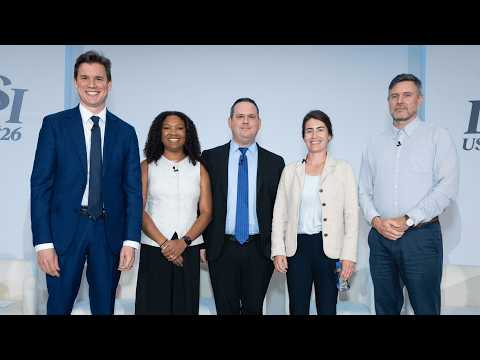
Peter Traianou 0:06
It's really unusual coming up here after the Singaporean group came in to say why Singapore and LSI Asia is in Singapore this year, and we're now talking about why Australia, I kind of feel like the guy at his best friend's wedding that decides to propose to his fiance. It's a bit that way, but we've got their permission, so we're good. Got a very, very distinguished panel experts in the Australian ecosystem. We'll go through if you want to introduce yourselves very briefly, Peter, I'll pass to you first Sure.
Peter Vranes 0:39
Peter Vrain, CEO, co founder of nutromix. We're a seven year old company based in Melbourne, Australia and San Diego.
Emily Casey 0:48
Excellent Emily. Emily Casey, I'm from a fund called 10 Mile. We are an Australian based and Australian focused Health Tech fund that does everything from digital health, Medtech, obviously, bio therapeutics. We have a focus on Australia, but also invest globally.
Matthew Frith 1:07
Fantastic. Matt, thanks, Peter. Matt Frith, the Chief Operating Officer at the Medtech actuator, where Asia Pacific's health venture catalyst. So we arrange run a range of programs to support innovators to more successfully commercialize their technologies,
Peter Traianou 1:21
suppose I better introduce myself as well. Peter trenu, I'm the president and CEO of a boutique advisory firm called emerging health connections. I wear many hats, including the chairman of veintek, a company that's presenting a little bit later today. I also work with the invest and Trade Commission of Western Australia in the Americas, helping West Australian companies land in the US, while trying to interact investment into the Australian ecosystem. So So with that, let's talk about the Australian ecosystem. What would you like to share with this audience about the Australian Medtech industry? Peter as a founder, someone that's had to build a company from a ground up. What are some of the highs and lows of doing that?
Peter Vranes 2:03
There's a few highs and lows over those years. Peter look, I think Australia is a great place to build a med tech company for a range of reasons. Number one, we have a fantastic research sector where consistently rated one of the best in the world, and that's that's a real engine room of talent, and that's really important. If you're going to build a successful mid tech company. You need access to that talent. And we do have that. We have a, you know, fantastic R D tax system that we all know about, where I think it's about 43, and a half percent of every r, d dollar comes back to us. So that's, that's very good the clinical trial space. We, we've, we've done clinical studies in the US. We've done them in Australia, and it is significantly cheaper to do them in Australia, apples for apples. So we find a lot of US companies come to Australia for that reason. So they're all really big pluses. But like anything, it's not all sort of roses. There are challenges we're not close to, you know, one of the world's biggest markets in the US or Europe. So that's a challenge for proximity capital. Capital is a challenge. So where our next round is a B round, which will be circa 45 million US dollars, plus we're starting to get outside the range of a lot of the Australian VCs at that stage. So most of most of the VCs that we're talking to now for our B round us VCs, we're in the US once a quarter, so we travel a lot. We're all and we need, by necessity, we always have to do that. So so pros and cons, but certainly a lot of a lot of good things that maybe a lot of people around the world don't realize about Australia in terms of building a Medtech company.
Peter Traianou 4:04
Excellent Peter, how much pressure do you have to maintain that Australian presence while outgrowing the investor ecosystem?
Peter Vranes 4:17
It's a good question. Pete, because we, you know, we're passionate Australians. We want to make this work in Australia. We've had, unfortunately, you know, examples of companies like saluted medical or Synchron that grew to a certain size and then went to the US. We lose so much in terms of jobs and growth from our country when that happens. And you know, some of our biggest success stories when we think about it, cochlea ResMed. They were founded in the 80s. It's been a long time since we had a really big North Star. So, so that's something that that we. Need as a nation to to put some things in place to prevent that. We have some good things. We have national reconstruction fund, $15 billion fund. We have breakthrough Victoria, where we're from, in Victoria, it's a $2 billion fund. But there you go. There's challenges in the way that that that's that that money is is given out and invested into companies. So there's opportunities there, and we try, we want to make this work in Australia, obviously, and we're going to do our best to try and do that.
Peter Traianou 5:34
Excellent. Emily, transitioning to you, the investor community is really critical to fuel the growth, right? You could build a Ferrari when it comes to to an ecosystem that actually is developing technology, but capital fuels that car. How do you from, from the investors perspective, look at that Australian ecosystem and what's available? There
Emily Casey 5:58
no completely. We all know that you always need capital, and there's almost an internal shortage of it, but that's actually why 10 Mile came into existence about two and a half years ago, because of the opportunity that we recognize, and a lot of people recognize, in the market that is Australia. Unfortunately, there's only two dedicated health funds in Australia. There's a few other smaller ones that have popped up in biotech and quite a lot of university based funds that do deep tech and spin outs, but there still is a general lack of capital. But on the flip side, there's still more than ever, particularly with the new government edition funds, which is great, and as a result, it means that there's all these interesting projects and or spin UPS kind of coming out, and it is a really ripe market to invest in at quite an attractive price in a lot of instances. And we've sort of seen a lot of the talent continue to build, with more companies that are scaling up, and more and more people focusing on health and life sciences, tech development, devices and engineering, it's really providing quite an interesting growing ecosystem. But that being said, we have quite a few companies that also hit kind of the Series A, Series B, ceiling or the valley of death, as everyone sort of knows, and so we do need more funding, but what I would pose as an opportunity is for overseas investors, overseas businesses, to come to Australia. You can actually get some good pieces of really high quality companies at earlier stages, or even hire really good talent for a much cheaper price, as well as have all these attractive tax R and D incentives and government support. There's a lot of non dilutive grants and things at the earlier stages that can really provide a good place to set up for success. So it's definitely challenging. We would always love more money, but I think we're seeing a lot of companies come through the pipeline, and I'm sure we'll continue to see a lot more.
Peter Traianou 7:59
So Emily, we've had the opportunity to chat to investors who are deploying global funds, and they're looking at Australia as a potential location to deploy those funds. You as an existing Australian VC. How do you see that play out in real life? Is it competition? Is it accretive?
Emily Casey 8:22
Look, I think it's, it's definitely a partnership style model, right? It's always hard to invest in things unless you are on the ground and seeing things up up in real view. So we've started forming more and more international syndicates. We've even seen a lot of companies that other investors have brought to us from overseas that are looking to perhaps explore Australia, and we've helped them set up or get connected with the right people, and they've been able to establish really cost efficient operations, which is really great. Like one of our companies, proton Intel, they do continuous potassium monitoring. They were originally based in Vancouver. They now set up a Melbourne office, which is great, and are able to do their clinical trials much faster and much cheaper, which is wonderful. And we're sort of forming more and more of these syndication partners. So if anyone is interested, always happy to chat. We love to share deal flow. I think there is, there is too many companies for us to service alone. And though we love working with other collaborators, and I think most of the ecosystem is like that. It has to be rising tide lifts all boats. Situation. Otherwise, we're all doomed. So I think we're all very dedicated to helping Australia flourish, and selfishly, then we'll see better commercial outcomes. Too
Peter Traianou 9:32
awesome. And if you had to break it down, how much of your funding goes into early stage, through, ramp up, through, ready to commercialize?
Emily Casey 9:40
Ooh, that's a ever evolving question. So we are only two and a half years old, but we now have 24 portfolio companies. Our sweet spot tends to be seed to series A That being said, we're actually doing a lot more incubations and early spin outs, just because we've sort of recognized that there is so much Tech with potential. And if we can help bring the right pieces and find the right pieces as well, which often are overseas, then we can help ramp them up, so definitely skewed a bit earlier, with a few growth stage companies and always open to exploring the right opportunity.
Peter Traianou 10:15
And one more for you, there's a lot of wealth in Australia. There's a lot of high net worth individuals, family offices that have made their money in either mining or property, who are interested in investing in Medtech, but really don't know how what sort of advice would you give them? Oh,
Emily Casey 10:33
yes, this is one of my favorite pet projects. You could say I also, with my other heart, run a one of the biggest health tech communities in the country, called what the health which is about 10,000 individuals with a whole host of family offices and VCs from all different areas. And the thing we often see is people are interested in the area, but obviously there is a bit of a high barrier to entry in terms of knowledge, getting to know the science and getting that confidence. So we've started to act as a bit of a partner. And I would encourage, obviously, anyone going into a new space to find trusted partners, work with them, make sure you feel comfortable, and then once you figure out a rhythm that works for you, you can then take that jump. I think what we're seeing as well, generally in VC period is that tech no longer has a huge barrier to entry, but things like med tech and biotech, as we all know, has the IP mode, and it's a bit harder. So I think a lot of VCs, a lot of high net worths, are turning their attention to health and med tech and Life Sciences, which is wonderful, and I'm sure it will continue to be that way. So please come chat if it's of interest.
Peter Traianou 11:41
Excellent, Matt. You get to see both sides of the equation. Your role is to connect founders and investors and all parts of the ecosystem. How would you describe the Australian ecosystem to someone that may have never experienced it?
Matthew Frith 11:55
Sure, I think the other guys have touched on a lot of the key points. I'll probably build on that maybe a few more from my perspective, but yeah. I mean, we've got a long history of very profound innovation being founded in Australia. So great source of r, d and technology, fantastic research talent innovations like, somewhat controversially, the Wi Fi and penicillin and all these fantastic innovations, even the torpedo and the pacemaker and so all created in Australia. So great destination for the creation of new IP. But yeah, it's challenging around getting those to go a little bit further. The lack of capital is one of those things. So you're right. We sit at the center of managing that supply and demand, if you like. So looking to try and work with whether it be governments, existing investors, or creating our own fund, also, as nem said, to try and bring some more risk capital to support the innovators that are coming up with these new, amazing technologies. So both that supply of capital, and it's true, everyone will always say there's not enough capital, but it's really true in Australia, so there's a fair shortage of early risk capital to support. And then on the demand side, we obviously do a lot of work in preparing the founders, because they also have to be ready to raise capital. Know how to do that and engage with investors better. So all of our time is spent on not just running acceleration programs, but getting them ready with the right investment documents. So data rooms, deal rooms, knowing how to pitch, knowing how to engage, not just running a pitch competition or, you know, getting, getting those sorts of things together. So, yeah, we we sit in the middle of that, we see a lot of great advantage. I think, of course, the capital is one of those opportunities for advantage. But and leveraging all of the things that guys said around R and D tax is a good element of Australia. I mean two more elements. We are a great commercial landing pad as well. So in addition to having all those fantastic financial benefits, which are in and of themselves, should be incentive enough to come into very economical clinical studies. So as an investor, you want to see your capital be deployed as efficiently as possible towards the right value, adding activities and doing clinical studies in Australia help helps you do that. But equally, if you're an early stage company and looking to come to a market, that's a good stepping stone to the US. It's a good market to commercialize in as well. And the third point I took about Australia, we're fun as well, right? So there's all this serious stuff around the business. But who doesn't want to live in that environment? I think we have a good approach to life and balancing out, you know, working hard. I think we have a reputation of being relaxed and laid back, and we make jokes of everything. And so we tend to have a good sense of humor, which I think is a wonderful element of our culture. But, you know, we are at that don't let that fool you. We are quite serious, and we we know how to look at a good deal, and we know how to do things well commercially, but I think we like to balance that work with play and enjoy life as well. Excellent.
Peter Traianou 14:56
Often companies come into this space and. Their North Star is we actually have to conquer the US to conquer this market. And we all agree that the US is the biggest market in Medtech. But let's face it, Asia Pacific is the fastest growing given that how does Australia fit in to an Asia Pacific strategy, not just for investors, but for companies. It on the company side. How would you
Peter Vranes 15:27
advise? That's a great question, Peter, and maybe one that we perhaps haven't gone deep enough ourselves to be honest, we are very we're very US centric for a reason, because to do what we do requires a certain amount of capital. So to justify that capital, we need a big market to do that. However a we will be launching early into Australia using the Early Access Program. That's not a revenue generating rational that's really cutting our teeth from a commercial perspective at a smaller market. And I think to Matt's point, you'll bring you're talking about that a little bit before that's actually not a bad idea. You're not doing because economically, you're going to make a lot of money. You're doing it because you you, before you enter that big market, you want to make sure that you're entering it a bit battle tested, and you can do that in Australia, so it's a great testing ground for that perspective. And that's one of the reasons we're doing that. So from, yeah, but from, from to answer your question, that there are a lot of opportunities, the challenge for a small company is, is knowing is focus, because there's lots of opportunities and and at some point you need to pick one and just focus on that and execute really well on that and the others opportunity, other opportunities will come down the track, but you can't chase them all.
Peter Traianou 17:09
You and I had a real good chat about that the other day, and one of the things that you mentioned to me was that small company CEOs really struggle to raise capital because they really don't know. How is that? Because there's a lack of focus. They're juggling too many balls in the air.
Peter Vranes 17:31
I don't think any entrepreneurs start the journey because they love raising capital. That's That's a necessity, but it's not what people get passionate about. They get passionate about a product, a service, solving a problem. That's what they want to do. That's great, but not when it comes to raising capital. Because you have to be elite. If you're the CEO of a Medtech company, your first job is do not run out of money. That's your first job. So you want to get passionate about it pretty fast. And you're maybe not passionate about it, but you you just, you just got to put a lot of energy, effort and time into capital raising. And that's what last night I was, I was talking about, that the importance of always, you're always capital raising. It's just the intensity that changes so and that's just a learned behavior that that doesn't always come naturally, because you don't start that. Your journey to do that, you start the journey to build a product. So I understand you get pulled in this other direction, but you know, a lot of companies go under not because they don't have a great product, it's just because they simply run out of money.
Peter Traianou 18:46
So Emily, with that in mind, given that whole philosophy around the Asia Pacific region being the fastest growing, why should investors really care about where they deploy their capital in Asia Pacific?
Emily Casey 19:01
Look, I think while APAC is sort of one of the fastest growing markets, it is still quite a fragmented market, right? And so you do have to tackle it piece by piece. And I think what we've observed in terms of companies coming to Australia or investors looking to deploy usually, Australia can be often a really safe landing ground. It may not always be the biggest market commercially, but with the tax R and D incentive, with a lot of the government incentives for setting up over there, the cost of clinical trials, it makes often a really friendly environment to set up in, not to mention, if you're coming from, say, the US or the UK or Europe, it's quite culturally similar as well. So I think that provides a really big advantage. And I would say that's probably the biggest advantage for Australia, not to mention the research. That is literally one of the hardest topics in terms of the media at the moment, in terms of R and D and why aren't we commercializing. It, and it's nothing new whatsoever. However, there still seems to be some part of the process that's failing, and my guess is it's a bit of talent and a bit of capital and focus. Ironically, sometimes you try to boil the ocean with a small amount of capital, what it may feel like a big amount, but a couple of million really isn't and I think we also need to just make sure that teams and companies are really focused in those early stages to know what their pathway is, what their regulatory barriers are, what their reimbursement pathways might be. Because I think in Australia, we have an awesome amount of tech, but unless you apply that commercial lens, you aren't going to succeed and see the growth which we require. So I think that, in itself, is a big learning that the market has undergone and has built capacity in and continues to with great programs like the actuator and other funds and incubators and such from most research institutes. So I think there's a lot of opportunity in that space.
Peter Traianou 21:04
Yeah, and Matt, you, you and I spoke about, you know, the Asia Pacific region and Australia, and how Australia fits into that Asia Pacific region. Yeah, you know, if you want to share with the audience your thoughts around that,
Matthew Frith 21:15
sure, absolutely. I think a couple of additional points just to think about Australia and picking up. It is relatively a smaller market, absolutely, particularly in terms of volume, but in terms of health care spend per capita, it's still quite a developed market where the government spends quite significant with a well, and yeah, broad, broad, universal health care and other things that mean there's a quite a high proportion of spending, even things like the National Disability Insurance Scheme, which is huge finding. We've seen Japanese companies come and look to commercialize on the basis of that reimbursement scheme. So there is some fantastic opportunities. The other thing would be geographically, I'd say, if you're looking to test a remote technology or looking for in home care, if you can get it to work in Australia, particularly states like Western Australia, if you can get it to work in those regions, you can get it to work anywhere in the world. It's hard for people to comprehend just the size of the land mass and the need in remote areas. But to test those types of technologies, if you can prove that use case in Australia, you could probably get it to work anywhere in the world. But more broadly, getting back to the question around where it fits as part of APAC strategy. So I mean, Pete spoke about this, reflecting on the journey of Nutromics. I guess our advice to companies is to think about a think global from day one. So you need growth, a sharp focus on market. Of course, you need beach head, but it's about those building blocks we're getting there. So be strategic, about thinking around different markets, or leveraging the strengths of different markets. Just because you're looking to commercialize in the US doesn't mean you don't pick a stepping stones to get there. So is a roadmap of how you're going to get to the US. It may be sometimes it's the right strategy to go directly to the USA. Or if you're coming from the USA, maybe you're thinking to go directly to a bigger market, like Japan or something like that, but it's very tricky, like there are culturally opposite ends of the spectrum, so thinking strategically about that and trying to take some stepping stones to where you're towards your eventual market is something that we advise people to do. So it's a it's a tricky balance there, right? Because you've got to maintain focus. I mean, we often get this with startups talking about market size, you know, we say to them, you have to sell the big vision, right? Definitely got to get investors excited about a big market. But equally, you need to show that you've got razor sharp focus on step one and step two and how you're going to get to that big market. So, yeah, so Australia is a great stepping stone. So thinking, a couple of programs we run. We've run programs being in companies from Europe into the APAC region, landing in both Singapore and Australia. And the value propositions for those markets are quite different. So Singapore is pretty small. They're not really coming in for the market, although it can still be a good market. So we say small, but for us, a startup looking for first revenue, it's still an okay market. So, so that's fine, but there's obviously fantastic advantages to being based in Singapore. Great commercial environment, great structuring environment, geography, all the benefits that make sense and I won't take, I mean, the last panel would have covered all of this off. So spend time sharing with our friends some of the benefits of being in Singapore and respectful of where we're sitting today. But yeah, in Australia, there's, there's great benefits to doing that as well, and and to, you know, coming out and leveraging the research environment. We spoke about some of the leading clinicians and researchers. I mentioned some of those technologies, amazing, leveraging those tax advantages, levering the remote environment, and equally, again, it's a reasonable size market as a stepping stone towards getting to the US. So that's how we position it for companies coming from Europe into a pack, and even from Japan, where they're coming out and coming into Australia, why they would do that? And from the US coming out? I think, yes, Singapore is great, but Australia is also a fantastic place to land. So you can start to be amongst friends. Questions, amongst allies, amongst someone that's culturally similar, which we all understand. When you're doing business, you do business with people. So it's nice to feel that connection in somewhere that's a bit familiar, as you're starting to get into this APAC region, because, as Emily mentioned, each market is incredibly different, like Indonesia, from Japan to Singapore. It's seen as Asia, but it's culturally very different. Has different requirements. So being somewhere you can be based that's a bit familiar, whilst you're starting to think about your plan for attacking each of those markets is a good benefit to Australia as well. Excellent.
Peter Traianou 25:37
I want to touch on something you said about the remote monitoring, something that Australia is really strong at, is the mining industry. And we can take a lot of lessons from that. In Western Australia, it's industry leading being able to control these massive haul packs from an office downtown in Perth. And I think I said the minister over there, I think we had people from NASA come to have a look at this, this setup. So there's things in Australia that we do at a world class standard that are translatable into the med tech space. And another thing to consider, as an investor, we talk about some of the opportunities there. I love to tell the story about, if you're a US investor, and you've got a million dollars, I can magically turn that into $2.3 million because of the exchange rate, we're going from one to 1.6 million Australian dollars now, and with the 43 and a half percent R and D tax rebate, we now got you up to 2.3 $2.4 million so your money does go a lot further in Australia. One last thing for everybody, starting from Pete, working down, what's the biggest opportunity for either an investor or a company that you want them to think about? About looking at Australia,
Peter Vranes 26:56
that's good question. If I put my investor hat on Pete,
Emily Casey 27:01
stealing my thunder. Pete,
Peter Vranes 27:03
thank you forgive me for letting me go first. I would say, if I was, if I was a VC, I'm looking for, looking for the 1% I'm looking for the ones that that everyone's missed and I can pick up because I'm skillful enough, and I'm at the right place at the right right time, and I can get that unicorn early. And, yeah, that's what they called it. Was it the dragon, the one that pays for your whole fund. In the US, you have a lot of companies, and you have a lot of investors, you have a lot of focus. I always think that in Australia, where just so far away from everyone that the lens is different than what the lens is in the US, and the chances of picking up a that unicorn is actually much greater just because you don't have the eyes that you do in the US. And I know VCs that have been created with literally that strategy in mind, that we do not look at us because there are 1000 eyes on those companies, and we're going where everyone isn't going. And to date, they've been quite successful with that strategy. So I think there's actually a lot to be said for that, that looking beyond where everyone else is looking may not be a bad strategy.
Peter Traianou 28:25
Awesome. Emily, do you want to put the company hat
Emily Casey 28:28
on? Oh, well, I know it'll be the talent and tax R and D credits, but coming back to the investor side, I really do think there is an abundance of interesting research. The government has thrown so much money at it, and a lot of private stakeholders have too. And I think you can find really well priced early stage companies that will be a great deal, and also are looking for the expertise and support that just frankly, we don't yet have in Australia, at least at scale in a lot of cases. And whilst we would love to see all these companies fulfill their full life cycle in Australia. It may not be possible, yet. We're realistic about that, and they may have to go overseas, but that's why we need great partners who know the markets have the capital, and there's other things to help them go overseas, and I truly believe there are some incredible companies that will create great returns bring us home.
Peter Traianou 29:19
Matt,
Matthew Frith 29:19
okay, so apart from, we're out of time, so I'll wrap up really quickly, but apart from having a bunch of fun, getting some hard work done, I think quite practically, with if you're a company, it's also less competitive. So if you go into the states, there's a lot of startups competing. Yes, there's more funding, but there's also more competition for that funding. So if you've got a great innovation as well, and you're looking to stand out, then you could probably do that with less competition in Australia,
Peter Traianou 29:42
and I wouldn't worry about going over time. We're Australian, we're always the first to your party. We're always the last one to leave. Thank you everybody.
Matthew Frith 29:49
Thank you.
Peter Traianou 29:50
Thank you.
Peter Traianou 0:06
It's really unusual coming up here after the Singaporean group came in to say why Singapore and LSI Asia is in Singapore this year, and we're now talking about why Australia, I kind of feel like the guy at his best friend's wedding that decides to propose to his fiance. It's a bit that way, but we've got their permission, so we're good. Got a very, very distinguished panel experts in the Australian ecosystem. We'll go through if you want to introduce yourselves very briefly, Peter, I'll pass to you first Sure.
Peter Vranes 0:39
Peter Vrain, CEO, co founder of nutromix. We're a seven year old company based in Melbourne, Australia and San Diego.
Emily Casey 0:48
Excellent Emily. Emily Casey, I'm from a fund called 10 Mile. We are an Australian based and Australian focused Health Tech fund that does everything from digital health, Medtech, obviously, bio therapeutics. We have a focus on Australia, but also invest globally.
Matthew Frith 1:07
Fantastic. Matt, thanks, Peter. Matt Frith, the Chief Operating Officer at the Medtech actuator, where Asia Pacific's health venture catalyst. So we arrange run a range of programs to support innovators to more successfully commercialize their technologies,
Peter Traianou 1:21
suppose I better introduce myself as well. Peter trenu, I'm the president and CEO of a boutique advisory firm called emerging health connections. I wear many hats, including the chairman of veintek, a company that's presenting a little bit later today. I also work with the invest and Trade Commission of Western Australia in the Americas, helping West Australian companies land in the US, while trying to interact investment into the Australian ecosystem. So So with that, let's talk about the Australian ecosystem. What would you like to share with this audience about the Australian Medtech industry? Peter as a founder, someone that's had to build a company from a ground up. What are some of the highs and lows of doing that?
Peter Vranes 2:03
There's a few highs and lows over those years. Peter look, I think Australia is a great place to build a med tech company for a range of reasons. Number one, we have a fantastic research sector where consistently rated one of the best in the world, and that's that's a real engine room of talent, and that's really important. If you're going to build a successful mid tech company. You need access to that talent. And we do have that. We have a, you know, fantastic R D tax system that we all know about, where I think it's about 43, and a half percent of every r, d dollar comes back to us. So that's, that's very good the clinical trial space. We, we've, we've done clinical studies in the US. We've done them in Australia, and it is significantly cheaper to do them in Australia, apples for apples. So we find a lot of US companies come to Australia for that reason. So they're all really big pluses. But like anything, it's not all sort of roses. There are challenges we're not close to, you know, one of the world's biggest markets in the US or Europe. So that's a challenge for proximity capital. Capital is a challenge. So where our next round is a B round, which will be circa 45 million US dollars, plus we're starting to get outside the range of a lot of the Australian VCs at that stage. So most of most of the VCs that we're talking to now for our B round us VCs, we're in the US once a quarter, so we travel a lot. We're all and we need, by necessity, we always have to do that. So so pros and cons, but certainly a lot of a lot of good things that maybe a lot of people around the world don't realize about Australia in terms of building a Medtech company.
Peter Traianou 4:04
Excellent Peter, how much pressure do you have to maintain that Australian presence while outgrowing the investor ecosystem?
Peter Vranes 4:17
It's a good question. Pete, because we, you know, we're passionate Australians. We want to make this work in Australia. We've had, unfortunately, you know, examples of companies like saluted medical or Synchron that grew to a certain size and then went to the US. We lose so much in terms of jobs and growth from our country when that happens. And you know, some of our biggest success stories when we think about it, cochlea ResMed. They were founded in the 80s. It's been a long time since we had a really big North Star. So, so that's something that that we. Need as a nation to to put some things in place to prevent that. We have some good things. We have national reconstruction fund, $15 billion fund. We have breakthrough Victoria, where we're from, in Victoria, it's a $2 billion fund. But there you go. There's challenges in the way that that that's that that money is is given out and invested into companies. So there's opportunities there, and we try, we want to make this work in Australia, obviously, and we're going to do our best to try and do that.
Peter Traianou 5:34
Excellent. Emily, transitioning to you, the investor community is really critical to fuel the growth, right? You could build a Ferrari when it comes to to an ecosystem that actually is developing technology, but capital fuels that car. How do you from, from the investors perspective, look at that Australian ecosystem and what's available? There
Emily Casey 5:58
no completely. We all know that you always need capital, and there's almost an internal shortage of it, but that's actually why 10 Mile came into existence about two and a half years ago, because of the opportunity that we recognize, and a lot of people recognize, in the market that is Australia. Unfortunately, there's only two dedicated health funds in Australia. There's a few other smaller ones that have popped up in biotech and quite a lot of university based funds that do deep tech and spin outs, but there still is a general lack of capital. But on the flip side, there's still more than ever, particularly with the new government edition funds, which is great, and as a result, it means that there's all these interesting projects and or spin UPS kind of coming out, and it is a really ripe market to invest in at quite an attractive price in a lot of instances. And we've sort of seen a lot of the talent continue to build, with more companies that are scaling up, and more and more people focusing on health and life sciences, tech development, devices and engineering, it's really providing quite an interesting growing ecosystem. But that being said, we have quite a few companies that also hit kind of the Series A, Series B, ceiling or the valley of death, as everyone sort of knows, and so we do need more funding, but what I would pose as an opportunity is for overseas investors, overseas businesses, to come to Australia. You can actually get some good pieces of really high quality companies at earlier stages, or even hire really good talent for a much cheaper price, as well as have all these attractive tax R and D incentives and government support. There's a lot of non dilutive grants and things at the earlier stages that can really provide a good place to set up for success. So it's definitely challenging. We would always love more money, but I think we're seeing a lot of companies come through the pipeline, and I'm sure we'll continue to see a lot more.
Peter Traianou 7:59
So Emily, we've had the opportunity to chat to investors who are deploying global funds, and they're looking at Australia as a potential location to deploy those funds. You as an existing Australian VC. How do you see that play out in real life? Is it competition? Is it accretive?
Emily Casey 8:22
Look, I think it's, it's definitely a partnership style model, right? It's always hard to invest in things unless you are on the ground and seeing things up up in real view. So we've started forming more and more international syndicates. We've even seen a lot of companies that other investors have brought to us from overseas that are looking to perhaps explore Australia, and we've helped them set up or get connected with the right people, and they've been able to establish really cost efficient operations, which is really great. Like one of our companies, proton Intel, they do continuous potassium monitoring. They were originally based in Vancouver. They now set up a Melbourne office, which is great, and are able to do their clinical trials much faster and much cheaper, which is wonderful. And we're sort of forming more and more of these syndication partners. So if anyone is interested, always happy to chat. We love to share deal flow. I think there is, there is too many companies for us to service alone. And though we love working with other collaborators, and I think most of the ecosystem is like that. It has to be rising tide lifts all boats. Situation. Otherwise, we're all doomed. So I think we're all very dedicated to helping Australia flourish, and selfishly, then we'll see better commercial outcomes. Too
Peter Traianou 9:32
awesome. And if you had to break it down, how much of your funding goes into early stage, through, ramp up, through, ready to commercialize?
Emily Casey 9:40
Ooh, that's a ever evolving question. So we are only two and a half years old, but we now have 24 portfolio companies. Our sweet spot tends to be seed to series A That being said, we're actually doing a lot more incubations and early spin outs, just because we've sort of recognized that there is so much Tech with potential. And if we can help bring the right pieces and find the right pieces as well, which often are overseas, then we can help ramp them up, so definitely skewed a bit earlier, with a few growth stage companies and always open to exploring the right opportunity.
Peter Traianou 10:15
And one more for you, there's a lot of wealth in Australia. There's a lot of high net worth individuals, family offices that have made their money in either mining or property, who are interested in investing in Medtech, but really don't know how what sort of advice would you give them? Oh,
Emily Casey 10:33
yes, this is one of my favorite pet projects. You could say I also, with my other heart, run a one of the biggest health tech communities in the country, called what the health which is about 10,000 individuals with a whole host of family offices and VCs from all different areas. And the thing we often see is people are interested in the area, but obviously there is a bit of a high barrier to entry in terms of knowledge, getting to know the science and getting that confidence. So we've started to act as a bit of a partner. And I would encourage, obviously, anyone going into a new space to find trusted partners, work with them, make sure you feel comfortable, and then once you figure out a rhythm that works for you, you can then take that jump. I think what we're seeing as well, generally in VC period is that tech no longer has a huge barrier to entry, but things like med tech and biotech, as we all know, has the IP mode, and it's a bit harder. So I think a lot of VCs, a lot of high net worths, are turning their attention to health and med tech and Life Sciences, which is wonderful, and I'm sure it will continue to be that way. So please come chat if it's of interest.
Peter Traianou 11:41
Excellent, Matt. You get to see both sides of the equation. Your role is to connect founders and investors and all parts of the ecosystem. How would you describe the Australian ecosystem to someone that may have never experienced it?
Matthew Frith 11:55
Sure, I think the other guys have touched on a lot of the key points. I'll probably build on that maybe a few more from my perspective, but yeah. I mean, we've got a long history of very profound innovation being founded in Australia. So great source of r, d and technology, fantastic research talent innovations like, somewhat controversially, the Wi Fi and penicillin and all these fantastic innovations, even the torpedo and the pacemaker and so all created in Australia. So great destination for the creation of new IP. But yeah, it's challenging around getting those to go a little bit further. The lack of capital is one of those things. So you're right. We sit at the center of managing that supply and demand, if you like. So looking to try and work with whether it be governments, existing investors, or creating our own fund, also, as nem said, to try and bring some more risk capital to support the innovators that are coming up with these new, amazing technologies. So both that supply of capital, and it's true, everyone will always say there's not enough capital, but it's really true in Australia, so there's a fair shortage of early risk capital to support. And then on the demand side, we obviously do a lot of work in preparing the founders, because they also have to be ready to raise capital. Know how to do that and engage with investors better. So all of our time is spent on not just running acceleration programs, but getting them ready with the right investment documents. So data rooms, deal rooms, knowing how to pitch, knowing how to engage, not just running a pitch competition or, you know, getting, getting those sorts of things together. So, yeah, we we sit in the middle of that, we see a lot of great advantage. I think, of course, the capital is one of those opportunities for advantage. But and leveraging all of the things that guys said around R and D tax is a good element of Australia. I mean two more elements. We are a great commercial landing pad as well. So in addition to having all those fantastic financial benefits, which are in and of themselves, should be incentive enough to come into very economical clinical studies. So as an investor, you want to see your capital be deployed as efficiently as possible towards the right value, adding activities and doing clinical studies in Australia help helps you do that. But equally, if you're an early stage company and looking to come to a market, that's a good stepping stone to the US. It's a good market to commercialize in as well. And the third point I took about Australia, we're fun as well, right? So there's all this serious stuff around the business. But who doesn't want to live in that environment? I think we have a good approach to life and balancing out, you know, working hard. I think we have a reputation of being relaxed and laid back, and we make jokes of everything. And so we tend to have a good sense of humor, which I think is a wonderful element of our culture. But, you know, we are at that don't let that fool you. We are quite serious, and we we know how to look at a good deal, and we know how to do things well commercially, but I think we like to balance that work with play and enjoy life as well. Excellent.
Peter Traianou 14:56
Often companies come into this space and. Their North Star is we actually have to conquer the US to conquer this market. And we all agree that the US is the biggest market in Medtech. But let's face it, Asia Pacific is the fastest growing given that how does Australia fit in to an Asia Pacific strategy, not just for investors, but for companies. It on the company side. How would you
Peter Vranes 15:27
advise? That's a great question, Peter, and maybe one that we perhaps haven't gone deep enough ourselves to be honest, we are very we're very US centric for a reason, because to do what we do requires a certain amount of capital. So to justify that capital, we need a big market to do that. However a we will be launching early into Australia using the Early Access Program. That's not a revenue generating rational that's really cutting our teeth from a commercial perspective at a smaller market. And I think to Matt's point, you'll bring you're talking about that a little bit before that's actually not a bad idea. You're not doing because economically, you're going to make a lot of money. You're doing it because you you, before you enter that big market, you want to make sure that you're entering it a bit battle tested, and you can do that in Australia, so it's a great testing ground for that perspective. And that's one of the reasons we're doing that. So from, yeah, but from, from to answer your question, that there are a lot of opportunities, the challenge for a small company is, is knowing is focus, because there's lots of opportunities and and at some point you need to pick one and just focus on that and execute really well on that and the others opportunity, other opportunities will come down the track, but you can't chase them all.
Peter Traianou 17:09
You and I had a real good chat about that the other day, and one of the things that you mentioned to me was that small company CEOs really struggle to raise capital because they really don't know. How is that? Because there's a lack of focus. They're juggling too many balls in the air.
Peter Vranes 17:31
I don't think any entrepreneurs start the journey because they love raising capital. That's That's a necessity, but it's not what people get passionate about. They get passionate about a product, a service, solving a problem. That's what they want to do. That's great, but not when it comes to raising capital. Because you have to be elite. If you're the CEO of a Medtech company, your first job is do not run out of money. That's your first job. So you want to get passionate about it pretty fast. And you're maybe not passionate about it, but you you just, you just got to put a lot of energy, effort and time into capital raising. And that's what last night I was, I was talking about, that the importance of always, you're always capital raising. It's just the intensity that changes so and that's just a learned behavior that that doesn't always come naturally, because you don't start that. Your journey to do that, you start the journey to build a product. So I understand you get pulled in this other direction, but you know, a lot of companies go under not because they don't have a great product, it's just because they simply run out of money.
Peter Traianou 18:46
So Emily, with that in mind, given that whole philosophy around the Asia Pacific region being the fastest growing, why should investors really care about where they deploy their capital in Asia Pacific?
Emily Casey 19:01
Look, I think while APAC is sort of one of the fastest growing markets, it is still quite a fragmented market, right? And so you do have to tackle it piece by piece. And I think what we've observed in terms of companies coming to Australia or investors looking to deploy usually, Australia can be often a really safe landing ground. It may not always be the biggest market commercially, but with the tax R and D incentive, with a lot of the government incentives for setting up over there, the cost of clinical trials, it makes often a really friendly environment to set up in, not to mention, if you're coming from, say, the US or the UK or Europe, it's quite culturally similar as well. So I think that provides a really big advantage. And I would say that's probably the biggest advantage for Australia, not to mention the research. That is literally one of the hardest topics in terms of the media at the moment, in terms of R and D and why aren't we commercializing. It, and it's nothing new whatsoever. However, there still seems to be some part of the process that's failing, and my guess is it's a bit of talent and a bit of capital and focus. Ironically, sometimes you try to boil the ocean with a small amount of capital, what it may feel like a big amount, but a couple of million really isn't and I think we also need to just make sure that teams and companies are really focused in those early stages to know what their pathway is, what their regulatory barriers are, what their reimbursement pathways might be. Because I think in Australia, we have an awesome amount of tech, but unless you apply that commercial lens, you aren't going to succeed and see the growth which we require. So I think that, in itself, is a big learning that the market has undergone and has built capacity in and continues to with great programs like the actuator and other funds and incubators and such from most research institutes. So I think there's a lot of opportunity in that space.
Peter Traianou 21:04
Yeah, and Matt, you, you and I spoke about, you know, the Asia Pacific region and Australia, and how Australia fits into that Asia Pacific region. Yeah, you know, if you want to share with the audience your thoughts around that,
Matthew Frith 21:15
sure, absolutely. I think a couple of additional points just to think about Australia and picking up. It is relatively a smaller market, absolutely, particularly in terms of volume, but in terms of health care spend per capita, it's still quite a developed market where the government spends quite significant with a well, and yeah, broad, broad, universal health care and other things that mean there's a quite a high proportion of spending, even things like the National Disability Insurance Scheme, which is huge finding. We've seen Japanese companies come and look to commercialize on the basis of that reimbursement scheme. So there is some fantastic opportunities. The other thing would be geographically, I'd say, if you're looking to test a remote technology or looking for in home care, if you can get it to work in Australia, particularly states like Western Australia, if you can get it to work in those regions, you can get it to work anywhere in the world. It's hard for people to comprehend just the size of the land mass and the need in remote areas. But to test those types of technologies, if you can prove that use case in Australia, you could probably get it to work anywhere in the world. But more broadly, getting back to the question around where it fits as part of APAC strategy. So I mean, Pete spoke about this, reflecting on the journey of Nutromics. I guess our advice to companies is to think about a think global from day one. So you need growth, a sharp focus on market. Of course, you need beach head, but it's about those building blocks we're getting there. So be strategic, about thinking around different markets, or leveraging the strengths of different markets. Just because you're looking to commercialize in the US doesn't mean you don't pick a stepping stones to get there. So is a roadmap of how you're going to get to the US. It may be sometimes it's the right strategy to go directly to the USA. Or if you're coming from the USA, maybe you're thinking to go directly to a bigger market, like Japan or something like that, but it's very tricky, like there are culturally opposite ends of the spectrum, so thinking strategically about that and trying to take some stepping stones to where you're towards your eventual market is something that we advise people to do. So it's a it's a tricky balance there, right? Because you've got to maintain focus. I mean, we often get this with startups talking about market size, you know, we say to them, you have to sell the big vision, right? Definitely got to get investors excited about a big market. But equally, you need to show that you've got razor sharp focus on step one and step two and how you're going to get to that big market. So, yeah, so Australia is a great stepping stone. So thinking, a couple of programs we run. We've run programs being in companies from Europe into the APAC region, landing in both Singapore and Australia. And the value propositions for those markets are quite different. So Singapore is pretty small. They're not really coming in for the market, although it can still be a good market. So we say small, but for us, a startup looking for first revenue, it's still an okay market. So, so that's fine, but there's obviously fantastic advantages to being based in Singapore. Great commercial environment, great structuring environment, geography, all the benefits that make sense and I won't take, I mean, the last panel would have covered all of this off. So spend time sharing with our friends some of the benefits of being in Singapore and respectful of where we're sitting today. But yeah, in Australia, there's, there's great benefits to doing that as well, and and to, you know, coming out and leveraging the research environment. We spoke about some of the leading clinicians and researchers. I mentioned some of those technologies, amazing, leveraging those tax advantages, levering the remote environment, and equally, again, it's a reasonable size market as a stepping stone towards getting to the US. So that's how we position it for companies coming from Europe into a pack, and even from Japan, where they're coming out and coming into Australia, why they would do that? And from the US coming out? I think, yes, Singapore is great, but Australia is also a fantastic place to land. So you can start to be amongst friends. Questions, amongst allies, amongst someone that's culturally similar, which we all understand. When you're doing business, you do business with people. So it's nice to feel that connection in somewhere that's a bit familiar, as you're starting to get into this APAC region, because, as Emily mentioned, each market is incredibly different, like Indonesia, from Japan to Singapore. It's seen as Asia, but it's culturally very different. Has different requirements. So being somewhere you can be based that's a bit familiar, whilst you're starting to think about your plan for attacking each of those markets is a good benefit to Australia as well. Excellent.
Peter Traianou 25:37
I want to touch on something you said about the remote monitoring, something that Australia is really strong at, is the mining industry. And we can take a lot of lessons from that. In Western Australia, it's industry leading being able to control these massive haul packs from an office downtown in Perth. And I think I said the minister over there, I think we had people from NASA come to have a look at this, this setup. So there's things in Australia that we do at a world class standard that are translatable into the med tech space. And another thing to consider, as an investor, we talk about some of the opportunities there. I love to tell the story about, if you're a US investor, and you've got a million dollars, I can magically turn that into $2.3 million because of the exchange rate, we're going from one to 1.6 million Australian dollars now, and with the 43 and a half percent R and D tax rebate, we now got you up to 2.3 $2.4 million so your money does go a lot further in Australia. One last thing for everybody, starting from Pete, working down, what's the biggest opportunity for either an investor or a company that you want them to think about? About looking at Australia,
Peter Vranes 26:56
that's good question. If I put my investor hat on Pete,
Emily Casey 27:01
stealing my thunder. Pete,
Peter Vranes 27:03
thank you forgive me for letting me go first. I would say, if I was, if I was a VC, I'm looking for, looking for the 1% I'm looking for the ones that that everyone's missed and I can pick up because I'm skillful enough, and I'm at the right place at the right right time, and I can get that unicorn early. And, yeah, that's what they called it. Was it the dragon, the one that pays for your whole fund. In the US, you have a lot of companies, and you have a lot of investors, you have a lot of focus. I always think that in Australia, where just so far away from everyone that the lens is different than what the lens is in the US, and the chances of picking up a that unicorn is actually much greater just because you don't have the eyes that you do in the US. And I know VCs that have been created with literally that strategy in mind, that we do not look at us because there are 1000 eyes on those companies, and we're going where everyone isn't going. And to date, they've been quite successful with that strategy. So I think there's actually a lot to be said for that, that looking beyond where everyone else is looking may not be a bad strategy.
Peter Traianou 28:25
Awesome. Emily, do you want to put the company hat
Emily Casey 28:28
on? Oh, well, I know it'll be the talent and tax R and D credits, but coming back to the investor side, I really do think there is an abundance of interesting research. The government has thrown so much money at it, and a lot of private stakeholders have too. And I think you can find really well priced early stage companies that will be a great deal, and also are looking for the expertise and support that just frankly, we don't yet have in Australia, at least at scale in a lot of cases. And whilst we would love to see all these companies fulfill their full life cycle in Australia. It may not be possible, yet. We're realistic about that, and they may have to go overseas, but that's why we need great partners who know the markets have the capital, and there's other things to help them go overseas, and I truly believe there are some incredible companies that will create great returns bring us home.
Peter Traianou 29:19
Matt,
Matthew Frith 29:19
okay, so apart from, we're out of time, so I'll wrap up really quickly, but apart from having a bunch of fun, getting some hard work done, I think quite practically, with if you're a company, it's also less competitive. So if you go into the states, there's a lot of startups competing. Yes, there's more funding, but there's also more competition for that funding. So if you've got a great innovation as well, and you're looking to stand out, then you could probably do that with less competition in Australia,
Peter Traianou 29:42
and I wouldn't worry about going over time. We're Australian, we're always the first to your party. We're always the last one to leave. Thank you everybody.
Matthew Frith 29:49
Thank you.
Peter Traianou 29:50
Thank you.
17011 Beach Blvd, Suite 500 Huntington Beach, CA 92647
714-847-3540© 2025 Life Science Intelligence, Inc., All Rights Reserved. | Privacy Policy