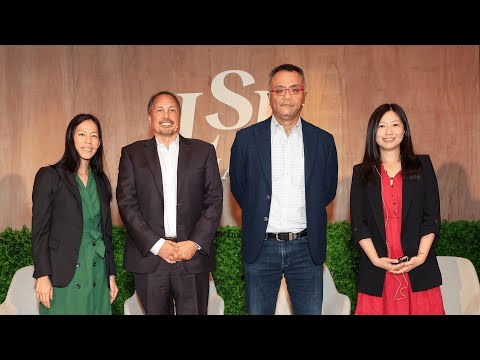
Joe Mullings 0:05
Thanks for taking the time this morning. I've got the privilege the treat, and these are two good old friends, well, not an age, but tenured friends of ours. Nadine and I have been together for how many years now?
Nadine Hachach-Haram 0:22
Oh, my God. 7-8, 7-8, years
Joe Mullings 0:24
We met on LinkedIn, yes. And Elliot and I have been about five now.
Elliot Street 0:31
Yeah, I may, I may tell them how we met, because a relatively funny story. So yeah,
Joe Mullings 0:36
and so they're two successful organizations that have come to the US, fought, the battles, made, the mistakes. Continue to fight the battles continue to win, continue to make mistakes, which is what I love about this panel this morning. It's like an M and M A surgeon will look at right is, here's the lessons that we've learned. We're hoping you can take some notes on it and certainly maybe expedite and save yourselves some money and or time. So we'll go there, but first for those who maybe might be under a rock, don't understand proximity and the sort of paths forward, but it started in 2016
Nadine Hachach-Haram 1:16
Yeah, that's right, yeah. So it's lovely to be here, and again, great to be amongst two really good friends of mine, so delighted to be able to hopefully share some of our learnings and accelerate some of your paths to crossing over the Atlantic. But my name is Nadine. I'm a reconstructive plastic surgeon. You can tell from my accent. I didn't grow up here. I've been I grew up in the States, but have been here for about 24 years and set up my company here. And proximity is really my solution, having lived and spent, you know, decades in operating rooms, to think about, how do we transform the operating room? How do we think about the operating room as a construct that is often an important part of hospitals, right? It's a big asset for hospitals. It's where we deliver really quality care to our patients, but it's quite an analog environment for hospitals as well. It's a big cost center. It's a big revenue driver, but the way we manage it and run it is very siloed. It's very disconnected. And so you end up with a lot of variability in care, variability in productivity and utilization, and variability in sort of the workforce and outcomes around that as well. And so my feeling was if we could bring in an operating system, a software that sits between the EHR and the cloud and becomes that nexus that enables us to connect to experts around various operating rooms, to collect all that multimodal data in the room. Think about all the data you've got, your medical imaging systems, your medical record systems, your staff, whatever device you're using, whether it's a robot, a video stack, you name it, and it's all sort of disconnected. If we can pull all of that data together, how do we really unlock insights that help us drive to those performance metrics that we care about, which are, of course, around quality and safety, but also as a health system leaders, it's around productivity and utilization. So we are kind of that intelligence layer sitting in the operating room, and we work largely with hospitals and medical device companies, and with hospitals, we are turning their ORS into smart, connected ors, and we can drive a very clear ROI for them around utilization and quality metrics. And then for big strategics, we help them accelerate their route to market and understanding of their devices in the market as well. So we've been able to show device partners that they can train twice as many doctors and nurses in half the time, that they're able to reduce their optics by deploying fewer staff to support more healthcare workers using their systems and devices, but also that they can accelerate their R and D pathway because they can actually understand and see how the devices are being used in the room. And to finally say, I mean, how we deploy it's simply we deploy camera sensors in the or and a sort of a box, sort of a stack, and through that, we're able to sort of connect and observe and bring all that information together. And we've been around for many years now, I think 810, years, we are in over 50 countries. We're deployed in, you know, hundreds and hundreds of operating rooms around the world, and we work with close to 40 medical device companies and hundreds of hospitals as well. So it's been an interesting journey so far, and excited to share more.
Elliot Street 4:19
Yeah, well, thanks Joe for for the invite and the LSI team. So I'm Elliot Street. I'm the co founder and CEO of Innovas medical, like Nadine. I'm a physician by training. Train in Manchester and Oxford and founded Innovas medical my bedroom whilst at medical school, looking at the problem of my own training pathway in surgery. That was 2012 so it was quite some time ago now, and ultimately, fast forward to today. What's the problem that Innovas as a business is solving? That problem is that we simply don't have enough fully trained surgeons on the planet to keep up with demand. It's causing 1.5 million preventable deaths per year. And our solution to that. That is to shift the paradigm of the way we train surgeons away from the patient bedside, which is unscalable and simply not working, into the simulated environment. And so we do that with a suite of integrated surgical training technologies. These are hybrid bits of hardware with a digital surgery platform sitting on top of them. And I think we'll share a few unique insights today in terms of scaling into the US based on the fact that we're a business that manufactures hardware here in the United Kingdom. So I think there's some stuff to share on that, and the fact that we have a product that has a double edged sword. So one positive is it's unregulated, so that's going to be an interesting arc for us to discuss. The flip side to that is it doesn't really have any clear purchasing pathway, so we're having to sort of make that one up, and we'll share a few stories of some inventive execution to drive adoption, specifically in the US, which we which we've then used elsewhere, globally. So looking forward to the discussion, and again, thanks for having
Joe Mullings 6:02
us fabulous. So as you can see, both are generating revenue. I still refer to them emerging tech companies. So I usually break down startup companies and emerging tech companies. Startup companies generally are very early stage A B round, usually and still on a pathway to, you know, clearance through the FDA, or approval through the FDA. But eventually, once you start to slide through on an execution and sales distribution, that's an emerging tech. Still, you might be looking for a liquidity event. You might not be that could be a roll up, that could be an acquisition, could be an IPO and I also delivery selected beside being two fabulous friends, it wasn't a device per se, because I think there's a lot to be learned about the adjacent technologies and adjacent solutions to the med tech industry. And our firm the Mullings group, works worldwide, and we're starting to see more and more health tech, Medtech, come into the US market that might not be making the device, per se. So there's some interesting dynamics to learn from there. So let's start at the at the at the primary pain points of Elliot. I'll start with you going commercial in a country that you're not familiar with, working with a health care sort of economy in the in the UK or EU that's totally different in the US. And what are the preconceived notions you had? And what did you meet upon first entry?
Elliot Street 7:34
Yeah, thanks. I will answer that question, but I'll start with a little arc, and the arc is how you and I met. So I mentioned at the start that we founded Innovas in 2012 from 2012 through to effectively 2021 our entire focus was our home market. So we built our business on a robust home market in the NHS, and we didn't look to expand internationally until we had a really, really solid base here, 2021 and prior to that, we actually started just before covid had to pause, and 2021 we were like, Okay, how are we going to break into the US market? Who do we know through a longer story, which we won't show here, we knew Joe, and I emailed Joe and said, Joe, I'm going to land in Florida. I'm coming to your office. I'd like to work there for a week. You don't know me, and by the way, would you like to interview me in one of your nice videos that you do, and he very kindly obliged. The reason I'm telling that story is the early approach to the US market for us was Go, get on the ground and just start asking loads and loads and loads of questions, challenge our own assumptions, share our almost 10 years of experience in the NHS, and then ask, is this equivalent in the US? Because you can go in with those, those assumptions that there will be equivalency, and very quickly you realize there isn't. The other thing we did, of course, is we were very targeted when we came to the US. So we started in Florida and said, We're not going to leave the state until we start selling product in this state. Why Florida? I like the weather, but it's densely populated, with some good organizations with pre for thinking around their procurement strategies. And when you get there, and I'm going to get a show of hands in a second, you get to the US, if you haven't been there, from a business perspective, it is massive. Florida is basically the UK. And so you have to try and break this problem down just before I do do hand over show of hands in the room who, who's in med tech looking to scale their business or growing their business, and keep your hand up if you're UK or European domiciled, yeah. Yeah. Okay, so it is a totally different kettle of fish, and we're going to talk about some of that with regards to the capital required and the other approaches. But that was generally our approach, go and find some friendlies, go and ask lots of stupid questions, and focus in one specific area and make sure that you can get some initial either product. Market fit, or some traction commercially, or at least some sense of commercial traction, early,
Joe Mullings 10:06
and they Dean, it reminded me. Elliot reminded me that you and I met you, reached down on LinkedIn. I did, I did.
Nadine Hachach-Haram 10:13
I messaged you. I remember it was a weekend. He responded. And I was having lunch with my kids. I was like, this really important call after like 15 minutes, I think we're on the call for about an hour, hour and a half, I think I missed. Half. I think I missed the whole lunch, but it was a really good call. And you really could understand that not only were, I mean, we don't build hardware, we are a software company that we were building, quite a disruptive category. It's not, it wasn't just the product that we were building, but it's actually the category we were disrupting because we were coming in and telling health systems and partners, you know, the operating room landscape was going to completely change. It was going to be digital, it's going to be data enabled, more objective, more transparent. And so there was a lot around thinking, around the culture, and how do you bring that technology? And so for us, you know, there'll be a lot of learnings around capital and deployment, but, but it was also about focus. We were very were very fortunate in the early days. Again, we started here, and I think there's some benefit to starting use. It's a great sandbox to test a lot of what you're doing at a much lower cost base. And really there's a proximity to customers, which is different than America, which is so much bigger. But what was interesting is we almost got pulled to the US, almost sooner than we were even ready. Covid had hit. A lot of the big strategics needed our technology. Like yesterday, I think we were a team of 10 or 15 at the time, one of my colleagues in the audience today, and the one of the biggest strategics, one of the top five, basically reached out and said, Can you service us in the US like from next week? And we have these 15 sites, and you know, we're like, yeah, of course we can, you know, and it was covid, and you know, we were going to make it work, but it was that pole. And so what we decided to do is, rather than go straight to the direct customer base, which is the hospitals and health systems, we were going to leverage the access through the strategic so the through the indirect market to understand and learn more about the the US health system market. Because whilst I grew up there, I didn't really work in the US health system, so I wasn't as familiar with how hospitals run, how procurement processes run. You know, how do you build the business case, the ROI for them? Because you've got to show that within a hospital. And so we were very fortunate to go through the strategics first, and that did a couple things for us. One, we got to really get access to the US market quickly. Two, it forced us to really think about how you scale as an organization. Like, how do you operationalize global scale? And that comes from, you know, implementation, customer support, you know, 24/7, you know, services. We didn't have to just work within UK hours. Now we had to be available for all hours. And then really think about, what are those entry points, or those wedges in the market? And finally, selfishly, what they did is they also put us into in front of some really big KOLs, some really big surgeons in the US market who became our biggest advocates. I mean, I still remember till this day. I think it was our maybe fourth, third or fourth month in working with the strategic supporting them, I get a call from UCSD, from one of one of their team members there, one of our customer success managers that we hired, and he said, the Chief of Surgery wants to speak to you. I'm like, and I'm thinking, Oh my God, we've totally like, messed it up. What's happened? Sante Santiago Horgan, says, Hello, you don't know me. I'm Dr Santiago Horgan. How did you come up with this? And you know, I talked him through the story, and he said, I absolutely love it. I'm going to be your biggest champion. And it was those early surgeons that really helped us then figure out how we sort of jump into the US health system. The other bit I couldn't echo enough is like just focusing on a few cities. I mean, we were getting demand up and down the country, but I mean, the US is huge, and if you need to deploy customer success or support on the ground, you really need to be targeted. And so, like you, we focused on Florida, Southern California, Colorado. I think those were the three areas we started. And then we added Chicago and Houston. And we've and even till this day, we're really just focused on those key areas and sort of expanding from there. So I think as you think about the US, you have to really think about when is the right time? Have you got enough of a pull or a specific focus to go to one area that you think you can sort of build a market there? Have you got the right capital? We'll talk a bit about that in a minute. But, but just being ultra, ultra focused and trying to build those early proof points is critical.
Joe Mullings 14:25
One of the here's the mistake I'll share with you. I've probably brought more than 40 companies into the US from O us early stage. Usually the first hire is what we get pulled in by the VCs or the CEO. And invariably, it's either from the Middle East, Israel. Israel is especially the UK, Germany, Italy, Australia. Those seem to be the most prolific. Here's what happens nearly every time. And then I want each of you to chime in on this is the the company tries to get some. Somebody in the US, and they know somebody who knows somebody, and then they hire that person, and usually it's a board member who knows somebody there, and they hire that person on the ground because it's a familiar and it was referred by a board member. So that's number one. Number two is you don't match the cultures. You don't understand the culture there. And if you're going to put somebody over there, that person has to understand your culture as well as you understanding theirs. And I work with a lot of Israeli companies, a very unique culture in med tech. I've been doing it for three decades, and it's more important that you get the hire who understands the culture on the source company side. And then finally, when you bring your product to the US it's going to be wrong. Your baby is going to be ugly as shit. And you've got to take the understanding that your baby is ugly, but together, you're going to make it pretty for the US market and that. And then finally, us, market wages are insanely high relative to rest of world, maybe Switzerland. So you have to be prepared to be well beyond your comfort zone, and oftentimes your lead commercial person will definitely be making more than your CEO in your home country, those are all Givens, and you've got to be prepared for that. And if you shop for price in the US, you're going to fill that position three times within the first two years, so that those with those ground rules. Va, Dean, will you? Will you just fill in the blanks?
Nadine Hachach-Haram 16:37
For me, there's a lot to fill in. I was thinking, I should have brought a paper and pen to write down some notes, many things. I mean, first of all, what's been really helpful for us, and I'm not just saying this because Joe is on stage, is when you're really thinking about setting up your business in another area, and when we thought about the US is, you know, the number of discussions we had with Joe. It wasn't just about, I need to hire a Commercial lead. Can you help me find her that it's we really went into in depth. I mean, I also we went in person and spent time with them. Is really thinking about the culture, the cost base, like, what is our budget? Can we? Can we actually set up in the US? I mean, one thing I didn't mention that I do is, I'm also the Gen, the kind of co founder of the NHS venture fund, radiant health ventures. And so I advise a lot of our companies, when is the right time, so they go to us, and, you know, everyone thinks, I'll just go to us and I'll hire one person, and that's it. No, there's a huge cost modeling that has to happen around actually going and executing in the US. It's not just about hiring ahead. There's a lot more around it. And so thinking through the market access, what's the right sort of level? You know, again, a lot we see a lot of companies, they all just need to go hire a CCO or president or a GM for America. You probably just need a director who's going to run around and, like, roll up their sleeves at the early stages as you're trying to figure out the market. You probably don't need to go up that senior. And so those are the kinds of search like, what level do we need to bring someone in at? What is the actual scope? What do we actually want them to do? Is it really going out and scouting? Because as a CEO of an early stage startup, you're probably doing most of the selling, so you just need someone to pick up the pieces and help follow through and close the deals. It's understanding what markets within the US you're going to be working in. Is it ASCs? Is it hospitals? Is it strategics? The culture piece is critical. I mean, it's funny. I used to say I'm the sort of translator in my company between English and English, but we had, you know, the Brits and the Americans, and they don't always speak the same language. And so I spend a lot of my time telling my American colleagues, look, you know, they're just a bit more subtle, you know, you just have to, you know. And then I'm having tell my British colleagues, the Americans are very direct, like you're just gonna don't take it personally. It's not emotional. And so you're having to sort of navigate that, and that's just between England and Britain. I can't imagine what it was like for Israel and America and all these other countries. So that culture piece is key, and also making sure that you know how much runway you have to actually invest because a lot of times what you end up doing is you'll hire someone. You run out of money in six months, they leave and you've sort of flopped your us launch from day one. So those are just some of the things to think about. And so as we thought about America, we thought, okay, what we really needed early on wasn't necessarily sales people. It was actually customer success. I could go sell it. I'm sure you were doing the selling early on, but it was more if we do get a customer, how do we make sure they love what we're doing and want to work with us? The only other thing I'll say, which is really on the product and the ugly baby, which I sort of agree with, as well as there's different tolerances I can say. And again, I can't speak for every product and every company. But in my experience, and my humble experience with the few companies I've worked with and my own company, is there's more tolerance here in the UK for an imperfect product. It can be a bit clunky, they'll work with you. They're a bit more patient. You can kind of work through it in the US that tolerance is not as high if you go. In and it doesn't work for a second or third time. You're done, like that's you're not going to come back to that customer again. And so we learned that in a way, the hard way. But luckily, we had those k wells like Santi that were really so excited about the product that they pushed us really hard and said, this has to be more seamless. This has to be less clicks. This has to work better. And so we dedicated, then a lot of engineering time to that. And so you have to know that going in with your product, it's not going to be a slam dunk just because it worked in the UK or in Europe or wherever else. You had customers that
Elliot Street 20:31
tolerated it. Yeah, I want to pick up on two points, actually three. Just follow through. This is really helpful. When you've got two powerhouses on the stage, I don't have to do any of my own active thinking. So the first thing that Joe mentioned there was around that the wages are way higher. Again, there's more people that filtered in. Put your hands up if you're a UK, European, domiciled Medtech company or business, great. So you've got the power of geographical arbitrage on your side. If you're the leader of that company, I think both of us did this, didn't we? Which was basically my story, was from 2021 until April of this year, I commuted to the US and spent at least 50% of my time in the US as our sales leader, and we hired those sort of mid to lower level sales managers and didn't hand over the reins of the most important market on the planet to a president or a sales leader. We took responsibility for that, and the arc of that was, first of all, we went in founder led sales. So people will buy this. Now we're going to put someone on the ground to either work behind the founder with the larger opportunities, or go and build those opportunities themselves, but still managed by the founder. And I will probably come back to the arc of our story in terms of partnership in a moment. So first point to really hammer home is you're you may look at the US and go, this is daunting. I don't have the resources that US companies do. I can't raise the capital, which I'm going to come on to next to go and compete, but you've just got to think laterally about the unfair advantage you do have geographical arbitrage being one, you being a lower cost burden to the business and reducing your burn rate and often being the best sales person in the business. You just have to get used to living on a plane and managing how much time you can spend in the US. That's the first piece. The second is, I don't know if we're going to come on to this in terms of raising capital. I mean, the founder set to my right is incredibly good at raising capital. The problem we have how many VCs are in the room before I brilliant. Thank you, and put your hand up if you're European and UK domicile VC or us, domicile. Yeah. Okay, so I'll speak from from personal experience in the UK venture capital markets. Our understanding of the amount of capital that's required to go and break the US is wildly different to what you actually require, and it's wildly different to those people who actually live in the US and have built lots of med tech businesses in the US. So I think that an intellectually honest conversation if you're raising capital, and your primary focus, and the primary discussion with your your VCs that you bring onto the cap table is we're raising capital to go and build and expand in the US. You're not asking for enough money. I don't care how much you're asking for, you're definitely not asking for enough money. You need a huge quantum of capital to go and do this. And the reason being, Nadine touched on it, you have to have the breathing space to get stuff wrong. Because to nadine's point, and to the point of our business, we were a 10 year old business that was in 80% of NHS Trusts by the time we went to the US, and our baby was still ugly and it still didn't work. And the Dean's point, we have two main customer segments, hospital systems and the strategics. The strategics are completely intolerant of anything that's not working perfectly as they should be, because they have no room for mistakes. And so you go to the US with something that works in the NHS, it may not work for the strategic so to bring this brown full circle, and maybe we'll get a chance to touch on our approach, then to actually how we've grown commercially in the US and the size of our footprint. Number one, power of geographical arbitrage. It's really important. You're just going to have to really hustle. And then number two is you're going to need more capital than you think you are, and you're going to make more mistakes. And you have to be honest with that upfront to the VCs and say, here's our plan. We to go wrong, and therefore we're going to need X amount of capital to give us the breathing space to
Joe Mullings 24:26
do that. Yeah, one of the things that Elliot mentioned that's really important to understand is, when the CEO is on the ground here, or somebody within highly, highly connected within the startup, is on the ground here, you're getting an unbiased view from the distant sort of outpost. I will tell you, after placing 9000 people over 35 years with more than 900 startups, people tend to be really good human beings, and people also. Tend to be incredibly biased for self preservation, especially sales people. And so when you're getting feedback from the marketplace, from an outpost in the US, and you have a time difference, a culture difference, communication difference, and a survival or recency bias from your commercial person that is US based, you're going to have a delay in real fidelity, high fidelity data, and so you're going to be making decisions on that data when it's probably not as accurate as you want it to be. And you'll be pouring time and money into that. So when you have the principal come over, and I've had good clients of mine from Israel move over there and are doing yeoman's work and hiring a US based connected person, one in particular structural heart play. But he moved his entire family over there to make sure that he got the data set that he needed in the US for that time period. So please keep that in mind is if you're bringing your company over there, if it's not you as the CEO sitting in here, it needs to be somebody else who's equity invested in the organization from from the home country. So any anything else on that? Because I do want to start talking about partnerships. Those are important too, in the States, Elliot, you want to open up with that? Yeah, let's, let's
Elliot Street 26:19
talk about partnership. So, so let's give you a little flavor for that arc of 2021, 2021. To where we are now. So 21 Elliot turns up with his backpack at Joe's office, ask all these questions. Says we're in 80% of the NHS. We've got a great product. We've actually made a few sales remotely during covid. And now I'm going on my travels around Florida. Founder sales followed, team on the ground followed very neat. We're in a very niche, and very scalable part of the medical technology sector being simulation. So we don't need 200 people on the ground in terms of sales managers. We put a team in into the US, and that team's focus was on what we call middle out adoptions of selling into the healthcare systems. And even with a lean team well run with lots of focus, we realized that actually we were going to need to leverage our customer segments and cross pollinate them to make sure that the US was a success, because even with a product that was selling, we weren't scaling quick enough with the amount of capital that we'd raised, and we were going to start getting ourselves into a bit of no man's land, where you had a team that were expensive being managed, okay, then you're in a difficult position of managed, okay, but you probably need someone managing them full time to get the most out of them, and then the cost base with that means that you run out of cash. So we were watching this unfold in front of us, going, Okay, this could, this could turn into a disaster, because we like to think we've done a really good job of this commercial entry incomes, our approach to partnerships. We were very lucky to partner with the aajl, leading gynecological society in the US, and a large strategic med tech, one of the leaders in women's health. And the way that partnership worked is we figured out that there was a huge amount of value for that strategic to invest in our technology and effectively deploy it into all 300 residency programs across America for over gym in 2023 we secured that contract, and what that meant was we suddenly were drinking from the fire hose of a strategic who had made a very visible, very large investment in this technology. We had to spin up a bricks and mortar base in the US. We had to pull in a full customer success and implementation team. And here's a lesson that we learned. We were too slow to challenge ourselves intellectually to say, Do we really need this sales team in the way we built it now that we've effectively completed us gynecology, and should we actually rebase the business quickly and focus that business entirely on that for the next few years? So my point, and it's a painful point, because when you're a confident CEO, and you have to be and you actually got some data points to say this is working. It's really hard to challenge yourself intellectually and say it's working, okay, but is it working to a scale that that's going to really make an impact? And so if I could say anything, one more show of hands. And this is starting to get monotonous, but for the med techs in the room, put your hand up if your customer segments are both strategics and hospital systems, or if you're just selling into hospital systems. So hands up, if you've got both as your customer segments, okay? And Nadine will talk about this. So just just one Moses in the corner there. If you have got more than one customer segment, I applaud you. Think about how you can cross pollinate them and gain leverage, because that's been huge for us. And the hard lesson learned was, once you have an inflection point like that, challenge yourself with some difficult decisions and act quickly.
Nadine Hachach-Haram 29:51
Nadine, I mean, some really great points. And I love how Elliot's really kind of digging in deep and showing those pain points. I mean, for us, it. Was interesting a couple things. One is, I think you're right. The strategics, you know, they're a tough customer, as they should be, and they will not tolerate, you know, anything less than excellence. And my colleague in the in the audience is laughing, because he had to face the brunt of a lot of that as well. But, you know, there was a bit of catch up. You like, you signed the deal, like, oh shit. Like, can we actually deliver this? So then you're sort of trying to hire the team to deliver, and it's sort of mass higher to get there, but I think for us, what the few of the mistakes. One is we thought we needed to go in sales heavy first, and then CSM customer success, and then quickly, then realized it really had to just be about customer success, because we were really doing the selling of the product was going to sell itself. The second is, when we started, we were treating these customers as two separate entities, and then realized actually you could triangulate and use the strategic as your channel into the system. And so you'll see from some of our partnerships, like Olympus, they became our route tomorrow, I think we signed about, you know, 150 200 rooms, you know, with them, just to get into that sort of market. So you can actually reduce your cost base and leverage the strategic to become your access to the market. The other point is recognizing, you know, at what point does one become your priority market? I mean, today, the US is 60, 70% of our business. We've doubled our recurring revenue year on year now for the past two, three years, and have a path to do that again next year. And so at some point, you then start to think about, well, what is really the right architecture? Now, as we have seen this growth, and as we have created that inflection point, what is the right architecture? Because at some point, Nadine and Elliot on a plane every week, you know, sort of falls over when I think our health starts to sort of take a take a hit. But we only really until this year, and really only until a month or two ago. With Joe's help, finally hired our GM for America. We said, Okay, now we're ready. It's 60, 70% of our revenue. We're doubling year on year. We've got a clear path and inflection. We now know it's working. Now we start to start to put the seniority, because it's a big cost. The one fortunate thing I think we had early on as well is that a lot of our investors were stateside. And I think that very honest discussion that you described, you can actually have with that investors. It was really hard in the early days to try to explain why I needed to pay a mid, mid range, sort of sales, customer success lead more than I was earning. So to our REM CO that was largely kind of European, Middle Eastern investors who said, want to understand, why would you pay that much like that's kind of market in America. And so I think understanding the cost space, how long you go, can you be smart about how you access the market in less costly ways through partnerships, is key, and also brings credibility. I mean, there's no doubt. I mean, not that Innovas didn't have a great brand here and as you were traversing the Atlantic. But you know, once you have ag l saying we're back in this product, and it's going to all of our residency programs or sages or others saying it's proximine, we're working with proximine. I think that that says a lot, and we still chase those still today. So for example, I can probably announce it now, because there'll be some press on it next week, but we can keep it a bit Chatham House, but like proximity is selected as the aircat North America platform, and so that's going to be a huge partnership for us that is going to leverage every person who walks through aircat is going to see proximity, every surgeon, every strategic every big customer, that's great for us. That's a partnership that's worth sort of investing in, because you know that those things will unlock, and I'm sure you've done the same with ag L, so I guess if I summarize my takeaways, like, really think about not 50 partnerships, because that sort of spray and pray approach doesn't work either. You You do not have the bandwidth. We made that mistake early on, and I know Bryan the audience will nod, you know, fearlessly, but we tried to get every logo we could get, and we went and tried to partner with everyone. You cannot do that like just pick three to four and go really deep, and don't think of partners as just med device or resellers hospitals and health systems. In the US are partners. They have a venture arm. They want to co develop with you. Half of the companies in our portfolio at Meridian health ventures actually have partnered with Cedar Sinai. And you go in early, you incubate there, you test your product, you test your business model. You have Orlando health ventures. You've got Mayo ventures, you've got, I mean, just so many of these groups that want to co develop and get warrants and have some structure with you that is there, and I would take advantage of that wholeheartedly. I think Northwell is another one Mount Sinai. So just think about if you don't if, and there's only a few that did strategics, if you really just sell to health systems, go find those one or two really innovative health systems and say, Let's partner with you. We can create some warrant structure, give you some equity, some sweat equity, some sweat equity, and let's really work with you to build out our product for the US market. And you'll become our reference and flagship site, because you absolutely need the reference site in the US you can't just walk in with a nice pitch deck. Everyone's got a nice pitch deck or a nice video,
Joe Mullings 34:55
and with that, Mayo is in the back corner there. So be sure to say after this. Mayo does a great job down to not being distracted. We only have a couple minutes left, and I did want to get the Q A but I think this may be as valuable as any both of you are tenured now and have enough power in the market. How badly can a strategic pull you into the deep end of the pool and leave you drowned without intentionally doing it. I don't know. I'm asking for a friend.
Elliot Street 35:23
Shall I go first? We very like our the main strategic partner for us in the US are we really enjoy working with them, but it requires a lot of active management. And I think I didn't touch on this, but I grossly underestimated the cadence of communication that was required to make sure that we were managing them well and they were managing us well. I'm someone that goes, Okay, there's the North Star. We all know what we're working towards. It's written down in contracts. Everyone go and just get your heads down. Do it. That assumption was a terrible assumption that that would work. And so first things, first practical piece of advice is, when you do that, when you do have those partnerships over communicate and put a huge amount of energy into the cadence, because what you don't want to do is lose the partnership and spend the next four years trying to get the next one. It's much more profitable to keep the ones you got. And to your point, Joe, can they pull you into the deep end? Yes. But really what you want is you want them to do that. Because, to nadine's point earlier, they are going to come in and they're going to hold you to a level of excellence that even two surgical based physicians will not hold themselves or their companies to, and that's transformational for your business. But you've got to be able to tread water for long enough and then swim against the Riptide, and that takes over communication, loads of energy.
Nadine Hachach-Haram 36:49
Oh, just add one point to that. Just in the interest of time, I agree with everything Elliot said. I think one probably not mistake, but it's sort of a learning I think we made along the way. Look, it's very easy in the early days. You know, you really want that logo, you want that partner. You're desperate to sort of please them. And so every time they say jump, you just say, how high and and I remember, you know, someone said, not every customer is a good customer. And so I think being very, very clear on the expectations on both sides, yes, naturally you're the weaker one, technically, from a sort of like, they're the big gorilla, you're the tiny startup company, and you're desperate to sort of please them. But I think standing your ground and being extremely clear on expectations in within that, I completely agree, regular cadence of communication is key. Don't, don't let them kind of swallow you up. And it's really hard to do because you're desperate to please them. And you can see the dollar signs if it goes well, but the best thing you can do early on is just be very, very clear on scope. And if it's not written down, make sure it's written down. Make sure you're revisiting it regularly with your MBRs and QBRs, so that everyone knows what the expectation is, because then otherwise, you'll just get blamed for anything that doesn't work, whether it's within your control or not within your control.
Joe Mullings 37:59
We've got two minutes left. Any questions from the floor at all while I've got these two phenomenal resources up front here. Yes,
Elliot Street 38:20
two hot nose. No, absolutely not. We were able to go to the US and look like that. That arc. We've got a lot left to do in the US, but that arc is pretty remarkable. And what I didn't share with you is we did that for with less than 3 million Sterling raised to get to go and basically take over the US gynecology training environment. The only reason we were able to do that is because we had such a stable business in the NHS, and such a stable business fueling things so that we had that optionality for if stuff doesn't go wrong, we'd have to raise loads of capital, because we're not going to run out of runway.
Nadine Hachach-Haram 38:54
And a lot of the build and testing that you want to do early on, you can do it at a much lower cost space here, like much, much lower. Not that the market is any less important, but just, you just can't afford to do that. And so by the time you go into the US, you're not going trying to figure out what is the product. You've got a product. It's now just, how do I tweak and iterate it for this market? And so you can accelerate then Fargo. I mean, we're the market leader in what we do, and we've done that from here, and we've conquered the US market through that. And I think we wouldn't be able to do that for just do that. We've just started from scratch there. At the pace
Elliot Street 39:25
at which we did it, I think we mentioned as well the names, the badges that we're putting on the businesses in the US. A lot of people say, who's using this? It's really powerful. If you turn around and say Imperial, Cambridge, Oxford, like those are big world, world renowned names, and if you lock those in, that gives you that credibility without having to then go and find your first pilot sites in the US. It's credibility by transfer.
Nadine Hachach-Haram 39:46
And last point is, you know, if you want to really partner with these strategics and be their global partner, because what you tend to see is companies that are born or just focused on the US really, just think about the US market. Companies like us, who are born out of Europe, always think global and built for global from day one, because you always know the. UK market will never be big enough. So from day one, we were always selected above other competitors with the big strategics, because we could give them a global footprint. From day one we could support data hosting in Europe, data hosting Middle East, data hosting in Asia, when a lot of the US competitors could only just do the US for them. And so actually gives you an advantage. I think,
Joe Mullings 40:17
as a good point guard are going to manage the clock well here. So I think we're out of time and please thank you for thanking my wonderful partners on the panel.
Joe Mullings 0:05
Thanks for taking the time this morning. I've got the privilege the treat, and these are two good old friends, well, not an age, but tenured friends of ours. Nadine and I have been together for how many years now?
Nadine Hachach-Haram 0:22
Oh, my God. 7-8, 7-8, years
Joe Mullings 0:24
We met on LinkedIn, yes. And Elliot and I have been about five now.
Elliot Street 0:31
Yeah, I may, I may tell them how we met, because a relatively funny story. So yeah,
Joe Mullings 0:36
and so they're two successful organizations that have come to the US, fought, the battles, made, the mistakes. Continue to fight the battles continue to win, continue to make mistakes, which is what I love about this panel this morning. It's like an M and M A surgeon will look at right is, here's the lessons that we've learned. We're hoping you can take some notes on it and certainly maybe expedite and save yourselves some money and or time. So we'll go there, but first for those who maybe might be under a rock, don't understand proximity and the sort of paths forward, but it started in 2016
Nadine Hachach-Haram 1:16
Yeah, that's right, yeah. So it's lovely to be here, and again, great to be amongst two really good friends of mine, so delighted to be able to hopefully share some of our learnings and accelerate some of your paths to crossing over the Atlantic. But my name is Nadine. I'm a reconstructive plastic surgeon. You can tell from my accent. I didn't grow up here. I've been I grew up in the States, but have been here for about 24 years and set up my company here. And proximity is really my solution, having lived and spent, you know, decades in operating rooms, to think about, how do we transform the operating room? How do we think about the operating room as a construct that is often an important part of hospitals, right? It's a big asset for hospitals. It's where we deliver really quality care to our patients, but it's quite an analog environment for hospitals as well. It's a big cost center. It's a big revenue driver, but the way we manage it and run it is very siloed. It's very disconnected. And so you end up with a lot of variability in care, variability in productivity and utilization, and variability in sort of the workforce and outcomes around that as well. And so my feeling was if we could bring in an operating system, a software that sits between the EHR and the cloud and becomes that nexus that enables us to connect to experts around various operating rooms, to collect all that multimodal data in the room. Think about all the data you've got, your medical imaging systems, your medical record systems, your staff, whatever device you're using, whether it's a robot, a video stack, you name it, and it's all sort of disconnected. If we can pull all of that data together, how do we really unlock insights that help us drive to those performance metrics that we care about, which are, of course, around quality and safety, but also as a health system leaders, it's around productivity and utilization. So we are kind of that intelligence layer sitting in the operating room, and we work largely with hospitals and medical device companies, and with hospitals, we are turning their ORS into smart, connected ors, and we can drive a very clear ROI for them around utilization and quality metrics. And then for big strategics, we help them accelerate their route to market and understanding of their devices in the market as well. So we've been able to show device partners that they can train twice as many doctors and nurses in half the time, that they're able to reduce their optics by deploying fewer staff to support more healthcare workers using their systems and devices, but also that they can accelerate their R and D pathway because they can actually understand and see how the devices are being used in the room. And to finally say, I mean, how we deploy it's simply we deploy camera sensors in the or and a sort of a box, sort of a stack, and through that, we're able to sort of connect and observe and bring all that information together. And we've been around for many years now, I think 810, years, we are in over 50 countries. We're deployed in, you know, hundreds and hundreds of operating rooms around the world, and we work with close to 40 medical device companies and hundreds of hospitals as well. So it's been an interesting journey so far, and excited to share more.
Elliot Street 4:19
Yeah, well, thanks Joe for for the invite and the LSI team. So I'm Elliot Street. I'm the co founder and CEO of Innovas medical, like Nadine. I'm a physician by training. Train in Manchester and Oxford and founded Innovas medical my bedroom whilst at medical school, looking at the problem of my own training pathway in surgery. That was 2012 so it was quite some time ago now, and ultimately, fast forward to today. What's the problem that Innovas as a business is solving? That problem is that we simply don't have enough fully trained surgeons on the planet to keep up with demand. It's causing 1.5 million preventable deaths per year. And our solution to that. That is to shift the paradigm of the way we train surgeons away from the patient bedside, which is unscalable and simply not working, into the simulated environment. And so we do that with a suite of integrated surgical training technologies. These are hybrid bits of hardware with a digital surgery platform sitting on top of them. And I think we'll share a few unique insights today in terms of scaling into the US based on the fact that we're a business that manufactures hardware here in the United Kingdom. So I think there's some stuff to share on that, and the fact that we have a product that has a double edged sword. So one positive is it's unregulated, so that's going to be an interesting arc for us to discuss. The flip side to that is it doesn't really have any clear purchasing pathway, so we're having to sort of make that one up, and we'll share a few stories of some inventive execution to drive adoption, specifically in the US, which we which we've then used elsewhere, globally. So looking forward to the discussion, and again, thanks for having
Joe Mullings 6:02
us fabulous. So as you can see, both are generating revenue. I still refer to them emerging tech companies. So I usually break down startup companies and emerging tech companies. Startup companies generally are very early stage A B round, usually and still on a pathway to, you know, clearance through the FDA, or approval through the FDA. But eventually, once you start to slide through on an execution and sales distribution, that's an emerging tech. Still, you might be looking for a liquidity event. You might not be that could be a roll up, that could be an acquisition, could be an IPO and I also delivery selected beside being two fabulous friends, it wasn't a device per se, because I think there's a lot to be learned about the adjacent technologies and adjacent solutions to the med tech industry. And our firm the Mullings group, works worldwide, and we're starting to see more and more health tech, Medtech, come into the US market that might not be making the device, per se. So there's some interesting dynamics to learn from there. So let's start at the at the at the primary pain points of Elliot. I'll start with you going commercial in a country that you're not familiar with, working with a health care sort of economy in the in the UK or EU that's totally different in the US. And what are the preconceived notions you had? And what did you meet upon first entry?
Elliot Street 7:34
Yeah, thanks. I will answer that question, but I'll start with a little arc, and the arc is how you and I met. So I mentioned at the start that we founded Innovas in 2012 from 2012 through to effectively 2021 our entire focus was our home market. So we built our business on a robust home market in the NHS, and we didn't look to expand internationally until we had a really, really solid base here, 2021 and prior to that, we actually started just before covid had to pause, and 2021 we were like, Okay, how are we going to break into the US market? Who do we know through a longer story, which we won't show here, we knew Joe, and I emailed Joe and said, Joe, I'm going to land in Florida. I'm coming to your office. I'd like to work there for a week. You don't know me, and by the way, would you like to interview me in one of your nice videos that you do, and he very kindly obliged. The reason I'm telling that story is the early approach to the US market for us was Go, get on the ground and just start asking loads and loads and loads of questions, challenge our own assumptions, share our almost 10 years of experience in the NHS, and then ask, is this equivalent in the US? Because you can go in with those, those assumptions that there will be equivalency, and very quickly you realize there isn't. The other thing we did, of course, is we were very targeted when we came to the US. So we started in Florida and said, We're not going to leave the state until we start selling product in this state. Why Florida? I like the weather, but it's densely populated, with some good organizations with pre for thinking around their procurement strategies. And when you get there, and I'm going to get a show of hands in a second, you get to the US, if you haven't been there, from a business perspective, it is massive. Florida is basically the UK. And so you have to try and break this problem down just before I do do hand over show of hands in the room who, who's in med tech looking to scale their business or growing their business, and keep your hand up if you're UK or European domiciled, yeah. Yeah. Okay, so it is a totally different kettle of fish, and we're going to talk about some of that with regards to the capital required and the other approaches. But that was generally our approach, go and find some friendlies, go and ask lots of stupid questions, and focus in one specific area and make sure that you can get some initial either product. Market fit, or some traction commercially, or at least some sense of commercial traction, early,
Joe Mullings 10:06
and they Dean, it reminded me. Elliot reminded me that you and I met you, reached down on LinkedIn. I did, I did.
Nadine Hachach-Haram 10:13
I messaged you. I remember it was a weekend. He responded. And I was having lunch with my kids. I was like, this really important call after like 15 minutes, I think we're on the call for about an hour, hour and a half, I think I missed. Half. I think I missed the whole lunch, but it was a really good call. And you really could understand that not only were, I mean, we don't build hardware, we are a software company that we were building, quite a disruptive category. It's not, it wasn't just the product that we were building, but it's actually the category we were disrupting because we were coming in and telling health systems and partners, you know, the operating room landscape was going to completely change. It was going to be digital, it's going to be data enabled, more objective, more transparent. And so there was a lot around thinking, around the culture, and how do you bring that technology? And so for us, you know, there'll be a lot of learnings around capital and deployment, but, but it was also about focus. We were very were very fortunate in the early days. Again, we started here, and I think there's some benefit to starting use. It's a great sandbox to test a lot of what you're doing at a much lower cost base. And really there's a proximity to customers, which is different than America, which is so much bigger. But what was interesting is we almost got pulled to the US, almost sooner than we were even ready. Covid had hit. A lot of the big strategics needed our technology. Like yesterday, I think we were a team of 10 or 15 at the time, one of my colleagues in the audience today, and the one of the biggest strategics, one of the top five, basically reached out and said, Can you service us in the US like from next week? And we have these 15 sites, and you know, we're like, yeah, of course we can, you know, and it was covid, and you know, we were going to make it work, but it was that pole. And so what we decided to do is, rather than go straight to the direct customer base, which is the hospitals and health systems, we were going to leverage the access through the strategic so the through the indirect market to understand and learn more about the the US health system market. Because whilst I grew up there, I didn't really work in the US health system, so I wasn't as familiar with how hospitals run, how procurement processes run. You know, how do you build the business case, the ROI for them? Because you've got to show that within a hospital. And so we were very fortunate to go through the strategics first, and that did a couple things for us. One, we got to really get access to the US market quickly. Two, it forced us to really think about how you scale as an organization. Like, how do you operationalize global scale? And that comes from, you know, implementation, customer support, you know, 24/7, you know, services. We didn't have to just work within UK hours. Now we had to be available for all hours. And then really think about, what are those entry points, or those wedges in the market? And finally, selfishly, what they did is they also put us into in front of some really big KOLs, some really big surgeons in the US market who became our biggest advocates. I mean, I still remember till this day. I think it was our maybe fourth, third or fourth month in working with the strategic supporting them, I get a call from UCSD, from one of one of their team members there, one of our customer success managers that we hired, and he said, the Chief of Surgery wants to speak to you. I'm like, and I'm thinking, Oh my God, we've totally like, messed it up. What's happened? Sante Santiago Horgan, says, Hello, you don't know me. I'm Dr Santiago Horgan. How did you come up with this? And you know, I talked him through the story, and he said, I absolutely love it. I'm going to be your biggest champion. And it was those early surgeons that really helped us then figure out how we sort of jump into the US health system. The other bit I couldn't echo enough is like just focusing on a few cities. I mean, we were getting demand up and down the country, but I mean, the US is huge, and if you need to deploy customer success or support on the ground, you really need to be targeted. And so, like you, we focused on Florida, Southern California, Colorado. I think those were the three areas we started. And then we added Chicago and Houston. And we've and even till this day, we're really just focused on those key areas and sort of expanding from there. So I think as you think about the US, you have to really think about when is the right time? Have you got enough of a pull or a specific focus to go to one area that you think you can sort of build a market there? Have you got the right capital? We'll talk a bit about that in a minute. But, but just being ultra, ultra focused and trying to build those early proof points is critical.
Joe Mullings 14:25
One of the here's the mistake I'll share with you. I've probably brought more than 40 companies into the US from O us early stage. Usually the first hire is what we get pulled in by the VCs or the CEO. And invariably, it's either from the Middle East, Israel. Israel is especially the UK, Germany, Italy, Australia. Those seem to be the most prolific. Here's what happens nearly every time. And then I want each of you to chime in on this is the the company tries to get some. Somebody in the US, and they know somebody who knows somebody, and then they hire that person, and usually it's a board member who knows somebody there, and they hire that person on the ground because it's a familiar and it was referred by a board member. So that's number one. Number two is you don't match the cultures. You don't understand the culture there. And if you're going to put somebody over there, that person has to understand your culture as well as you understanding theirs. And I work with a lot of Israeli companies, a very unique culture in med tech. I've been doing it for three decades, and it's more important that you get the hire who understands the culture on the source company side. And then finally, when you bring your product to the US it's going to be wrong. Your baby is going to be ugly as shit. And you've got to take the understanding that your baby is ugly, but together, you're going to make it pretty for the US market and that. And then finally, us, market wages are insanely high relative to rest of world, maybe Switzerland. So you have to be prepared to be well beyond your comfort zone, and oftentimes your lead commercial person will definitely be making more than your CEO in your home country, those are all Givens, and you've got to be prepared for that. And if you shop for price in the US, you're going to fill that position three times within the first two years, so that those with those ground rules. Va, Dean, will you? Will you just fill in the blanks?
Nadine Hachach-Haram 16:37
For me, there's a lot to fill in. I was thinking, I should have brought a paper and pen to write down some notes, many things. I mean, first of all, what's been really helpful for us, and I'm not just saying this because Joe is on stage, is when you're really thinking about setting up your business in another area, and when we thought about the US is, you know, the number of discussions we had with Joe. It wasn't just about, I need to hire a Commercial lead. Can you help me find her that it's we really went into in depth. I mean, I also we went in person and spent time with them. Is really thinking about the culture, the cost base, like, what is our budget? Can we? Can we actually set up in the US? I mean, one thing I didn't mention that I do is, I'm also the Gen, the kind of co founder of the NHS venture fund, radiant health ventures. And so I advise a lot of our companies, when is the right time, so they go to us, and, you know, everyone thinks, I'll just go to us and I'll hire one person, and that's it. No, there's a huge cost modeling that has to happen around actually going and executing in the US. It's not just about hiring ahead. There's a lot more around it. And so thinking through the market access, what's the right sort of level? You know, again, a lot we see a lot of companies, they all just need to go hire a CCO or president or a GM for America. You probably just need a director who's going to run around and, like, roll up their sleeves at the early stages as you're trying to figure out the market. You probably don't need to go up that senior. And so those are the kinds of search like, what level do we need to bring someone in at? What is the actual scope? What do we actually want them to do? Is it really going out and scouting? Because as a CEO of an early stage startup, you're probably doing most of the selling, so you just need someone to pick up the pieces and help follow through and close the deals. It's understanding what markets within the US you're going to be working in. Is it ASCs? Is it hospitals? Is it strategics? The culture piece is critical. I mean, it's funny. I used to say I'm the sort of translator in my company between English and English, but we had, you know, the Brits and the Americans, and they don't always speak the same language. And so I spend a lot of my time telling my American colleagues, look, you know, they're just a bit more subtle, you know, you just have to, you know. And then I'm having tell my British colleagues, the Americans are very direct, like you're just gonna don't take it personally. It's not emotional. And so you're having to sort of navigate that, and that's just between England and Britain. I can't imagine what it was like for Israel and America and all these other countries. So that culture piece is key, and also making sure that you know how much runway you have to actually invest because a lot of times what you end up doing is you'll hire someone. You run out of money in six months, they leave and you've sort of flopped your us launch from day one. So those are just some of the things to think about. And so as we thought about America, we thought, okay, what we really needed early on wasn't necessarily sales people. It was actually customer success. I could go sell it. I'm sure you were doing the selling early on, but it was more if we do get a customer, how do we make sure they love what we're doing and want to work with us? The only other thing I'll say, which is really on the product and the ugly baby, which I sort of agree with, as well as there's different tolerances I can say. And again, I can't speak for every product and every company. But in my experience, and my humble experience with the few companies I've worked with and my own company, is there's more tolerance here in the UK for an imperfect product. It can be a bit clunky, they'll work with you. They're a bit more patient. You can kind of work through it in the US that tolerance is not as high if you go. In and it doesn't work for a second or third time. You're done, like that's you're not going to come back to that customer again. And so we learned that in a way, the hard way. But luckily, we had those k wells like Santi that were really so excited about the product that they pushed us really hard and said, this has to be more seamless. This has to be less clicks. This has to work better. And so we dedicated, then a lot of engineering time to that. And so you have to know that going in with your product, it's not going to be a slam dunk just because it worked in the UK or in Europe or wherever else. You had customers that
Elliot Street 20:31
tolerated it. Yeah, I want to pick up on two points, actually three. Just follow through. This is really helpful. When you've got two powerhouses on the stage, I don't have to do any of my own active thinking. So the first thing that Joe mentioned there was around that the wages are way higher. Again, there's more people that filtered in. Put your hands up if you're a UK, European, domiciled Medtech company or business, great. So you've got the power of geographical arbitrage on your side. If you're the leader of that company, I think both of us did this, didn't we? Which was basically my story, was from 2021 until April of this year, I commuted to the US and spent at least 50% of my time in the US as our sales leader, and we hired those sort of mid to lower level sales managers and didn't hand over the reins of the most important market on the planet to a president or a sales leader. We took responsibility for that, and the arc of that was, first of all, we went in founder led sales. So people will buy this. Now we're going to put someone on the ground to either work behind the founder with the larger opportunities, or go and build those opportunities themselves, but still managed by the founder. And I will probably come back to the arc of our story in terms of partnership in a moment. So first point to really hammer home is you're you may look at the US and go, this is daunting. I don't have the resources that US companies do. I can't raise the capital, which I'm going to come on to next to go and compete, but you've just got to think laterally about the unfair advantage you do have geographical arbitrage being one, you being a lower cost burden to the business and reducing your burn rate and often being the best sales person in the business. You just have to get used to living on a plane and managing how much time you can spend in the US. That's the first piece. The second is, I don't know if we're going to come on to this in terms of raising capital. I mean, the founder set to my right is incredibly good at raising capital. The problem we have how many VCs are in the room before I brilliant. Thank you, and put your hand up if you're European and UK domicile VC or us, domicile. Yeah. Okay, so I'll speak from from personal experience in the UK venture capital markets. Our understanding of the amount of capital that's required to go and break the US is wildly different to what you actually require, and it's wildly different to those people who actually live in the US and have built lots of med tech businesses in the US. So I think that an intellectually honest conversation if you're raising capital, and your primary focus, and the primary discussion with your your VCs that you bring onto the cap table is we're raising capital to go and build and expand in the US. You're not asking for enough money. I don't care how much you're asking for, you're definitely not asking for enough money. You need a huge quantum of capital to go and do this. And the reason being, Nadine touched on it, you have to have the breathing space to get stuff wrong. Because to nadine's point, and to the point of our business, we were a 10 year old business that was in 80% of NHS Trusts by the time we went to the US, and our baby was still ugly and it still didn't work. And the Dean's point, we have two main customer segments, hospital systems and the strategics. The strategics are completely intolerant of anything that's not working perfectly as they should be, because they have no room for mistakes. And so you go to the US with something that works in the NHS, it may not work for the strategic so to bring this brown full circle, and maybe we'll get a chance to touch on our approach, then to actually how we've grown commercially in the US and the size of our footprint. Number one, power of geographical arbitrage. It's really important. You're just going to have to really hustle. And then number two is you're going to need more capital than you think you are, and you're going to make more mistakes. And you have to be honest with that upfront to the VCs and say, here's our plan. We to go wrong, and therefore we're going to need X amount of capital to give us the breathing space to
Joe Mullings 24:26
do that. Yeah, one of the things that Elliot mentioned that's really important to understand is, when the CEO is on the ground here, or somebody within highly, highly connected within the startup, is on the ground here, you're getting an unbiased view from the distant sort of outpost. I will tell you, after placing 9000 people over 35 years with more than 900 startups, people tend to be really good human beings, and people also. Tend to be incredibly biased for self preservation, especially sales people. And so when you're getting feedback from the marketplace, from an outpost in the US, and you have a time difference, a culture difference, communication difference, and a survival or recency bias from your commercial person that is US based, you're going to have a delay in real fidelity, high fidelity data, and so you're going to be making decisions on that data when it's probably not as accurate as you want it to be. And you'll be pouring time and money into that. So when you have the principal come over, and I've had good clients of mine from Israel move over there and are doing yeoman's work and hiring a US based connected person, one in particular structural heart play. But he moved his entire family over there to make sure that he got the data set that he needed in the US for that time period. So please keep that in mind is if you're bringing your company over there, if it's not you as the CEO sitting in here, it needs to be somebody else who's equity invested in the organization from from the home country. So any anything else on that? Because I do want to start talking about partnerships. Those are important too, in the States, Elliot, you want to open up with that? Yeah, let's, let's
Elliot Street 26:19
talk about partnership. So, so let's give you a little flavor for that arc of 2021, 2021. To where we are now. So 21 Elliot turns up with his backpack at Joe's office, ask all these questions. Says we're in 80% of the NHS. We've got a great product. We've actually made a few sales remotely during covid. And now I'm going on my travels around Florida. Founder sales followed, team on the ground followed very neat. We're in a very niche, and very scalable part of the medical technology sector being simulation. So we don't need 200 people on the ground in terms of sales managers. We put a team in into the US, and that team's focus was on what we call middle out adoptions of selling into the healthcare systems. And even with a lean team well run with lots of focus, we realized that actually we were going to need to leverage our customer segments and cross pollinate them to make sure that the US was a success, because even with a product that was selling, we weren't scaling quick enough with the amount of capital that we'd raised, and we were going to start getting ourselves into a bit of no man's land, where you had a team that were expensive being managed, okay, then you're in a difficult position of managed, okay, but you probably need someone managing them full time to get the most out of them, and then the cost base with that means that you run out of cash. So we were watching this unfold in front of us, going, Okay, this could, this could turn into a disaster, because we like to think we've done a really good job of this commercial entry incomes, our approach to partnerships. We were very lucky to partner with the aajl, leading gynecological society in the US, and a large strategic med tech, one of the leaders in women's health. And the way that partnership worked is we figured out that there was a huge amount of value for that strategic to invest in our technology and effectively deploy it into all 300 residency programs across America for over gym in 2023 we secured that contract, and what that meant was we suddenly were drinking from the fire hose of a strategic who had made a very visible, very large investment in this technology. We had to spin up a bricks and mortar base in the US. We had to pull in a full customer success and implementation team. And here's a lesson that we learned. We were too slow to challenge ourselves intellectually to say, Do we really need this sales team in the way we built it now that we've effectively completed us gynecology, and should we actually rebase the business quickly and focus that business entirely on that for the next few years? So my point, and it's a painful point, because when you're a confident CEO, and you have to be and you actually got some data points to say this is working. It's really hard to challenge yourself intellectually and say it's working, okay, but is it working to a scale that that's going to really make an impact? And so if I could say anything, one more show of hands. And this is starting to get monotonous, but for the med techs in the room, put your hand up if your customer segments are both strategics and hospital systems, or if you're just selling into hospital systems. So hands up, if you've got both as your customer segments, okay? And Nadine will talk about this. So just just one Moses in the corner there. If you have got more than one customer segment, I applaud you. Think about how you can cross pollinate them and gain leverage, because that's been huge for us. And the hard lesson learned was, once you have an inflection point like that, challenge yourself with some difficult decisions and act quickly.
Nadine Hachach-Haram 29:51
Nadine, I mean, some really great points. And I love how Elliot's really kind of digging in deep and showing those pain points. I mean, for us, it. Was interesting a couple things. One is, I think you're right. The strategics, you know, they're a tough customer, as they should be, and they will not tolerate, you know, anything less than excellence. And my colleague in the in the audience is laughing, because he had to face the brunt of a lot of that as well. But, you know, there was a bit of catch up. You like, you signed the deal, like, oh shit. Like, can we actually deliver this? So then you're sort of trying to hire the team to deliver, and it's sort of mass higher to get there, but I think for us, what the few of the mistakes. One is we thought we needed to go in sales heavy first, and then CSM customer success, and then quickly, then realized it really had to just be about customer success, because we were really doing the selling of the product was going to sell itself. The second is, when we started, we were treating these customers as two separate entities, and then realized actually you could triangulate and use the strategic as your channel into the system. And so you'll see from some of our partnerships, like Olympus, they became our route tomorrow, I think we signed about, you know, 150 200 rooms, you know, with them, just to get into that sort of market. So you can actually reduce your cost base and leverage the strategic to become your access to the market. The other point is recognizing, you know, at what point does one become your priority market? I mean, today, the US is 60, 70% of our business. We've doubled our recurring revenue year on year now for the past two, three years, and have a path to do that again next year. And so at some point, you then start to think about, well, what is really the right architecture? Now, as we have seen this growth, and as we have created that inflection point, what is the right architecture? Because at some point, Nadine and Elliot on a plane every week, you know, sort of falls over when I think our health starts to sort of take a take a hit. But we only really until this year, and really only until a month or two ago. With Joe's help, finally hired our GM for America. We said, Okay, now we're ready. It's 60, 70% of our revenue. We're doubling year on year. We've got a clear path and inflection. We now know it's working. Now we start to start to put the seniority, because it's a big cost. The one fortunate thing I think we had early on as well is that a lot of our investors were stateside. And I think that very honest discussion that you described, you can actually have with that investors. It was really hard in the early days to try to explain why I needed to pay a mid, mid range, sort of sales, customer success lead more than I was earning. So to our REM CO that was largely kind of European, Middle Eastern investors who said, want to understand, why would you pay that much like that's kind of market in America. And so I think understanding the cost space, how long you go, can you be smart about how you access the market in less costly ways through partnerships, is key, and also brings credibility. I mean, there's no doubt. I mean, not that Innovas didn't have a great brand here and as you were traversing the Atlantic. But you know, once you have ag l saying we're back in this product, and it's going to all of our residency programs or sages or others saying it's proximine, we're working with proximine. I think that that says a lot, and we still chase those still today. So for example, I can probably announce it now, because there'll be some press on it next week, but we can keep it a bit Chatham House, but like proximity is selected as the aircat North America platform, and so that's going to be a huge partnership for us that is going to leverage every person who walks through aircat is going to see proximity, every surgeon, every strategic every big customer, that's great for us. That's a partnership that's worth sort of investing in, because you know that those things will unlock, and I'm sure you've done the same with ag L, so I guess if I summarize my takeaways, like, really think about not 50 partnerships, because that sort of spray and pray approach doesn't work either. You You do not have the bandwidth. We made that mistake early on, and I know Bryan the audience will nod, you know, fearlessly, but we tried to get every logo we could get, and we went and tried to partner with everyone. You cannot do that like just pick three to four and go really deep, and don't think of partners as just med device or resellers hospitals and health systems. In the US are partners. They have a venture arm. They want to co develop with you. Half of the companies in our portfolio at Meridian health ventures actually have partnered with Cedar Sinai. And you go in early, you incubate there, you test your product, you test your business model. You have Orlando health ventures. You've got Mayo ventures, you've got, I mean, just so many of these groups that want to co develop and get warrants and have some structure with you that is there, and I would take advantage of that wholeheartedly. I think Northwell is another one Mount Sinai. So just think about if you don't if, and there's only a few that did strategics, if you really just sell to health systems, go find those one or two really innovative health systems and say, Let's partner with you. We can create some warrant structure, give you some equity, some sweat equity, some sweat equity, and let's really work with you to build out our product for the US market. And you'll become our reference and flagship site, because you absolutely need the reference site in the US you can't just walk in with a nice pitch deck. Everyone's got a nice pitch deck or a nice video,
Joe Mullings 34:55
and with that, Mayo is in the back corner there. So be sure to say after this. Mayo does a great job down to not being distracted. We only have a couple minutes left, and I did want to get the Q A but I think this may be as valuable as any both of you are tenured now and have enough power in the market. How badly can a strategic pull you into the deep end of the pool and leave you drowned without intentionally doing it. I don't know. I'm asking for a friend.
Elliot Street 35:23
Shall I go first? We very like our the main strategic partner for us in the US are we really enjoy working with them, but it requires a lot of active management. And I think I didn't touch on this, but I grossly underestimated the cadence of communication that was required to make sure that we were managing them well and they were managing us well. I'm someone that goes, Okay, there's the North Star. We all know what we're working towards. It's written down in contracts. Everyone go and just get your heads down. Do it. That assumption was a terrible assumption that that would work. And so first things, first practical piece of advice is, when you do that, when you do have those partnerships over communicate and put a huge amount of energy into the cadence, because what you don't want to do is lose the partnership and spend the next four years trying to get the next one. It's much more profitable to keep the ones you got. And to your point, Joe, can they pull you into the deep end? Yes. But really what you want is you want them to do that. Because, to nadine's point earlier, they are going to come in and they're going to hold you to a level of excellence that even two surgical based physicians will not hold themselves or their companies to, and that's transformational for your business. But you've got to be able to tread water for long enough and then swim against the Riptide, and that takes over communication, loads of energy.
Nadine Hachach-Haram 36:49
Oh, just add one point to that. Just in the interest of time, I agree with everything Elliot said. I think one probably not mistake, but it's sort of a learning I think we made along the way. Look, it's very easy in the early days. You know, you really want that logo, you want that partner. You're desperate to sort of please them. And so every time they say jump, you just say, how high and and I remember, you know, someone said, not every customer is a good customer. And so I think being very, very clear on the expectations on both sides, yes, naturally you're the weaker one, technically, from a sort of like, they're the big gorilla, you're the tiny startup company, and you're desperate to sort of please them. But I think standing your ground and being extremely clear on expectations in within that, I completely agree, regular cadence of communication is key. Don't, don't let them kind of swallow you up. And it's really hard to do because you're desperate to please them. And you can see the dollar signs if it goes well, but the best thing you can do early on is just be very, very clear on scope. And if it's not written down, make sure it's written down. Make sure you're revisiting it regularly with your MBRs and QBRs, so that everyone knows what the expectation is, because then otherwise, you'll just get blamed for anything that doesn't work, whether it's within your control or not within your control.
Joe Mullings 37:59
We've got two minutes left. Any questions from the floor at all while I've got these two phenomenal resources up front here. Yes,
Elliot Street 38:20
two hot nose. No, absolutely not. We were able to go to the US and look like that. That arc. We've got a lot left to do in the US, but that arc is pretty remarkable. And what I didn't share with you is we did that for with less than 3 million Sterling raised to get to go and basically take over the US gynecology training environment. The only reason we were able to do that is because we had such a stable business in the NHS, and such a stable business fueling things so that we had that optionality for if stuff doesn't go wrong, we'd have to raise loads of capital, because we're not going to run out of runway.
Nadine Hachach-Haram 38:54
And a lot of the build and testing that you want to do early on, you can do it at a much lower cost space here, like much, much lower. Not that the market is any less important, but just, you just can't afford to do that. And so by the time you go into the US, you're not going trying to figure out what is the product. You've got a product. It's now just, how do I tweak and iterate it for this market? And so you can accelerate then Fargo. I mean, we're the market leader in what we do, and we've done that from here, and we've conquered the US market through that. And I think we wouldn't be able to do that for just do that. We've just started from scratch there. At the pace
Elliot Street 39:25
at which we did it, I think we mentioned as well the names, the badges that we're putting on the businesses in the US. A lot of people say, who's using this? It's really powerful. If you turn around and say Imperial, Cambridge, Oxford, like those are big world, world renowned names, and if you lock those in, that gives you that credibility without having to then go and find your first pilot sites in the US. It's credibility by transfer.
Nadine Hachach-Haram 39:46
And last point is, you know, if you want to really partner with these strategics and be their global partner, because what you tend to see is companies that are born or just focused on the US really, just think about the US market. Companies like us, who are born out of Europe, always think global and built for global from day one, because you always know the. UK market will never be big enough. So from day one, we were always selected above other competitors with the big strategics, because we could give them a global footprint. From day one we could support data hosting in Europe, data hosting Middle East, data hosting in Asia, when a lot of the US competitors could only just do the US for them. And so actually gives you an advantage. I think,
Joe Mullings 40:17
as a good point guard are going to manage the clock well here. So I think we're out of time and please thank you for thanking my wonderful partners on the panel.
17011 Beach Blvd, Suite 500 Huntington Beach, CA 92647
714-847-3540© 2026 Life Science Intelligence, Inc., All Rights Reserved. | Privacy Policy