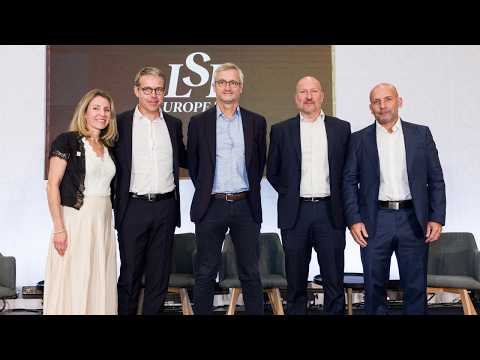
Precision Diagnostics for Prevention and Early Intervention: Shifting from Illness to Wellness | LSI Europe '25

Industry leaders from diagnostic companies and venture capital discuss how advanced diagnostic technologies are transforming healthcare from reactive treatment to proactive prevention, enabling earlier interventions and a wellness-focused approach.
Join Our Next Event
Partner with the leaders
shaping the future of
Medtech at LSI USA ‘26
March 16th - 20th, 2026
Waldorf Astoria, Monarch Beach

Soyoung Park  0:05  
Hello everybody, thank you for joining our panel discussion. I appreciate that. So we are going to talk about the how our technology evolved from illness to wellness. So with that topic, we brought the amazing panelists here, and we'd like to talk about their technologies and their difficulties and what they actually achieved here. So first of all, my name is Soyoung Park. I'm the general partner of 1004 venture partners located in San Francisco, Bay Area, San Diego and Boston. We invest in transformative technologies to support healthy aging. My goal is to reduce the longevity goal between the lifespan and health span. So now I'd like to toast to our amazing panelists here. Would you please introduce yourself?


Scott Burger  0:54  
Hello, everyone. My name is Scott Burger. I'm the CEO of angio insight. I've been in artificial intelligence and machine learning for a number of years, starting out with Johnson Johnson and bio since Webster 15 years ago, spent 10 years there, then had the great opportunity to work for heart flow, where I brought that technology to market and saw firsthand how difficult new to transformative technologies are bring, are to bring to the to the marketplace. Since then, I've been the Chief Commercial Officer at a company called El lucid technology, which is another AI machine learning technology right now I have the wonderful opportunity to work at Anjo insight, where I'm the CEO, and we have a transformative technology, not only to do FFR in the cath lab more quickly and easily, because there's a significant unmet need there, but one of the things that's near and dear to my heart is the diagnosis of coronary microvascular disease. Which one out of two women have coronary microvascular disease, as opposed to the large vessels coronary artery disease. And we have a real opportunity to be able to transform medicine by not only giving that that CD analysis, but going a little deeper and finding predominantly women who have small vessel disease. So it's been an exciting challenge, and we're having a lot of fun at Andrew insight, right?


Toon Ovebeeke  2:26  
I'm Toon Ovebeeke. I'm the CEO and co founder of Vitestro. I have a background in mechanical engineering, joint painting company, and in 20 2017 I found a fidestrong. We automate the blood drawing procedure from start to end. And Id came from a good friend of mine. His father was diagnosed with cancer. He had chemotherapy, and it was very difficult to draw blood from his veins. So he said, is it not possible to improve this procedure? So we started to talk to a lot of labs in hospitals, and since then, we basically developed a device that does the blood drawing procedure completely autonomously. So it picks up the new needle, the band edge, it's fresh alcohol in the arm to patients, looks for the veins located, draws blood from the patient, and then sticks a bandage on the arm of the patient. So robotic, robotic device. And then, very exciting. We're CE marked right now, and we're working on our FDA clearance.


John Sperzel  3:26  
Hi, everyone. I'm John Sperzel. I have spent 30 years in diagnostics, came up through the commercial organization of many of the large diagnostic companies. The companies that I've been with are now owned by Roche, Siemens and Abbott, the last 15 years have been in smaller diagnostic companies ranging from pre revenue to 150 million in revenue. I'm also a heart transplant recipient, and I sit on the board of directors of the organ procurement and transplantation network that's under the US Department of Health and Human Services that was part of my promise to pay it forward. I'm privileged to be the CEO of vivid diagnostics, which is a spin out from the University of Oxford, and it is currently funded by Oxford science enterprises. Our mission is to bring precision diagnostics to the microbiology field, which has been relying on blood cultures for almost 50 years, which is an outdated, antiquated technology and has two significant limitations for patients, payers and providers. One is that it takes days to get diagnostic results, and two, it is very imprecise or insensitive system that has sensitivity of about 60% meaning it misses a lot of infections. So how we're doing that is we are detecting sepsis causing pathogens, bacterial or fungal pathogens, directly in blood in only 30 minutes. We're also detecting antibiotic resistance or antibiotic susceptibility. In three hours. Both of those take days today, and those diagnostic delays lead to increased cost poor patient outcomes, and we think we can dramatically improve that and disrupt that microbiology field. Excellent.


Soyoung Park  5:15  
Thank you so much for the introduction. What you are developing and also executed is impressive, and also it's really aligned our goal, illness to wellness. So I am just curious. You are definitely more into the prevention. We all know prevention is important, but why we didn't have prevention so far? And I want to hear your motivation and your vision, what you want to achieve, what kind of impact you want to bring to the society through your technology and your research. Can you share with that, briefly, with us?


Scott Burger  5:53  
Yeah, absolutely. So I firmly believe that that prevention and early detection go together hand in hand, and in today's world, for a patient to go into the cath lab, 50% of the time, they come out without an answer as to why they have chest pain. A lot of those delays whether, whether it be coronary artery disease or coronary microvascular disease, actually lead to heart failure, as well as a number of other problems. So ensuring that we have early detection to be able to find what is at the heart of the problem of these patients will be critical to ensure that that we save, save money and save lives downstream with these patients and with health systems, as we look at the aging that's happening in our population right now, we really have to focus on making sure that we get to the heart of the problem, whatever it may be, in my instance, heart, but for everyone's problem, we have to get to that earlier so that we can make sure that We improve the patient's lives, reduce the costs.


Toon Ovebeeke  7:01  
Absolutely, yeah, so, so obviously, prevention is, is better than curing something. So if you look at blood drawing, specifically, because 70% of the decision making in the in the medical world is based on blood. So blood is just like, extremely important right in US alone, there are over 1 billion blood rolls done every year, 1 billion, and that number grows every year by four to 6% depending on the numbers that you look at, four to 6% that's about like 50 million additional blood rolls per year. And in order to keep up with that volume growth, shortage on labor is a huge issue. So we see our technology really as an enabler for, well, early treatment, or at least like prevention. So that's that's really our vision, that we can make sure that we transform that part of the of the process so we can enable prevention.


John Sperzel  8:04  
Well, Scott, I've personally been in the cath lab 28 times for right heart tissue biopsy, and so I know firsthand what it's like to wait for diagnostic results. And I think so young as you talk about the prevention, prevention and rapid detection do go hand in hand. I mean, think you got that right. Scott and many issues, illnesses, diseases, rapid detection is critical to patient outcomes. We're focused on initially, sepsis and antibiotic resistance, and there, the data is clear for every hour of delayed targeted treatment, meaning that you have the patient on the right drug for the right bug, mortality rate increases by up to 8% that's 8% for every hour of delayed diagnostic treatment. So in some cases, diagnostic delays are frustrating, like we'd like to have the answer sooner. In other cases, diagnostic delays are life threatening. You take a patient that has a bacterial infection that can become septic, that can lead to severe sepsis, limb amputation and death that can happen in a matter of hours and days. So fiddling around with diagnostics that are based on old technologies that lead to delays of hours, or, in many cases, days, leads to poor patient outcomes, leads to longer hospital stays, which is increased hos cost for the hospital. And in our case, we're not just trying to save the patient, we're also trying to preserve the antibiotics and the anti fungals that we have now and not overuse them, give clinicians the tools so they can get these patients on targeted treatment and reduce the global threat of antibiotic resistance.


Soyoung Park  9:54  
Yeah, absolutely. Now we all know if we find a disease. As early as we can, we can actually help the patients to live longer and treat them very, very efficiently. So as you said, Scott, I'm curious. We actually, if we can help with your technology. I know you are all into the AI technologies. We are talking about AI all the time nowadays, and we actually think about, okay, everybody talking about AI, but where we are in health care, and you guys are definitely all in front line to talk. You bring the AI to our real world in diagnostics and also robotics. So Scott, you bring it up more like, how can we make it accurate? How can we actually make it more useful? So, of course, all of us know AI, but can you explain AI? How does it actually improve our lives with especially for you through your technology? How accurate? How precise, actually, we can help the patients and providers can find out this disease, and then what does it mean to the patient and providers?


Scott Burger  11:11  
Yeah, so it's an interesting it's an interesting question, as I think back on my career and what Charlie Taylor and John Stevens did at heart flow with developing that technology, it allowed a physician to look more deeply into how the blood is flowing through the heart, and we've seen that make dramatic impact on patients lives, getting patients into the cath lab when they need to and keeping them out of the cath lab when they don't need to go. It's amazing to to watch the transformations in AI as I think back in my time at Hartford, and fast forward 15 years, looking at the technology and how it's changed, and imagining that that a lot of the AI that was done 15 years ago has fundamentally changed. It's much quicker, it's much more robust. And so we've really focused on using some of the cutting edge AI algorithms to incorporate into our system. And what we see with that is ensuring that we have a mix of engineers who have vast experience, but also bringing people in who are who are fresh out of school, who have the latest AI education, to be able to insert some of that into what we do, what what we're seeing with with accuracy on things that that currently are very difficult to do, the the diagnosis of coronary microvascular disease, it takes 15 to 20 minutes, and it's done probably less than 3% of the time because it's so tough to do, but one in two women have it. So so there needs to be something that can be done, but it has to be fast and it has to be accurate, and so our focus is really on ensuring that we're using the right type of algorithms to drive speed, to drive reliability and to drive ease of use, because we see a lot of things that that may work very well on the cath lab or other places, but they're not used because they're difficult or they take too long, and so You have to balance both of those things. And I, when I was young, my my grandmother had chest pain, and she went to the cath lab. They thought everything was fine. In less than 12 months, she was no longer with us. And so that's always stuck with me, that we need something for this. And so when I had the opportunity to sit down and talk with Andrew insight, I was blown away by the technology, and I saw right away that this is something that that could make FFR better, but more importantly, it could save women's lives.


Soyoung Park  13:53  
Yeah, also, thank you for sharing your stories. Makes me feel sad, but that's the reason we are here. We really want to help people to live healthy as long as they can, and we want them to maintain their dignity of life, to the through, throughout their lives. So Jon, you actually kind of also using AI technologies and more focused on the sepsis. So would you please kind of tell us how only you can actually find sepsis, and what does it really mean to the providers and patients we find sepsis earlier? Can we be sure way faster in like an infection as well? And then how does it actually can affect


John Sperzel  14:36  
it's one of the three pillars of innovation in our platform. So the first thing that we're doing to try to take a major leap forward in sepsis and antimicrobial resistance is do the detection directly from blood. I mean, blood specimens are messy. They're difficult to deal with. We have to separate billions of red blood cells in a single sample, and we do that. That through innovation, using micro fluidics, reagent free, is a very cost effective injection molded plastic that doesn't have cold supply chain issues. So that was a real core innovation. And I would say that when our our venture investor invested in the company, they took a bet that we would figure that out, and we have. The second is that we could develop a database, a Raman spectra database, because we're using Raman spectroscopy, where we shine a laser on a pathogen and and we fingerprint it. And that database is really critical, because it's going to allow us to scale very quickly and very cost effectively. We can start with 40 to 50 targets that will cover 95% of bacterial driven bloodstream infections, but we need to ultimately scale that to hundreds, so we can displace blood culture entirely, and a database driven model is what Brooker used, who's the market leader with their MALDI TOF system, except they still rely on a positive blood culture. So we're going to do what they did with the database model, but we're going to do it directly from blood, which is going to make it much faster and quickly scalable. The third piece is really, really critical. And if you're developing a diagnostic in 2025 and you're not using AI and machine learning, you better figure out how to incorporate it into your platform, and you better start yesterday. For us, what allows us to do is provide precision, which is making sure we get the right answer for the customer. And speed and speed is really critical. We talked about how important it is to to have a rapid detection system when it comes to sepsis and antimicrobial resistance, which are two of the biggest killers in the world. Many people don't know this. Sepsis kills more people globally than all cancers combined. Sepsis 11 million every year, all cancers combined, about 10 and a half. So most people are not aware of that. It's the number one killer in US hospitals. It's the number one cost of hospitalization, and it's the number one cause of hospital readmission. So this is a big problem. We have to solve it to save patients, but we also have to solve it to save the antibiotics that we have that currently work, and if we keep misusing them over using them, they're not going to work on common infections, and the pipeline for antimicrobials is very, very thin. So we're using AI as a core element, core pillar of our of our platform, yeah,


Soyoung Park  17:33  
this amazing weekend now to answer the questions the patient way faster, just going to blink of eye. We now find out you have a sepsis or not, and now let's can enter it right away. But all of this without blood. We cannot do anything we are talking about with the blood. Now we can do anything so toon, please let us know you built literally like amazing robot. Do you can do blood draw automatically? What does it mean? Does it mean the patients go there and they just kind of automatically, the blood just kind of evaporate and they collect it there. Could you explain to us a little bit more about it?


Toon Ovebeeke  18:10  
Yeah, sure, yeah. So we well, first of all, it's the number one question, right? Are patients willing to use a robotic device to dry a blood and can sound scary, but I think it isn't. So we we spent a lot of time on, like, the usability of the system, the design of the system. How can we make it as friendly as possible? So that's basically, that was the starting point of the technology. Because how you are going to develop the technology really, like, we put the user first, basically in whole development process. So patient just inserts the arm in the device. They can just see the arm like it's not a black box with a hole in it, though it's very open design. There's a strap around the arm like a Tony K, which is also with the current bottle ring setting. And this is relax, lean back, look at the user interface, and then, well, they're both gone wrong, right? So we have done over 6000 blood rots to date, and well, patient adoption is one of the most important things that we measured, and what helps is patient experience less pain. Using our technology, you can even distract them, although we don't do it yet, it's definitely a huge opportunity in the future, like, Well, looking at a Disney Disney video or whatever. It's a great opportunity to distract people, and when you're distracted, you don't feel pain. So we really try to make that patient journey as good as possible, because once patient return to the lab or hospital, well, we need to make sure that they choose for the device if they if they have a choice, right? In some institutions, there might not be a choice, but in many there will be. So we have tested this in with a lot of like European data that support that. Then you go to the US, and then obviously, in the US is like. Well US patients are very different, so you need to test it in the US as well. So we did a test at Mayo Clinic, so we tested it very extensively as well, and actually the feedback of the well US population was even more positive than the European population. So although this is a hurdle, I'm sure we will we have solved it, and we can roll it out for a broader population.


Soyoung Park  20:22  
Yeah, that's really cool. So now we even automate the block draw. And I'm just curious you think about that. A lot of people think about, oh, my goodness, will AI take over my job? Am I losing my job? Because not everything is automated, so kind of that blow drawer kind of robotics, maybe we don't need that many specialists. So how can you kind of answer these kind of questions on your perspectives?


Toon Ovebeeke  20:55  
Yeah, so with our customers, and it's no not with our with our main customers, are key, like our key opinion leaders, but especially with like, the phlebotomist itself, there's obviously, obviously, like, fear that we will replace them, right? That's their fear. If we, if we explain them, like, how many rotations there are? Like, how sometimes it's so busy there's like, over one and a half hour waiting lights. And if you explain them, well, if you get use of machines. How great, if you can get rid of the weight lines, right? That's like they just, there's, there's more capacity to do the blood drawing. And besides that, the role will change, because some of them, they have been phlebotomies for the last 20 years. If your role changes from doing a blood draw. Because the reason that they are phlebotomists may be good to mention that is that they want to be involved in care. They want to help the patient. That's that's their main number one reason, if we give them the opportunity to supervise several devices at the same time, so their interaction with the patient becomes more and more because they can say to the patient, well, you're a good go. They they put a hand on the shoulder. You're all you're set, you're all set. Let's go. And so their time, the time that they have to interact with the patient, will even increase in a supervised setting compared to what's today. So if you've taken through that process and help to explain them, and I think the previous panel was about like, also that education is so important and and we believe that as well, and that's also why we implemented the well, we train the trainers and the trainers then train the rest. So you need to be certified to to use system as a supervisor, just to make sure that they get the right education to to well, to let the patients feel comfortable using the device.


Soyoung Park  22:38  
Yeah, that's amazing. So AI technologies not only make our process more efficient, but also help the people to kind of focus on more like personal interaction, rather than just doing mechanical tasks. So I really hope it it happens that way, and it lead us to have a better lives in the future, let's just shifting our gear and talk about a little bit more about your business development. So now we, you guys, already made a lot of success in development and probably about to execute your technology, and you've already executed your technology previously. So I want to, want to kind of share your wisdom or experiences, so you can actually show that what was the kind of most difficult and hurdles you experience in the innovation developing this kind of innovative technologies using AI sounds like an amazing a lot of buzz there, but still, it's very hard to develop. So I'm kind of want to share your stories to our audience. Maybe start from Scott, sure, sure.


Scott Burger  23:55  
So there's a couple of different things there. First of all, on the development side, as you're growing your team to to innovate, I've been in organizations in the past where you see that if you don't have a culture that embraces change and and willingness to make mistakes, you sometimes have a hurdle where, where some of the engineers aren't completely transparent with With with some of the challenges that they've seen. So we've, we've really focused on ensuring that it's a culture where people are okay to make mistakes, share them right away, and we'll together, we'll work them out. It's, it's something that I think is so important, just having that culture where everyone feels like they can be vulnerable, and everyone feels like they can add to input on what things are happening. As far as the commercialization, I think back to my days at hartflow, where I took over the western half of North America for the whole field team. And hartflow is a tremendous technology, but what we. Saw was CTA was only done in 6% of diagnostic cases. It's up to 10% now, but it's it wasn't only about growing the ffrct. You had to grow the CT first, and reimbursement is always such a barrier, so you have to be strategic, and you have to really think outside the box on how you can make this a viable solution to the to the physicians, so that they can use it with their patients when the reimbursement may not be there, reimbursement is such a big driver in our marketplace, and finding ways to to ensure that you work with the facilities and ensure that they can use the technology as you're building that that level of evidence for for reimbursement is critical.


Soyoung Park  25:52  
Start with John


John Sperzel  25:53  
Sure so on the development side, and then I'll come to commercialization. On the development side, I've generally seen barriers in two areas, either technical or regulatory, and in almost every case, besides having the right corporate culture, it's come down to having the right people the right have the right people on the bus and have the right people in the right seats on the bus and and that's critical. So make sure you have the right talent in the company to solve problems, or, if it's a short term problem, make sure you have the right external partner to help solve that that specific problem on the commercialization side. And I've commercialized diagnostics, as I said earlier, in very large companies and in smaller companies. The playbook for successful commercialization doesn't differ that much from company to company. I mean, it starts with having a good product and having the right clinical data. And it's not just data to get through regulatory agencies. It's data that's compelling for customers to adopt your product, to try it, and then to use it. So there's a there's a clinical data element, and then there are establishing key opinion leaders, getting key reference accounts and and reimbursement. Fortunately for us, at vive dx, our technology, if we look at the US market, is paid for under the DRG payment system. So that's not a regulatory hurdle that we have to necessarily jump over. It's one that we we can play within and with an effective diagnostic tool that we think is highly differentiated. We think we can play there really well when it comes to hurdles commercially, I think as a as a smaller company or an innovative company that's entering the market. One of the biggest hurdles that I've encountered is access to customers. And again, if we think about the US hospital market, it's 6500 hospitals. Feels like a reachable end, right? 6500 you don't need an army to reach that. It's not like hundreds of 1000s of physician offices. However, in this environment, the sales process is much more complicated. It can be much longer, and it involves many more people within hospitals before they adopt innovative technology. And I've seen firsthand where sales reps couldn't get access to customers because the company or the brand was not well known. I've seen instances where, if it was an important capital sale, the CFO or somebody in finance at a high level would step in and look at the company's balance sheet. And there was just a panel here before us talking about raising capital, and so having a thin balance sheet can be a barrier to entry in in many markets, including US hospital market. So ways that I have overcome that in the past is through partnerships, through partnerships with some of the major diagnostic companies, which on the one hand, we might view as competitors or people that would take a defensive posture with our products, but I have personally been involved in some of those relationships where they turned out to be super successful for all parties. So there are large diagnostic partners, there are pharmaceutical partners, which sometimes have different incentives, and sometimes don't always work, but they can work beautifully in the case of a diagnostic that can help direct an antimicrobial, for example, which is what we're doing at vivid dx. And then lastly, there are large distributors that that I have partnered with to overcome the Customer Access side of things in international markets outside the US, in many cases, distributors have a big advantage because they've been selling products in certain markets for decades where a new, innovative company comes in, again, unknown brand, no relationships, barriers to entry, so partnerships are. Really effective way to knock down some of those barriers to entry, especially in the early days. I'll give you one example I was I was building a US company for a European based public company that we had no infrastructure, we had no people, we had no facilities, and we established a partnership with Abbott, an exclusive commercial partnership, and that lasted three years, and it was great for them because they needed entry into a certain market. It was great for us because we needed access into that market. And after three years, we went our separate ways. Obviously, Abbott is a super successful company. It didn't hurt them to lose our product. Our company was acquired, and then Abbott acquired that company, so they got it back. So again, these kind of partnerships can take on many different forms and go down many different roads that we don't necessarily envision entirely.


Soyoung Park  30:54  
Yeah, amazing insight. It's really exciting to hear about your real story. So June, would you please share you I know your robots are already using in the European hospitals. So how was your experience to actually make this acquisition by the hospitals for the large machine medical devices? So what was your experience? Can you give us a little bit more detailed experience?


Toon Ovebeeke  31:20  
Yeah, so we had sort of first question you need to ask yourself is, are you going direct, or are you going through a distributor or a partnership? So we decided to go direct, which requires more capital, but at least it's within your control, your expansion. So in Europe, it's slightly easier, because in Europe, you can sell your devices before you get CE marking. So it's possible to start commercialization already when your product is not yet regulatory cleared in us. In US, that's in no go. It's not allowed by the FDA to do that. So in Europe, we were allowed, we were able to sell the first, I think we sold about 15 devices before, so one five before we got ready for a clearance, which was a great way to Well, first of all, show investors that there's traction, but also that your order book for the first year, because we have, we are now in the middle of a limited market release, so your order book for first years is basically full. You have the size where you build those relationships with over the years, and then you can start deploying the first system straight after you get the regulatory clearance to start with your post market study, if required. In our case, that was not required, but if it's required, then it's great way to do that, to combine those two things in the US. I think it's slightly more complicated, especially as a European company, because you need to build up everything in the US, set up the entities. You need to hire the right people to do the work for you. You're not there every day, so it's more difficult to control it. So we were lucky enough to to find our chief current, our currently, our Chief Commercial Officer in us, who's been, well, very successful already with previous companies and now joined us. So he's leading now the commercialization, or, well, we are still pre FDA, but not call it commercialization, but market research in the US. So he's leading that right now, and we're now setting up all the collaboration ships with a lot of different hospitals and hospital systems, and that works out very well. So building those relationships over time, I think, is very valuable and and very important to well, generate the right clinical evidence support that commercialization once you're ready for it, and that's what we're doing now, but we because we also want to do the servicing ourselves, at least from start onwards. We really take a regional approach within us, because it's in terms of like size keyword, show we take this regional approach with those who will target the systems. And so far so good. I mean, no commercialization yet in us, but in Europe, it works out pretty well.


Soyoung Park  34:03  
Sounds that's amazing. I really, really enjoy to hear your like a forced attempt initially. Maybe it's a baby step, but hopefully it'll be a big in the future. So we can actually have a lot of people can benefit this cutting edge technologies. So I just gonna want to wrap it up. Now. We have only three minutes left. Sorry, I couldn't go to the Q and A session. But as all our effort, what we really try to do is to convert from illness to wellness approach. So we want to start from prevention rather than cure. So for that, is there any you want to share as wisdom or device or Kip? Could you kind of share one each?


Scott Burger  34:53  
Yeah, absolutely. So I had the the honor of attending the World Heart Summit. I was asked to be on a panel of. At the World Heart for the World Heart Federation, and it was a women's microvascular dysfunction panel and early early detection prevention was, was the panel that I was sitting on. And there were physicians from Africa, from from Asia, from South Asia, Australia. And I grew up in a small community in North Dakota and and I talked a little bit about my grandmother. You don't know if it was women's heart disease, you don't know if it was physicians who aren't super skilled, or you don't know if it's the technology being 30 plus years ago. But what really struck me is is after we were done with that panel discussion, having the opportunity to sit down and talk with many of these doctors, and they all talked about, none of this AI reaches us because it oftentimes needs skilled users. And so I think as as AI is, is moving towards prevention and and early early diagnosis. I think it's really critical that we take into account that these technologies need to be able to be used by not only the largest institutions, but the smallest institutions, and not only in countries like the United States or Great Britain, but in a smaller country, in rural areas. So that's one of the things we're focused on. It at angio. Insight is we want early detection, we want prevention, but we want it to be able to be used by everyone, and that's a real focus for us.


Toon Ovebeeke  36:38  
Yes, I think prevention is a huge opportunity, and especially today with liquid biopsies, what it just gives the ability to screen like whole populations and for example, and it's just already started with with the screenings, I think the the main question is, is, is it cheaper, or is it more expensive? And that's, that's a question that I think is not yet answered, and there's a lot of different opinions about that. Opinions about that, because many people believe it's more expensive because, boy, you detect it early, or you have a false positive, for example. So I think that's still a hurdle to overcome. I think our device can really be an enabler to accelerate this trend. So looking forward to the next couple of years to see how that


John Sperzel  37:22  
plays out. Well, I'm a living example of illness to wellness. I was a perfectly healthy guy for 53 years, got diagnosed with something that has been diagnosed 300 times in medical history, meantime, to death of four months. And I will tell you that diagnostics were a very, very important part of my survival and getting a heart transplant, I fought for my life for 55 days in a cardiac surgical intensive care unit. So I know how important diagnostics are and precision diagnostics are the future. Excellent.


Soyoung Park  37:55  
Thank you so much all. Please give us a round of applause to our amazing panelists. We're there sharing stories. Thank you so much. Thank you. Thank you.