Brian Rowett 0:05
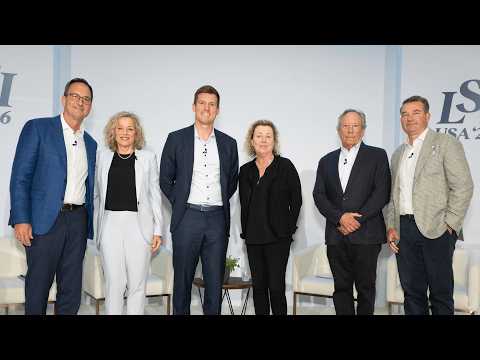
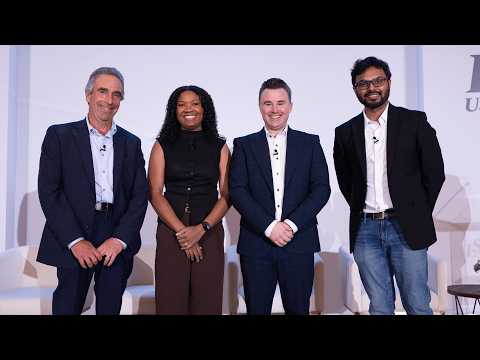
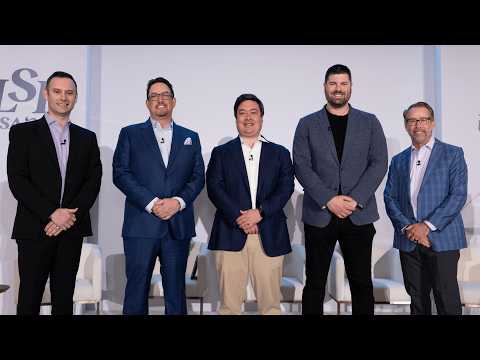
Hi everyone. Thanks for for joining us this afternoon. It's a pleasure to be here and to bear witness to all the exciting innovation that continues to brew in healthcare. I'm Brian Rowett. I'm an investment banker at Goldman Sachs, I've been in our healthcare practice for almost a decade now. I'm joined by our panelists, Bibi, Ashley, Craig and and David, who will all introduce themselves in kind. So maybe let's go to that. Maybe we can spend two minutes each you could. You can tell us about your background, your firm's focus, and what kind of companies you invest in. And then we can go on to some themes you're seeing in this space. Maybe we'll start with Bibi.
Bibi Sattar Marques 0:51
Thank you. Hi everyone. So I'm Bibi Sattar Marques. I'm partner at Buenavista Equity Partners. We VC firm based in Portugal and Spain. We have activities in Latin America, in the US, bridging now with the Asian countries as well. We are in venture capital. We're very much focused in health tech and med tech. I've been working VC for the last 10 years before I was at PwC consultancy and also did some work in regulation in terms of health tech, main focus currently, and main sectors that we invest in, remote patient monitoring, oncology, cardiology and mental health. So
Ashley Friedman 1:39
Thanks. Hi. I'm Ashley Friedman. I'm with Signet Healthcare Partners. Signet is a specialty growth equity firm. We focused exclusively on pharma and medical devices. We've been around for a little over 20 years. We're investing out of our fifth fund. Average check size is about $20 million dollars per deal within medical devices. We invest across therapeutic areas. We're agnostic to particular areas, more focused on business model. Typically enter companies circa $10 million of revenues with the goal of helping them grow from 10 to 100 and hopefully getting a interesting and exciting exit.
Craig Matturro 2:25
Hi everyone. This is Craig Matturro. I'm with 1315 Capital. We're a similar to the other panelists, a healthcare growth equity firm. So all we do is invest in commercial stage healthcare companies. Commercial stage for us is really 5 million of revenue on the low end, upward to 50 plus million on the high end, and really providing that capital and expertise to help companies navigate and scale to the next inflection point. We're broad within healthcare. We do healthcare services, consumer health and wellness, outsource pharma, Medtech services and as well as and medical device companies, which is pretty broad, includes devices, tools, diagnostics. We're about a decade into the firm on our third family of funds, a little over a billion at u m and we write check sizes anywhere from five up to $40 million into companies.
David Kereiakes 3:19
I'm David Kereiakes. Thank you to the team at LSI for including me again this year. I come from a family of 20 physicians, nurses, scientists on both sides, and so spent a lifetime in healthcare. Rather than become an MD, I decided I wanted to try and have not only an impact on patient lives, but the lives of those delivering care. And so most recently, I helped run innovation and investments for Providence, St Joseph, the third largest non profit health system before joining Windham. Windham has been around for 17 years. We're investing out of our fourth fund, I joined as a co managing partner to help lead that fund, where we focus in medical devices, software, digital health and diagnostics, and uniquely the convergence that we're seeing across all of those verticals. So thank you for having
Brian Rowett 4:11
me. There's so much innovation happening in healthcare. There's, there's, there's so much of it showcased here throughout the week. Maybe you can each talk about some of the most interesting categories you're seeing now. What are some of the most promising technologies? What are the areas that you see most ripe for disruption? Maybe we'll start with you Dave, and work back this way.
David Kereiakes 4:36
Yeah, so having a foot in both devices and software digital health, having lived inside of a nonprofit for six years, the fortunate, unfortunately, it's a target rich environment. There's no shortage of problems plaguing the healthcare system, which means opportunity and now. Healthcare is finally coming into the digital age. It's it can't be impervious to it for as long as it has. And so we're starting to see a $4 trillion industry, the third largest global economy in and of itself, behind China and the US finally starting to be realize the benefits of what software and digital health can provide in efficiency. So even just access and cost, affordability of care is just the basics, is where we're seeing a lot of great opportunity. Of course, there's cardiology that's seeing a lot of advancements, and the appetite from strategics are still still healthy and makes that category viable. But there are a lot of opportunities, so I'll leave some for my colleagues here to talk on to Yeah,
Craig Matturro 5:56
I would say a similar theme there. This touches on broader than just medical devices, but cost containment. It's just care is getting so much more expensive, and I think a key aspect to that is the movement of procedures to the ASC setting. And there's some really innovative companies, whether it's from a product business model or just even a service model, that's enabling a lot of these procedures to move outside the four walls of a hospital and move into a lower cost setting in the ASC should be better care for the patient, better turnaround time, less invasive procedures, and there's a payment model to help kind of support that move so A lot of interesting opportunities there that we're paying attention to.
Ashley Friedman 6:45
I'd echo what Craig said. We're acutely focused on moving from higher acuity settings to lower acuity settings that enables better economics, better patient care, and closer touch points between the physician, the end user, and ultimately the device companies, we tend to focus on areas that are highly concentrated and niche, and you like areas where there hasn't necessarily been a lot of development, or where the standard of care hasn't changed in the last 30 or 40 years. So we look at one of the most recent areas that we spent a lot of time in, and ultimately ended up investing in. It was an organ transplant and preservation, where the standard of care was an ice bucket, and so we invested in a business that enabled better preservation and transportation, and ultimately better outcomes in that area. It's a highly, highly concentrated area, which is something that is of interest to us when we think about commercializing as a small company, highly targeted market. And there's just some markets that don't lend themselves to commercialization when you're a small, independent company, and there are others that are and so when we look at areas, we look at them through that lens. So that's something that we've been really focused on. And we continue to look for these specialty, niche areas where the standard of care is really not evolved over time, and where we can introduce a device or a therapy or a procedural solution that allows that area to evolve?
Bibi Sattar Marques 8:26
Well, we've been focusing mainly in the major problems that we identified in terms of health needs. So we have currently aging population. We have a lot of burden in the workforce shortages, actually in the workforce for dedicated to to health, also trying to democratize the access and possibilities of a larger number of people to have access To quality medical services. And taking that into account, we that's why we're focusing in in remote patient monitoring, so we can decrease the burden in the hospitals, and we can allow for patients to have better outcomes in terms of quality of service, also regarding oncology patients. What we saw after COVID, we have a lot of collateral situations coming out from the situation regarding COVID and the consequences that generated in terms of oncology patients. So basically this would be the main categories where we are currently trying to bring value in investing. Thank you.
Brian Rowett 9:44
How does the growth and maybe we can just what's the middle school term, pop popcorn. This next one. How does the growth investing market view the trade off between growth and profitability? How has that changed over time, and where do you see it go?
Bibi Sattar Marques 10:02
Going. So I would say that for early stage investors, we invest in seed until CVSA, we can sacrifice profitability in the beginning to increase growth for the companies. I would say for late stage investors, growth and profitability need to go hand in hand, because they need to prepare the next stages and long term value for the for the company. Also, what we see is that, as a seed investor, that we need to be more focused in allowing the company to actually do the proof of concept to prepare the entry in a strong way, the entry in the market, regulatory path, all that requires for the investors to be side by side with the with the founders working in stabilizing basically all the conditions so that the company, when enters the market, They prepare to actually go hand in hand with growth and profitability.
Ashley Friedman 11:06
I can comment on this one is one of my favorite topics. I know you guys know this. Being growth investors, you always hear we're going to go narrow and deep. Every company says that. No company does it zero. So as growth investors, we're always juggling profitability and growth, but those are really second order questions. I think the first order is, you don't get a prize for growth and you don't get a prize for profitability, you get a prize for growing enterprise value. So the question is, is what the right mix is between growing the top line and being mindful of profitability? And there's trade offs, and it depends on what area you're in. It depends on who your potential buyers are, and it depends on how you're going to work backwards from your exit to say, what is it that I'm going to get credit for, and what is it that's going to drive the enterprise value of the company? We're growth investors, so we're obviously mindful of not hemorrhaging money and burning uncontrollably. But at the same time, I'd say, in about a quarter of the investments that we're involved in, we actually push our companies to burn more, not less, because we think that there are good uses of capital. So it could be that, yeah, you could grow the top line by 30 or 40 or 50% and that's great. The question is, is, how much enterprise value do you generate by doing that versus, for example, running a study that gets you a new reimbursement code? And I think so all those things have to be fine tuned. They're bespoke. They're situation specific. There is no sort of rule of thumb. Oh well, you need to grow the top line by 30% and you need to be cash flow positive by year four of launch. I don't think it works like that. It really depends on assessing the situation and figuring out what grows the value of the business if you're growing at, you know, 100% top line and you have a 90% gross margin, sure put your foot on the gas and keep going. That works. But not everybody is in that situation. So I think the most dangerous thing you can do, because when we think about this, we think about, where are you? Where are you in the curve of your launch, and can you be a sustainable company? Right? Because if you're not, you might be looking at a financing in another two years, and everybody's sitting around looking at each other and saying, Okay, well, have we built value, or did we just spend the last two years burning money? And are we gonna have to raise another round? And everybody's at the same place that they started at, so it's really getting yield for the activity that you're doing,
David Kereiakes 13:43
yeah, if, if I can, I think there's a miss. And since there's a lot of entrepreneurs in the audience, there's a misperception on investors that money creates growth, and that's not it markets do, and customers and time in the market, right? And we just help enable that, and we help fund it. And the math, it's a simple equation, money in has to create more money out, right? And so growth is hard to come by. It's not created by capital that just gets put into a business. And there's this, potentially a textbook out there that says, once you get FDA approval, you need to raise 30 million, 40 million, 50 million to commercialize. And a lot of entrepreneurs come to us and say that, but there isn't the data that that helps us solve the money and creates this amount of money out and that the market is showing that because us just putting 3040, 50 million into a business that hasn't started commercializing yet is rolling the dice to see whether that the market will actually pull you or you're going to have to push which just means more money in that equation becomes out of line. So it's, I always encourage entrepreneurs, and it's a. Against kind of goes against larger funds that want to put money, good money, into good Technologies, a lot of money, to start with, a small amount of capital in a small setting, a small region, a targeted approach, with a target, targeted customer profile. And you can always tell the story that it just didn't work in that market. And this is what we learned. And you can tell that story and still attract new capital, because that math equation can still be solved
Craig Matturro 15:30
there. The only thing I'll add quickly is on the, you know, our 5 million revenue minimum, there's nothing necessarily magic about that number, but what we're trying to understand is the unit economics, and we want that proven out. So your bottom line could still be burning but we really want to make sure reps. We want to see how a rep scales up. Can they get up to a million dollars a year? What's the ramp up period for that? Is there a leaky bucket on the customer, where they adopt for the first three months and then fall off a cliff. So it's all that underlying metrics that then lead to, yes, if you fast forward in three years from now, absorb more overhead, will it be profitable? And seeing that underlying data gives us the confidence to see that.
Ashley Friedman 16:17
One last thing I'd add is, I mean, I think the most it's very difficult, because you've taken a long time to get your device approved. Yeah, you've probably done studies. Studies were probably bent towards getting regulatory approval. They may not have the right mix or value proposition for commercial or reimbursement, and now you're sitting there in your commercial, and you almost have to fight the impulse to say, Okay, we're going to hire 20 reps right off the bat. Because if you hire those reps and you don't start to ramp and you don't get traction, and you don't know what that unit economic model is, you're in a bad place fast. Unfortunately, that's just kind of the way devices and direct commercial rollouts work. They're very expensive, they're very risky, and rolling the dice before you know what the model looks like is something that we're very, very hesitant about.
Brian Rowett 17:21
I know you guys don't all invest in the same stages of companies, but maybe you can each talk a little bit about what financial profile you look for. What addressable market do you look to define for business, or have business define top line growth, gross margins, pathway to gross margins, ultimately, profitability. Maybe you can spend a minute or two on that.
Craig Matturro 17:46
I mean, you know, for us, we're very opportunistic, so we don't need the multi billion dollar market that's growing, you know, double digits. We kind of look at the opportunity in relation to the market. So we've been investors in wound care companies and neuro rehab companies, orthopedic companies. So maybe not the traditionally, you know, highest growth or sexiest market. So, you know, we're really just looking for, does that opportunity fit that profile and the strategics in the space? So you don't necessarily need a multi billion dollar market to create a lot of value for an investor who might or your company that might be looking to raise 20 to 50 million over the life of its existence. 200 $300 million exit could be very attractive, and again, can fit in a lot of different markets. So again, we look at it holistically or individually for each opportunity. In case,
Brian Rowett 18:45
how important is an expected strategic bid in the context of making investments or or put, put another way, how do you think about the likelihood of m and a takeout when you're when you're making an investment.
Bibi Sattar Marques 19:03
So go ahead in terms of investment decision, I would say it's very, very, very important, because while analyzing the value of the company, how it will increase, after going into all the milestones define for the growth and for value creation for the company, the strategic partner can basically enhance the value of the company and can help them in a transaction in the future, and being the exit, basically of the of the investor. So I would say it has a very it's very important to have the to understand whether the company will be able to attract strategics and in in the roadmap where we will be able to bring in this strategic to actually help the company to grow and to increase its value.
David Kereiakes 19:56
Yeah, there's no hiding that. We need a liquidity event, right? We're we need to invest and then return capital to our investors. But oftentimes entrepreneurs look at running 100 meter dash, and they cross that finish line and there's nobody there, and then you have to turn to the corner to run a 200 meter, then you run a 400 meter, and all of a sudden you're running a mile, and you're exhausted, the lights are starting to go out. Your legs, you can't feel them anymore. And so what we try to do is find really good opportunities where we can add more value than the cost of our capital. Help build a business to be bought, not sold, and just by building with that North Star that is this better for the business? Are we building the right infrastructure? And you really have to have a good foundation in order to enable growth. Somebody will come and buy it, and you can't predict when that head of business development will make that decision and when timing is right on their side. You just have to prepare for a long journey, pack accordingly and start the process. Communicate incredibly well and succinctly, so that you can bring all these other people along with you, whether a sales rep, an engineer, an attorney, an accountant, an investor. I mean, it's such a diverse group that really can help drive things forward, and at that time, it becomes opportunistic and and you end up being bought, which is a much different experience than being sold.
Ashley Friedman 21:36
Yeah. I mean, if I would just add to that, I think different made some really good points. Great companies get bought. They're not sold. Now, the dirty little secret in medical devices is, you know, you don't put your head down, execute, and then come up and flip a switch and you say, Okay, we're going to run a process. And there's 20 companies that show up, and you get 12 Lois, and then you're picking from the four or five that are best, and you get to, you know, create all this great competitive Tang. It doesn't usually work like that, or it hasn't for me, unfortunately. So in reality, in devices, you've got maybe three, four or five good buyers. Maybe there's one or two that are coming out of left field. Maybe there's a large private equity firm that's maybe looking to build a platform in the space, but you're not usually going to have, you know, 20 buyers deep. So without that buyer density, you can't, you can't fake the competitive nature of the exit the buyers know it. And so I think something that you have to do is get away from this idea of, we're going to flip a switch into exit mode. Exit mode. We have to prepare for the exit and work back from the exit. What do I need to look like in order to exit? Where do I need to be? From a revenue perspective, do I need to be break even or not? Some buyers need you to be break even in order for them to digest the acquisition. Some buyers care more about growth. And so it's it's different strokes for different folks. And then the question is, is okay if I, if I kind of know what the profile looks like, and I'm going to work backwards, and by the way, the profile is going to be different for different folks, and they may be distracted. So you can't just say, Okay, well, 2026 we're exiting. That's it. Work like that, right? So I think you have to establish a dialog with your buyers along the way, and there has to be a bit of this, which is, yeah, we're going to be for sale at some point. Most probably we want to get to know you, but you want to get to know us as well. And that dance, I mean, at least in my experience, that's not a six month dance, it's not a one year dance, it's three or four years. And, oh, by the way, during those three or four years, the person who may be heading up business development may rotate out as well, so that might start the clock. But I think that that sort of working backwards, and then really thinking about establishing relationships with the right types of buyers, what their profile looks like, and how you reduce their risk to get into the business, because that's really what drives a lot of exits, I think. So you have to have to think about that constantly. Have to work at it over time. It's not a flipping of the switch. Yeah,
Craig Matturro 24:10
well, you mentioned with the person leaving, you know, I think you really need to control your destiny and not rely on that group to be there in three years to pull the trigger on, you know, one they can move the goal posts on you. Oh, sorry, it's you're actually need to be at 100 million before we get interested. The BD person could have laughed. New CEO could have changed strategy. So it's definitely we're thinking about who the buyers are when we're going into an investment. But at the end of the day, the ultimate flexibility is to control your own destiny. It goes back to that profitability versus growth story. Is there a pathway to, if you need to hold on for another two or three years, can you do that in a capital efficient way that doesn't totally turn the cap table upside down? So, you know, all those factors we really want to, you know, have a long term sustainable pathway where. Where we're not, you know, we can let the buyer come to our companies, and not vice versa.
Brian Rowett 25:06
If I had to guess, all of you are meeting with some entrepreneurs and some companies for the very first time this week, maybe you can spend a minute each on what does the most effective sort of pitch, pitch look like if you're just sitting down for 1530 minutes with a with an entrepreneur?
David Kereiakes 25:28
Yeah, I would just say, I find the entrepreneurs I've worked with can succinctly communicate a complex value proposition in two sentences such that I'm not an MD, I'm not the smartest person in the room here that I can understand that and go and talk to a neurosurgeon and pitch it to them, and when you're able to succinctly communicate what we do is incredibly hard. There are a lot easier ways to make money than investing in healthcare and bringing a device to market and changing the way that we deliver care. Few more impactful on your community, but you have to be able to succinctly communicate a complex message to a variety of different people, such that they come along this crazy journey with you. So that's what I find is most effective. There's a whole lot of other stuff that goes into it, but you don't have to tell us everything, too. I think the best conversations are where you see the light bulb in our head go off and we start telling you what you already know, right? Have you thought about this? Have you thought about that? That's when we really start getting engaged with you, and want to be collaborative. And I think that's that's a learning
Craig Matturro 26:52
it's well said. I would love every pitch to be like that.
Ashley Friedman 26:57
Yeah, I agree. I don't. I don't have much to add on that. I mean, maybe the one thing I'd add so I want to understand what the sort of origin story is. Why are you doing this? What's sort of the mission? But I think that, combined with that value proposition, in a short, efficient period of time, in a simple manner that I can understand. I think that's that's the key. Then maybe one other thing is, you know, kind of what are you actually looking for in an investor beyond just capital? And I think that's important.
Bibi Sattar Marques 27:31
So I would also agree, I mean, has been said, Got
Brian Rowett 27:36
a minute and a half. I'd be remiss to not ask at this year's conference about the impact of AI. You know, we see a lot of tech innovation crossing into Medtech AI, of course, is is top of mind for everyone, all industries. What strategies do you see DC working best
Craig Matturro 27:59
a little less, maybe on the device side. But back to your point on how much is spent in healthcare, I think it's, you know, 15 to 30% on administrative costs. So that's a trillion plus dollars. So we're seeing a lot of companies that are able to basically make doctors and the whole system more efficient, to be able to see more patients deliver better care. And again, that ends up being a little more administrative, administrative versus actually delivering care, diagnosing a patient, or, you know, doing the surgery. So I think that that's where we're seeing some opportunities, where they're ingesting data, helping to make better insights make a physician's job easier. So yeah, that's
David Kereiakes 28:39
that side is coming. I think the regulatory and compliance concerns are real, and have kind of put a damper on the clinical side of AI, which I think will be remarkable. I think it would be really interesting to incorporate that in our practice, especially when you have a physician who's seeing their 10th patient at the end of the day, or at the end of the shift, where that that bias and just human nature comes into play. But there's this is such a Labor intensive industry, it's massive, and it's far from efficient, right? And so we have a well understood and recognized labor shortage. And so if you're able to better direct demand to the appropriate supply and allow that individual to operate at the best at the highest licensure that they can, that solves, in itself, a lot of the challenges that we have from a staffing standpoint and from a patient perspective, getting lost in the system, just being able to talk to somebody that can answer your problem when you need it. I'm really excited about the opportunity that AI has in it. It's been around for a long time, but what we're seeing in with generative AI and all of the and just how quickly it's it's turning Yeah. Yeah, it's an interesting space to be investing in because of how quickly the last gen is becoming obsolete and but it's, it's an exciting opportunity
Brian Rowett 30:09
With that, I think we're out of time. Thanks so much to our panelists, and thanks for joining today. Thank you.
Craig Matturro 30:16
Thank you.
Brian Rowett 0:05
Hi everyone. Thanks for for joining us this afternoon. It's a pleasure to be here and to bear witness to all the exciting innovation that continues to brew in healthcare. I'm Brian Rowett. I'm an investment banker at Goldman Sachs, I've been in our healthcare practice for almost a decade now. I'm joined by our panelists, Bibi, Ashley, Craig and and David, who will all introduce themselves in kind. So maybe let's go to that. Maybe we can spend two minutes each you could. You can tell us about your background, your firm's focus, and what kind of companies you invest in. And then we can go on to some themes you're seeing in this space. Maybe we'll start with Bibi.
Bibi Sattar Marques 0:51
Thank you. Hi everyone. So I'm Bibi Sattar Marques. I'm partner at Buenavista Equity Partners. We VC firm based in Portugal and Spain. We have activities in Latin America, in the US, bridging now with the Asian countries as well. We are in venture capital. We're very much focused in health tech and med tech. I've been working VC for the last 10 years before I was at PwC consultancy and also did some work in regulation in terms of health tech, main focus currently, and main sectors that we invest in, remote patient monitoring, oncology, cardiology and mental health. So
Ashley Friedman 1:39
Thanks. Hi. I'm Ashley Friedman. I'm with Signet Healthcare Partners. Signet is a specialty growth equity firm. We focused exclusively on pharma and medical devices. We've been around for a little over 20 years. We're investing out of our fifth fund. Average check size is about $20 million dollars per deal within medical devices. We invest across therapeutic areas. We're agnostic to particular areas, more focused on business model. Typically enter companies circa $10 million of revenues with the goal of helping them grow from 10 to 100 and hopefully getting a interesting and exciting exit.
Craig Matturro 2:25
Hi everyone. This is Craig Matturro. I'm with 1315 Capital. We're a similar to the other panelists, a healthcare growth equity firm. So all we do is invest in commercial stage healthcare companies. Commercial stage for us is really 5 million of revenue on the low end, upward to 50 plus million on the high end, and really providing that capital and expertise to help companies navigate and scale to the next inflection point. We're broad within healthcare. We do healthcare services, consumer health and wellness, outsource pharma, Medtech services and as well as and medical device companies, which is pretty broad, includes devices, tools, diagnostics. We're about a decade into the firm on our third family of funds, a little over a billion at u m and we write check sizes anywhere from five up to $40 million into companies.
David Kereiakes 3:19
I'm David Kereiakes. Thank you to the team at LSI for including me again this year. I come from a family of 20 physicians, nurses, scientists on both sides, and so spent a lifetime in healthcare. Rather than become an MD, I decided I wanted to try and have not only an impact on patient lives, but the lives of those delivering care. And so most recently, I helped run innovation and investments for Providence, St Joseph, the third largest non profit health system before joining Windham. Windham has been around for 17 years. We're investing out of our fourth fund, I joined as a co managing partner to help lead that fund, where we focus in medical devices, software, digital health and diagnostics, and uniquely the convergence that we're seeing across all of those verticals. So thank you for having
Brian Rowett 4:11
me. There's so much innovation happening in healthcare. There's, there's, there's so much of it showcased here throughout the week. Maybe you can each talk about some of the most interesting categories you're seeing now. What are some of the most promising technologies? What are the areas that you see most ripe for disruption? Maybe we'll start with you Dave, and work back this way.
David Kereiakes 4:36
Yeah, so having a foot in both devices and software digital health, having lived inside of a nonprofit for six years, the fortunate, unfortunately, it's a target rich environment. There's no shortage of problems plaguing the healthcare system, which means opportunity and now. Healthcare is finally coming into the digital age. It's it can't be impervious to it for as long as it has. And so we're starting to see a $4 trillion industry, the third largest global economy in and of itself, behind China and the US finally starting to be realize the benefits of what software and digital health can provide in efficiency. So even just access and cost, affordability of care is just the basics, is where we're seeing a lot of great opportunity. Of course, there's cardiology that's seeing a lot of advancements, and the appetite from strategics are still still healthy and makes that category viable. But there are a lot of opportunities, so I'll leave some for my colleagues here to talk on to Yeah,
Craig Matturro 5:56
I would say a similar theme there. This touches on broader than just medical devices, but cost containment. It's just care is getting so much more expensive, and I think a key aspect to that is the movement of procedures to the ASC setting. And there's some really innovative companies, whether it's from a product business model or just even a service model, that's enabling a lot of these procedures to move outside the four walls of a hospital and move into a lower cost setting in the ASC should be better care for the patient, better turnaround time, less invasive procedures, and there's a payment model to help kind of support that move so A lot of interesting opportunities there that we're paying attention to.
Ashley Friedman 6:45
I'd echo what Craig said. We're acutely focused on moving from higher acuity settings to lower acuity settings that enables better economics, better patient care, and closer touch points between the physician, the end user, and ultimately the device companies, we tend to focus on areas that are highly concentrated and niche, and you like areas where there hasn't necessarily been a lot of development, or where the standard of care hasn't changed in the last 30 or 40 years. So we look at one of the most recent areas that we spent a lot of time in, and ultimately ended up investing in. It was an organ transplant and preservation, where the standard of care was an ice bucket, and so we invested in a business that enabled better preservation and transportation, and ultimately better outcomes in that area. It's a highly, highly concentrated area, which is something that is of interest to us when we think about commercializing as a small company, highly targeted market. And there's just some markets that don't lend themselves to commercialization when you're a small, independent company, and there are others that are and so when we look at areas, we look at them through that lens. So that's something that we've been really focused on. And we continue to look for these specialty, niche areas where the standard of care is really not evolved over time, and where we can introduce a device or a therapy or a procedural solution that allows that area to evolve?
Bibi Sattar Marques 8:26
Well, we've been focusing mainly in the major problems that we identified in terms of health needs. So we have currently aging population. We have a lot of burden in the workforce shortages, actually in the workforce for dedicated to to health, also trying to democratize the access and possibilities of a larger number of people to have access To quality medical services. And taking that into account, we that's why we're focusing in in remote patient monitoring, so we can decrease the burden in the hospitals, and we can allow for patients to have better outcomes in terms of quality of service, also regarding oncology patients. What we saw after COVID, we have a lot of collateral situations coming out from the situation regarding COVID and the consequences that generated in terms of oncology patients. So basically this would be the main categories where we are currently trying to bring value in investing. Thank you.
Brian Rowett 9:44
How does the growth and maybe we can just what's the middle school term, pop popcorn. This next one. How does the growth investing market view the trade off between growth and profitability? How has that changed over time, and where do you see it go?
Bibi Sattar Marques 10:02
Going. So I would say that for early stage investors, we invest in seed until CVSA, we can sacrifice profitability in the beginning to increase growth for the companies. I would say for late stage investors, growth and profitability need to go hand in hand, because they need to prepare the next stages and long term value for the for the company. Also, what we see is that, as a seed investor, that we need to be more focused in allowing the company to actually do the proof of concept to prepare the entry in a strong way, the entry in the market, regulatory path, all that requires for the investors to be side by side with the with the founders working in stabilizing basically all the conditions so that the company, when enters the market, They prepare to actually go hand in hand with growth and profitability.
Ashley Friedman 11:06
I can comment on this one is one of my favorite topics. I know you guys know this. Being growth investors, you always hear we're going to go narrow and deep. Every company says that. No company does it zero. So as growth investors, we're always juggling profitability and growth, but those are really second order questions. I think the first order is, you don't get a prize for growth and you don't get a prize for profitability, you get a prize for growing enterprise value. So the question is, is what the right mix is between growing the top line and being mindful of profitability? And there's trade offs, and it depends on what area you're in. It depends on who your potential buyers are, and it depends on how you're going to work backwards from your exit to say, what is it that I'm going to get credit for, and what is it that's going to drive the enterprise value of the company? We're growth investors, so we're obviously mindful of not hemorrhaging money and burning uncontrollably. But at the same time, I'd say, in about a quarter of the investments that we're involved in, we actually push our companies to burn more, not less, because we think that there are good uses of capital. So it could be that, yeah, you could grow the top line by 30 or 40 or 50% and that's great. The question is, is, how much enterprise value do you generate by doing that versus, for example, running a study that gets you a new reimbursement code? And I think so all those things have to be fine tuned. They're bespoke. They're situation specific. There is no sort of rule of thumb. Oh well, you need to grow the top line by 30% and you need to be cash flow positive by year four of launch. I don't think it works like that. It really depends on assessing the situation and figuring out what grows the value of the business if you're growing at, you know, 100% top line and you have a 90% gross margin, sure put your foot on the gas and keep going. That works. But not everybody is in that situation. So I think the most dangerous thing you can do, because when we think about this, we think about, where are you? Where are you in the curve of your launch, and can you be a sustainable company? Right? Because if you're not, you might be looking at a financing in another two years, and everybody's sitting around looking at each other and saying, Okay, well, have we built value, or did we just spend the last two years burning money? And are we gonna have to raise another round? And everybody's at the same place that they started at, so it's really getting yield for the activity that you're doing,
David Kereiakes 13:43
yeah, if, if I can, I think there's a miss. And since there's a lot of entrepreneurs in the audience, there's a misperception on investors that money creates growth, and that's not it markets do, and customers and time in the market, right? And we just help enable that, and we help fund it. And the math, it's a simple equation, money in has to create more money out, right? And so growth is hard to come by. It's not created by capital that just gets put into a business. And there's this, potentially a textbook out there that says, once you get FDA approval, you need to raise 30 million, 40 million, 50 million to commercialize. And a lot of entrepreneurs come to us and say that, but there isn't the data that that helps us solve the money and creates this amount of money out and that the market is showing that because us just putting 3040, 50 million into a business that hasn't started commercializing yet is rolling the dice to see whether that the market will actually pull you or you're going to have to push which just means more money in that equation becomes out of line. So it's, I always encourage entrepreneurs, and it's a. Against kind of goes against larger funds that want to put money, good money, into good Technologies, a lot of money, to start with, a small amount of capital in a small setting, a small region, a targeted approach, with a target, targeted customer profile. And you can always tell the story that it just didn't work in that market. And this is what we learned. And you can tell that story and still attract new capital, because that math equation can still be solved
Craig Matturro 15:30
there. The only thing I'll add quickly is on the, you know, our 5 million revenue minimum, there's nothing necessarily magic about that number, but what we're trying to understand is the unit economics, and we want that proven out. So your bottom line could still be burning but we really want to make sure reps. We want to see how a rep scales up. Can they get up to a million dollars a year? What's the ramp up period for that? Is there a leaky bucket on the customer, where they adopt for the first three months and then fall off a cliff. So it's all that underlying metrics that then lead to, yes, if you fast forward in three years from now, absorb more overhead, will it be profitable? And seeing that underlying data gives us the confidence to see that.
Ashley Friedman 16:17
One last thing I'd add is, I mean, I think the most it's very difficult, because you've taken a long time to get your device approved. Yeah, you've probably done studies. Studies were probably bent towards getting regulatory approval. They may not have the right mix or value proposition for commercial or reimbursement, and now you're sitting there in your commercial, and you almost have to fight the impulse to say, Okay, we're going to hire 20 reps right off the bat. Because if you hire those reps and you don't start to ramp and you don't get traction, and you don't know what that unit economic model is, you're in a bad place fast. Unfortunately, that's just kind of the way devices and direct commercial rollouts work. They're very expensive, they're very risky, and rolling the dice before you know what the model looks like is something that we're very, very hesitant about.
Brian Rowett 17:21
I know you guys don't all invest in the same stages of companies, but maybe you can each talk a little bit about what financial profile you look for. What addressable market do you look to define for business, or have business define top line growth, gross margins, pathway to gross margins, ultimately, profitability. Maybe you can spend a minute or two on that.
Craig Matturro 17:46
I mean, you know, for us, we're very opportunistic, so we don't need the multi billion dollar market that's growing, you know, double digits. We kind of look at the opportunity in relation to the market. So we've been investors in wound care companies and neuro rehab companies, orthopedic companies. So maybe not the traditionally, you know, highest growth or sexiest market. So, you know, we're really just looking for, does that opportunity fit that profile and the strategics in the space? So you don't necessarily need a multi billion dollar market to create a lot of value for an investor who might or your company that might be looking to raise 20 to 50 million over the life of its existence. 200 $300 million exit could be very attractive, and again, can fit in a lot of different markets. So again, we look at it holistically or individually for each opportunity. In case,
Brian Rowett 18:45
how important is an expected strategic bid in the context of making investments or or put, put another way, how do you think about the likelihood of m and a takeout when you're when you're making an investment.
Bibi Sattar Marques 19:03
So go ahead in terms of investment decision, I would say it's very, very, very important, because while analyzing the value of the company, how it will increase, after going into all the milestones define for the growth and for value creation for the company, the strategic partner can basically enhance the value of the company and can help them in a transaction in the future, and being the exit, basically of the of the investor. So I would say it has a very it's very important to have the to understand whether the company will be able to attract strategics and in in the roadmap where we will be able to bring in this strategic to actually help the company to grow and to increase its value.
David Kereiakes 19:56
Yeah, there's no hiding that. We need a liquidity event, right? We're we need to invest and then return capital to our investors. But oftentimes entrepreneurs look at running 100 meter dash, and they cross that finish line and there's nobody there, and then you have to turn to the corner to run a 200 meter, then you run a 400 meter, and all of a sudden you're running a mile, and you're exhausted, the lights are starting to go out. Your legs, you can't feel them anymore. And so what we try to do is find really good opportunities where we can add more value than the cost of our capital. Help build a business to be bought, not sold, and just by building with that North Star that is this better for the business? Are we building the right infrastructure? And you really have to have a good foundation in order to enable growth. Somebody will come and buy it, and you can't predict when that head of business development will make that decision and when timing is right on their side. You just have to prepare for a long journey, pack accordingly and start the process. Communicate incredibly well and succinctly, so that you can bring all these other people along with you, whether a sales rep, an engineer, an attorney, an accountant, an investor. I mean, it's such a diverse group that really can help drive things forward, and at that time, it becomes opportunistic and and you end up being bought, which is a much different experience than being sold.
Ashley Friedman 21:36
Yeah. I mean, if I would just add to that, I think different made some really good points. Great companies get bought. They're not sold. Now, the dirty little secret in medical devices is, you know, you don't put your head down, execute, and then come up and flip a switch and you say, Okay, we're going to run a process. And there's 20 companies that show up, and you get 12 Lois, and then you're picking from the four or five that are best, and you get to, you know, create all this great competitive Tang. It doesn't usually work like that, or it hasn't for me, unfortunately. So in reality, in devices, you've got maybe three, four or five good buyers. Maybe there's one or two that are coming out of left field. Maybe there's a large private equity firm that's maybe looking to build a platform in the space, but you're not usually going to have, you know, 20 buyers deep. So without that buyer density, you can't, you can't fake the competitive nature of the exit the buyers know it. And so I think something that you have to do is get away from this idea of, we're going to flip a switch into exit mode. Exit mode. We have to prepare for the exit and work back from the exit. What do I need to look like in order to exit? Where do I need to be? From a revenue perspective, do I need to be break even or not? Some buyers need you to be break even in order for them to digest the acquisition. Some buyers care more about growth. And so it's it's different strokes for different folks. And then the question is, is okay if I, if I kind of know what the profile looks like, and I'm going to work backwards, and by the way, the profile is going to be different for different folks, and they may be distracted. So you can't just say, Okay, well, 2026 we're exiting. That's it. Work like that, right? So I think you have to establish a dialog with your buyers along the way, and there has to be a bit of this, which is, yeah, we're going to be for sale at some point. Most probably we want to get to know you, but you want to get to know us as well. And that dance, I mean, at least in my experience, that's not a six month dance, it's not a one year dance, it's three or four years. And, oh, by the way, during those three or four years, the person who may be heading up business development may rotate out as well, so that might start the clock. But I think that that sort of working backwards, and then really thinking about establishing relationships with the right types of buyers, what their profile looks like, and how you reduce their risk to get into the business, because that's really what drives a lot of exits, I think. So you have to have to think about that constantly. Have to work at it over time. It's not a flipping of the switch. Yeah,
Craig Matturro 24:10
well, you mentioned with the person leaving, you know, I think you really need to control your destiny and not rely on that group to be there in three years to pull the trigger on, you know, one they can move the goal posts on you. Oh, sorry, it's you're actually need to be at 100 million before we get interested. The BD person could have laughed. New CEO could have changed strategy. So it's definitely we're thinking about who the buyers are when we're going into an investment. But at the end of the day, the ultimate flexibility is to control your own destiny. It goes back to that profitability versus growth story. Is there a pathway to, if you need to hold on for another two or three years, can you do that in a capital efficient way that doesn't totally turn the cap table upside down? So, you know, all those factors we really want to, you know, have a long term sustainable pathway where. Where we're not, you know, we can let the buyer come to our companies, and not vice versa.
Brian Rowett 25:06
If I had to guess, all of you are meeting with some entrepreneurs and some companies for the very first time this week, maybe you can spend a minute each on what does the most effective sort of pitch, pitch look like if you're just sitting down for 1530 minutes with a with an entrepreneur?
David Kereiakes 25:28
Yeah, I would just say, I find the entrepreneurs I've worked with can succinctly communicate a complex value proposition in two sentences such that I'm not an MD, I'm not the smartest person in the room here that I can understand that and go and talk to a neurosurgeon and pitch it to them, and when you're able to succinctly communicate what we do is incredibly hard. There are a lot easier ways to make money than investing in healthcare and bringing a device to market and changing the way that we deliver care. Few more impactful on your community, but you have to be able to succinctly communicate a complex message to a variety of different people, such that they come along this crazy journey with you. So that's what I find is most effective. There's a whole lot of other stuff that goes into it, but you don't have to tell us everything, too. I think the best conversations are where you see the light bulb in our head go off and we start telling you what you already know, right? Have you thought about this? Have you thought about that? That's when we really start getting engaged with you, and want to be collaborative. And I think that's that's a learning
Craig Matturro 26:52
it's well said. I would love every pitch to be like that.
Ashley Friedman 26:57
Yeah, I agree. I don't. I don't have much to add on that. I mean, maybe the one thing I'd add so I want to understand what the sort of origin story is. Why are you doing this? What's sort of the mission? But I think that, combined with that value proposition, in a short, efficient period of time, in a simple manner that I can understand. I think that's that's the key. Then maybe one other thing is, you know, kind of what are you actually looking for in an investor beyond just capital? And I think that's important.
Bibi Sattar Marques 27:31
So I would also agree, I mean, has been said, Got
Brian Rowett 27:36
a minute and a half. I'd be remiss to not ask at this year's conference about the impact of AI. You know, we see a lot of tech innovation crossing into Medtech AI, of course, is is top of mind for everyone, all industries. What strategies do you see DC working best
Craig Matturro 27:59
a little less, maybe on the device side. But back to your point on how much is spent in healthcare, I think it's, you know, 15 to 30% on administrative costs. So that's a trillion plus dollars. So we're seeing a lot of companies that are able to basically make doctors and the whole system more efficient, to be able to see more patients deliver better care. And again, that ends up being a little more administrative, administrative versus actually delivering care, diagnosing a patient, or, you know, doing the surgery. So I think that that's where we're seeing some opportunities, where they're ingesting data, helping to make better insights make a physician's job easier. So yeah, that's
David Kereiakes 28:39
that side is coming. I think the regulatory and compliance concerns are real, and have kind of put a damper on the clinical side of AI, which I think will be remarkable. I think it would be really interesting to incorporate that in our practice, especially when you have a physician who's seeing their 10th patient at the end of the day, or at the end of the shift, where that that bias and just human nature comes into play. But there's this is such a Labor intensive industry, it's massive, and it's far from efficient, right? And so we have a well understood and recognized labor shortage. And so if you're able to better direct demand to the appropriate supply and allow that individual to operate at the best at the highest licensure that they can, that solves, in itself, a lot of the challenges that we have from a staffing standpoint and from a patient perspective, getting lost in the system, just being able to talk to somebody that can answer your problem when you need it. I'm really excited about the opportunity that AI has in it. It's been around for a long time, but what we're seeing in with generative AI and all of the and just how quickly it's it's turning Yeah. Yeah, it's an interesting space to be investing in because of how quickly the last gen is becoming obsolete and but it's, it's an exciting opportunity
Brian Rowett 30:09
With that, I think we're out of time. Thanks so much to our panelists, and thanks for joining today. Thank you.
Craig Matturro 30:16
Thank you.
17011 Beach Blvd, Suite 500 Huntington Beach, CA 92647
714-847-3540© 2025 Life Science Intelligence, Inc., All Rights Reserved. | Privacy Policy